
Complete information about the practice of “Salute to the Moon” or “Chandra Namaskar”
- Story of Origin of Chandra Namaskar
- Advantages and benefits
- Peculiarities of practice
- Variants of asana sequence in practice
Story of Origin of Chandra Namaskar
The origin story of Chandra Namaskar is shrouded in mystery, but we have found that Namaskar sequences are mentioned in ancient tantric texts.
Modern yoga information sources cite two sources respected in yoga circles that mention the practice of Chandra Namaskar:
– Swami Satyananda Saraswati’s book Asana, Pranayama, Mudra, Bandha in the late XIX century
– Nilakanthashivacharya in his work “Kriyasara” from the fourteenth century AD
Nilakantha was one of the teachers in the line of succession to Swami Satyananda. Thus, these two sources refer to followers of Shaivism.
Unfortunately, we could not find any mention of the moon salutation in the work of Satya Satyananda Saraswati… In his work, he only describes the practice of Surya Namaskar in great detail.
When studying information about the Tantric scriptures, without being a Sanskrit scholar, we must rely on the information and knowledge of those who have dedicated their lives to the study of the ancient Sanskrit texts.
Our contemporary Dr. Christopher Tompkins. He studied Vedic religion and Buddhism at Harvard and the Berkeley Institute. He is currently researching and translating ancient Tantric scripts from 350-1350 A.D. More information about his work can be found on his website.
Where did this series of exercises come from?
With this in mind, this article draws on the translations and research of Christopher Tompkins.
Nilakantha based his work on ancient sacred texts, the Amsha Tantra and the Ajita Tantra, which date from the early modern period. They describe the three main sequences of namaskaras, corresponding to dawn, noon, and dusk.
Namaskara is a ritual greeting that not only involves the physical performance of postures but also has a deep spiritual and mental meaning. In this article, we will not deal with tantric ritualism, but will simply address the sources of the origin of certain knowledge and its relationship to modern practices.
At sunrise, it is prescribed to perform Surya Namaskar, a traditional “classical” sequence consisting of 12 postures. Each of these 12 postures symbolizes one of the 12 signs of the zodiac.
At lunchtime, one should perform the Namaskar sequence, which corresponds to the modern known “Surya Namaskar B” sequence taught in Ashtanga Vinyasa Yoga.
 When twilight sets in, the texts prescribe performing Namaskara, the sequence of which corresponds to the modern sequence, which corresponds to one of the modern Chandra Namaskar sequences. A detailed description of the postures can be found in Chapter 51 of the Amsha Tantra and partly in Chapter 76 of the Ajita Tantra.
see Dr. Christopher Tompkins. He studied Vedic religion and Buddhism at Harvard and the Berkeley Institute. Today he researches and translates ancient tantric writings from 350-1350 AD. You can find more information about his work on his website.
The photo shows one of the Moon Salutation sequences practiced by yogis. As can be seen in the modern illustration of Chandra Namaskar, each movement is repeated in reverse order to complete a complete cycle of downward and upward movements.
Benefits and advantages of Chandra Namaskar
 In sacred texts, the movements of a person practicing this Namaskara are compared to the spontaneous flight of a bee around a lotus flower. An analogy is drawn with a greedy bee in search of the nectar of the lotus flower, being swallowed by its eight petals. The image of the devoured “lotus bee” is key to understanding the practice of Namaskar performed during twilight. It appears in one of the earliest tantric texts ─ “Kalottara“. In this way, the practitioner tries to curb the wayward and fickle nature of his mind, which is symbolically associated with an active and fickle bee.
During the practice of Namaskar, the practitioner learns to focus on the supreme nectar of life, on merging with Shiva (supreme consciousness), and on the center of his own heart.
Chandra Namaskar (Moon Salutation) carries the calming and cool energy of the moon, so its practice promotes good and deep sleep. By doing a few rounds of Chandra Namaskar you can easily relax after a day’s work, calm down and balance your inner and outer world. The cool energy of the Moon will cool and calm your mind. And the next morning you will feel rested and full of energy.
It is believed that the Moon Greeting complex activates the energy of the Ida energy channel. The Ida channel is also called the lunar channel. It originates near the navel, runs along the spinal canal, and ends in the left nostril. The lunar channel is responsible for the right hemisphere of the brain and activates creativity and intuition.
Because the practice of Chandra Namaskar helps restore energy balance, it is considered ideal for people who are often stressed.
Peculiarities of practicing the Moon Salutation
It is best to practice the Moon Salutation in the evening or at night when the Moon is in the sky. You can do it both outdoors and indoors. It all depends on the weather conditions and your capabilities.
Chandra Namaskar is a more spontaneous and flowing practice than Surya Namaskar. In it, one movement slowly flows into another. The movements should be done leisurely and even with some spontaneity in the movements. We can say that slow movements are one of the main distinguishing features of Chandra Namaskar’s practice.
The Moon governs the Earth’s water resources, so while practicing Moon Salutation it is recommended to imagine that you are standing in water. In this way you will get a greater energy boost from this practice
 Some sources claim that Chandra Namaskar consists of 14 asanas. And ancient tantric texts describe 16 body postures. In any case, all sources point to the connection of postures with the phases of the moon. While performing this practice it is not easy to count correctly the number of asanas in the Chandra Namaskar sequence:
- there are “transitional” asanas acting as vinyasas,
- many asanas have different variations of performance, which also makes it difficult to count their number accurately.
Each asana should be synchronized with the breath – inhalation, exhalation or breath-holding.
Variants of asana sequence in the practice
In modern yoga practice, there are different variants of the Moon Salutation. Having studied the bulk of them, it is possible to distinguish 2 very different sequences. One of them is very close to the asana sequence described in ancient tantric texts. The other one most likely originates from modern yoga practices in India.
Before you start practicing Chandra Namaskar, you need to attune your mind and body. To do this, stand at the beginning of the mat and close your eyes. Breathe evenly and calmly. Fold your hands in Anjali mudra (palms in front of the chest joined by little fingers) and imagine that you are standing ankle-deep in calm and cool water. The water reflects the large full moon, which shines brightly and illuminates everything around you. The moon’s light penetrates inside you and calms the waves of your mind. Thoughts become less and less and you concentrate completely on your sensations. Now start practicing.
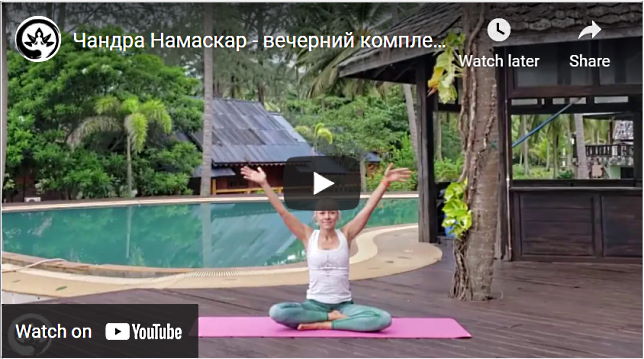
The sequence of asanas in Chandra Namaskar
close to the descriptions in tantric texts:

Asanas in the Chandra namaskar complex
Asana name | Variations | Breathing | |
| Prayer pose | Pranamasana | Palms in anjali mudra | inhale and exhale |
| Extend arms upward | Hasta Uttanasana | Standing back bend with hands – Anuvittasana | inhale |
| Bend forward standing on bent legs | Lunar Uttanasana | Bending forward, palms under the feet – Padahasthasana | exhale |
| Horseman/Runner pose | Ashva Sanchalanasana / Banarasana | inhale | |
| Crescent Moon Pose | Ardha Chandrasana | One hand up and back – Somachandrasana I, II | exhale and inhale |
| Spontaneous half Garland pose | Sahaja ardha malasana | exhale, inhale, and exhale | |
| Rider/Runner pose | Ashva Sanchalanasana/Banarasana | breathe | |
| Dog naked down | Adho mukha shvanasana | Plank pose – Chaturanga dandasana | exhale |
| Eight Point Pose | Ashtanga Namaskar Asana | Cervicothoracic flexion – Uttanashisasana | breath hold |
| Cobra Pose | Bhujangasana | Turning the head to the side, looking behind the shoulder | inhale |
| Dog naked down | Adho Mukha Shvanasana | Move from foot to foot | exhale inhale |
| Dog head down on 3 legs | Adho Mukha Shvanasana | Feet alternately lift up | exhale |
| Horseman/Runner pose | Ashva Sanchalanasana / Banarasana | inhale | |
| Crescent Moon Pose | Ardha Chandrasana | One hand up and back – Somachandrasana I, II | exhale and inhale |
| Bend forward standing on bent legs | Lunar Uttanasana | Bending forward, palms under the feet – Padahasthasana | exhale |
| Stretch your arms up | Hasta Uttanasana | Anuvittasana | inhale |
| Prayer Pose | Pranamasana | The palms in anjali mudra | exhalation |
This is what half of the Chandra Namaskar cycle looks like. The second half contains the same sequence of asanas, only this time the asymmetrical asanas should be performed in a mirror image.
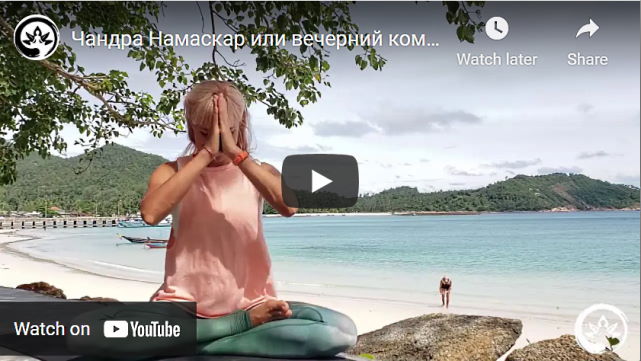
Greetings to the Moon, video option 1:
Greetings to the Moon, video option 2:
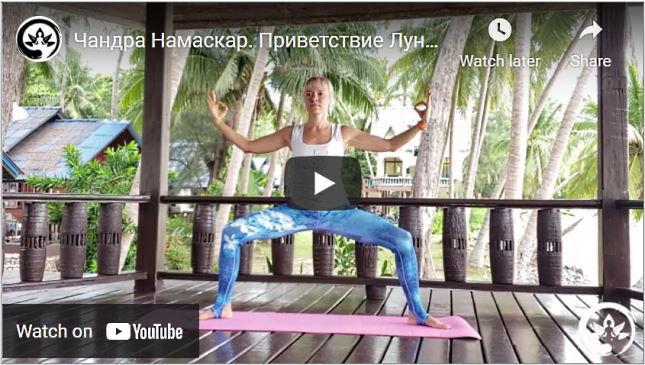
In these video exercises, the asana sequences are slightly different from each other. You can choose a variant closer to you. Also, you can not only watch and listen to the yoga instructor’s explanations but also practice Greetings to the Moon together with us.
Chandra Namaskar complex
A sequence of poses originating in the modern world of yoga in India:

| Name of asana | Variations or peculiarities of execution | Breathing | |
Stand at the beginning of the mat so that the long part of the mat is on your left side | |||
| Prayer Pose | Pranamasana | Palms near the chest, hands in Anjali mudra | Inhale Exhale |
| Bend to the side with arms extended upward | Urdhva that-asana | First, bend towards the long side of the mat (left) Bend to 2 sides | Inhale. Exhale in a bend Inhale |
| Stupa purpose/goddess pose | Utkata konasana / Rudrasana | Hands bent at the elbows, palms up. Legs flexed | Exhale |
| Triangle pose | Uthita Trikonasana | Bend toward the left leg Right arm up | Inhale Exhale |
| Bend to foot | Parshvottanasana | Turn the body to the left and bend toward the left leg | Inhale. Exhale |
| Stupa pose/goddess pose | Utkata konasana / Rudrasana | Hands bent at the elbows, palms up. Legs flexed | Exhale |
| Triangle pose | Uthita Trikonasana | Bend toward the left leg Right arm up | Inhale Exhale |
| Bend to foot | Parshvottanasana | Turn the body to the left and bend toward the left leg | Inhale. Exhale |
| Bending to the side with arms extended upward | Urdhva that-asana | Place the right foot against the left foot First, bend toward the long side of the mat (right side) Bend to 2 sides | Inhale. Exhale in bend Inhale |
| Prayer pose | Pranamasana | Palms near the chest, hands in Anjali mudra | Exhale |
This is what half of the Moon Salutation circle looks like. The second half of the circle is performed in the opposite direction, starting to move to the right.
Video lesson with a detailed description of performing Chandra Namaskar in the “modern version” of the asana sequence:
Chandra Namaskar can be performed as an independent practice or as a warm-up before the evening yoga practice. To fully warm up the body it is enough to perform 2-3 full circles of Moon Salutation, but always observe your sensations and well-being. If you feel you want to practice longer, continue up to 7 circles or more.
Practice consciously and with a smile in online classes with us.
Practice yoga and be happy! 🙏