Namaskaram, friends! Every year we return to the Isha Center — the most powerful place of energy we know of in India. Here we go through our own personal sadhana: cleansing, recharging, finding new meaning, and going deeper within ourselves. That’s exactly why we never bring groups or tours here — this is our own personal time, our inward path, and we really hope you’ll understand.
That said, there’s plenty we’re happy to share: how to fly here, how to book your stay, what actually happens inside, and what to expect. So this is a full practical guide — everything we’ve learned firsthand over years of visiting, gathered in one place so your first days here are easier and more comfortable. Filming isn’t allowed on the grounds, so this article leans on stories and our own photos rather than video. Even so, that also means it’s honest, lived experience.
In this article, you’ll find:
- How to get to the Isha Center
- Booking accommodation: what to know in advance
- How long you can stay in the ashram
- Check-in and registration on arrival
- Dress code and what to bring
- Getting around the grounds
- Food at the ashram
- The three main temples and the daily rhythm
- Volunteering and service
- Rituals and programs
- Money and shopping on site
- The best time to visit
How to get to the Isha Center
The Isha Center is located in southern India, in the state of Tamil Nadu, near the city of Coimbatore. There are two main ways to fly in. The first is via Delhi, with a connecting domestic flight to Coimbatore. The second is via Chennai, a major international hub in the south; from there you can also reach the center by taxi, though it costs more and takes several hours. So the Delhi route is the better option.
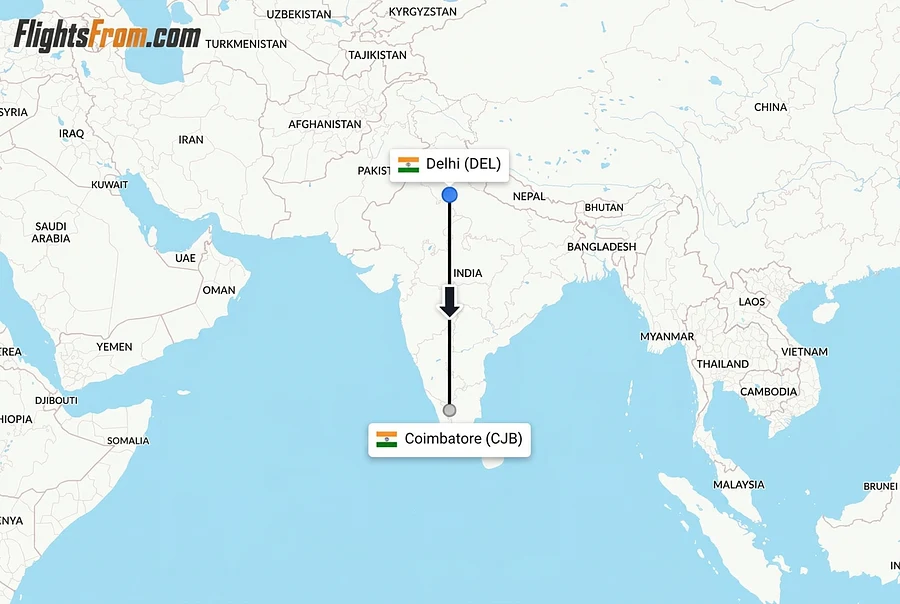
From Coimbatore airport, it’s straightforward. Walk out, turn left, and you’ll find the taxi counter. Just say “Isha Center” — every driver knows the place. The average fare is around 1,800 rupees, and the ride takes about an hour and ten to fifteen minutes.
If you want to save money, India is also easy to travel by train and sleeper bus — the buses look just like train berths, with lower and upper bunks. It’s an experience in itself, but be ready for stations to be genuinely crowded and loud. That’s simply a different culture, so it helps to be mentally prepared for the fact that here, nobody yields the right of way to anyone. Flights, meanwhile, aren’t much pricier than trains or buses if you book two to three months ahead, since prices drop noticeably that far out. And don’t forget: domestic flights in India usually cap checked baggage at 15 kg.
Booking accommodation: what to know in advance
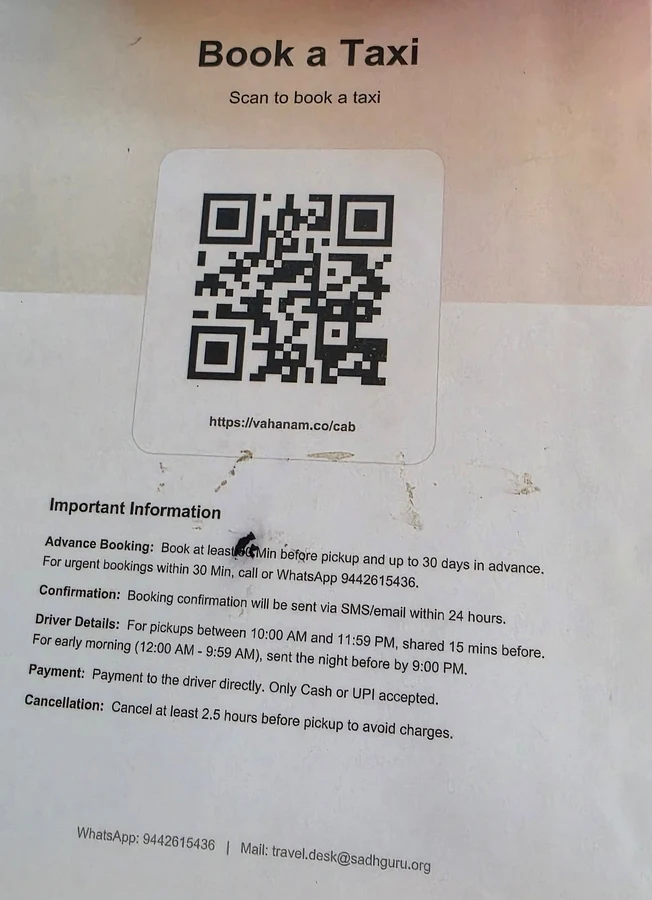
This is probably the single most important organizational detail, and the rule here is strict. Until you’ve booked your accommodation on the Isha Center website ahead of time, you won’t have access to anything on the grounds: not the dining hall, not seva, not the temples. In other words, your booking is your pass to everything that happens here.
The Isha Center actually runs two separate booking sites: one for local residents, which is clear and convenient, and a second one for foreigners, which is far less intuitive at first glance. Even so, be patient, because there is logic to it — the whole system is simply run manually, by real people, not bots. That means confirmation won’t be instant; it comes by email, and sometimes you’ll need to wait. On the upside, though, you always have a real human being to write to if something needs adjusting, which is a genuine advantage in a world of automated everything.
One important cultural nuance: if you book an air-conditioned room for three people, by Indian convention that means two people sleep on beds and the third sleeps on the floor on a mattress. So if you want everyone to have their own bed, choose a Family Room instead — no air-conditioning, but only family rooms offer more than two sleeping spots.
The rooms themselves are deliberately austere: a simple bed, authentic copper water jugs, a kettle, cups — everything you genuinely need, and nothing more. And in that moment you really understand — you don’t actually need much in life to feel comfortable.
How long you can stay in the ashram
There are clear rules here as well. If you’ve never completed any Isha Center program, not even online, you can stay independently for no more than 5-7 days, with no extensions. However, if you’ve completed Inner Engineering and its second, concluding stage, that window extends to 7-10 days.
Staying longer is only possible through a program. For example, a program might last 21 days, and if accommodation is included, you stay for the full duration. If it isn’t included, you book separately instead. The third option is volunteering, an entirely different commitment that can range from a month to six months or even a year. More on volunteering later in the article.
One thing worth flagging: if you’ve completed an Isha Center program before, always register future trips under the same email you used originally. The system ties your history to that specific email address. Book under a new one, and you simply won’t be recognized — much like passport control, where the passport you registered with has to match the one you arrive with.
Check-in and registration on arrival
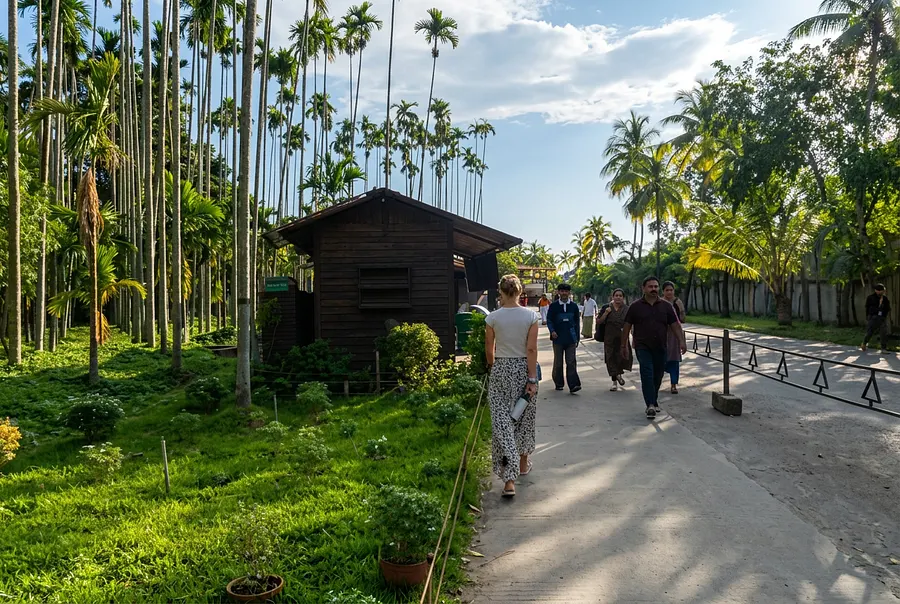
So, you’ve made it. Next you’ll need to find the reception desk yourself, among the crowd. Inside, everything follows a clear three-step logic: first you hand over your documents, then you pay for your stay, and finally you receive your room key along with a wristband or card that gives you access to the entire grounds.
Important: payment is accepted only on site, not by card online in advance and not through the website. On arrival you can pay with a foreign card or in cash. It’s best not to exchange money at the airport, though, since the rate is poor. Instead, it’s more convenient to withdraw cash from an ATM right before entering the center, or ask your taxi driver to stop at one along the way. It’s also worth carrying two different cards, just in case one doesn’t work at the local ATM. Most machines let you withdraw around 10,000 rupees at a time, roughly $200-300, which is enough to cover a few days.
Organizing all of this yourself — bookings, on-site payments, deciphering English-language forms — is a real quest. If that’s not for you, our club runs its own guided spiritual tour to Kailash. Another place with genuinely powerful energy, worth visiting at least once in a lifetime. We handle all the logistics there.
Dress code and what to bring
If you’re worried about not having the right clothes, don’t be. After all, almost everything can be bought on site, and none of it is expensive.
That said, the dress code is fairly strict, especially for women: legs must be fully covered, so even a long skirt needs leggings underneath. No plunging necklines either, shoulders should stay covered, and clothing should be loose rather than fitted. Men aren’t allowed to wear shorts either. As for footwear, choose something as simple as possible, since you’ll be taking it off constantly, everywhere — so the easier it slips on and off, the more comfortable you’ll be.
What’s genuinely worth packing ahead of time, though, is your own toiletries. On the grounds, rooms have only a shower, sink, and toilet, so no towels, shampoo, or toothpaste are provided; you bring your own. There’s no toilet paper in the form you’re used to either, since that’s part of the local culture, and a bidet hose is provided instead. If you’d like, you can still buy paper at the small on-site shop.
Also bring a water bottle (drinking fountains with cold water are placed all over the grounds), and plan your connectivity ahead of time, because there’s no wifi on site. Either arrange roaming that supports Indian carriers before you leave home. Or be ready to spend an hour or two buying a local SIM card, which involves a bit of patience and getting your photo taken in a little booth.
Getting around the grounds
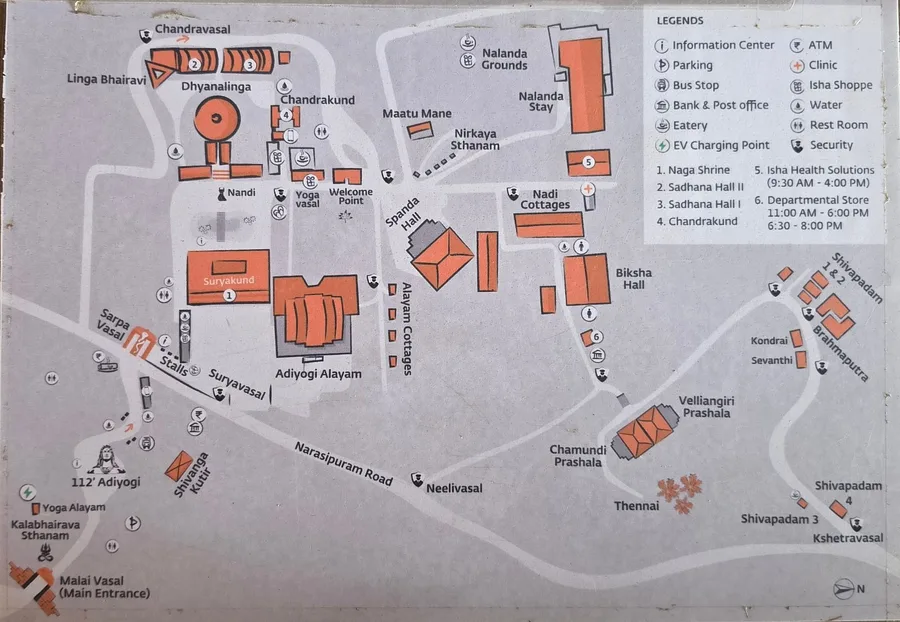
The Isha Center grounds are genuinely enormous. In fact, we once counted our steps from our cottage to the Kalabhairava temple: 3,500 steps one way, and the same back. So a single walk to a distant temple and back already covers your daily step count.
You can get around by electric carts, bicycles, and electric motorbikes, and every now and then you’ll even spot ox-drawn carts, which feel atmospheric and genuinely authentic. However, these forms of transport are usually available to those staying longer term, whether on a program or as a volunteer. So if you’re visiting for just a few days, you’ll most likely be walking instead.
When choosing accommodation, keep this in mind: there are cottages right on the ashram’s main grounds, and there’s also a separate cottage village. From there, it takes a 5-7 minute bus ride, or a 10-15 minute walk, to reach the center. Generally, more budget-friendly options sit farther out, while pricier ones sit closer to the heart of the ashram. So if walking distance to the temples first thing in the morning matters to you, it’s worth factoring in when you book.
Food at the ashram
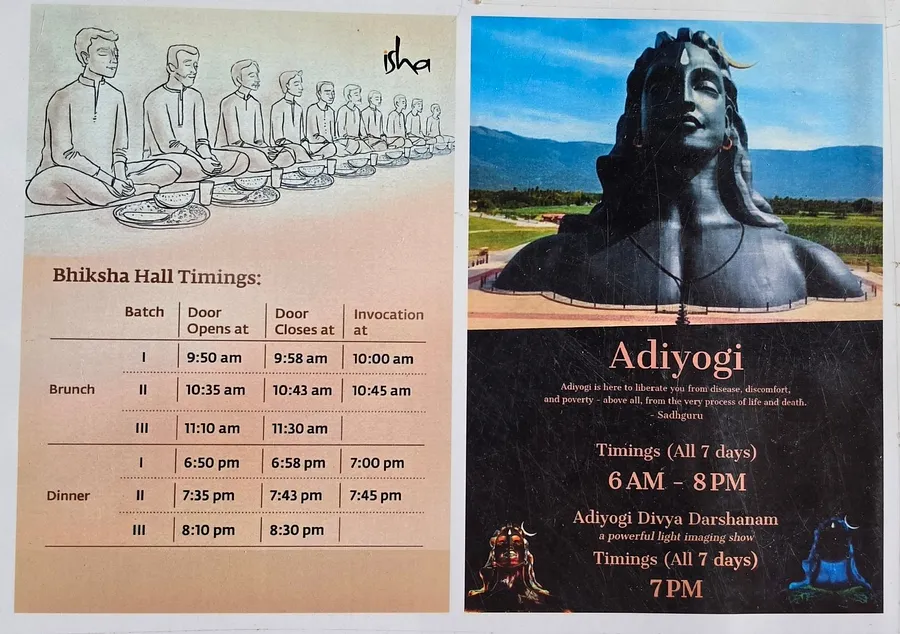
If you book accommodation at the ashram, two vegetarian meals a day are included in the price. The dining hall runs on strict time slots: the doors open at a set time and then close. So if you’re late, you’re simply not getting in, which means it’s worth keeping the schedule in mind.
The dining hall itself has two floors: the first serves spicy Indian food, while the second is milder, and that’s where most foreigners tend to go. Everyone eats sitting on the floor, off large steel plates — sometimes even bamboo leaves are used instead of plates. Filming isn’t allowed inside, but the atmosphere is genuinely special: a mantra plays, and food is served by people carrying buckets and ladles.
One useful tip: when you’re being served, show a flat palm gesture for “just a little” if you don’t want a large portion, otherwise you’ll be given a generous, default amount. Either way, there’s always enough food — vegetarian, carb-heavy, with plenty of legumes, a bit of fruit, and enough fiber for easy digestion. There’s also a small paid canteen on site, so you can pick up mango or papaya salad and fresh juice if you’d like something extra.
The three main temples and the daily rhythm
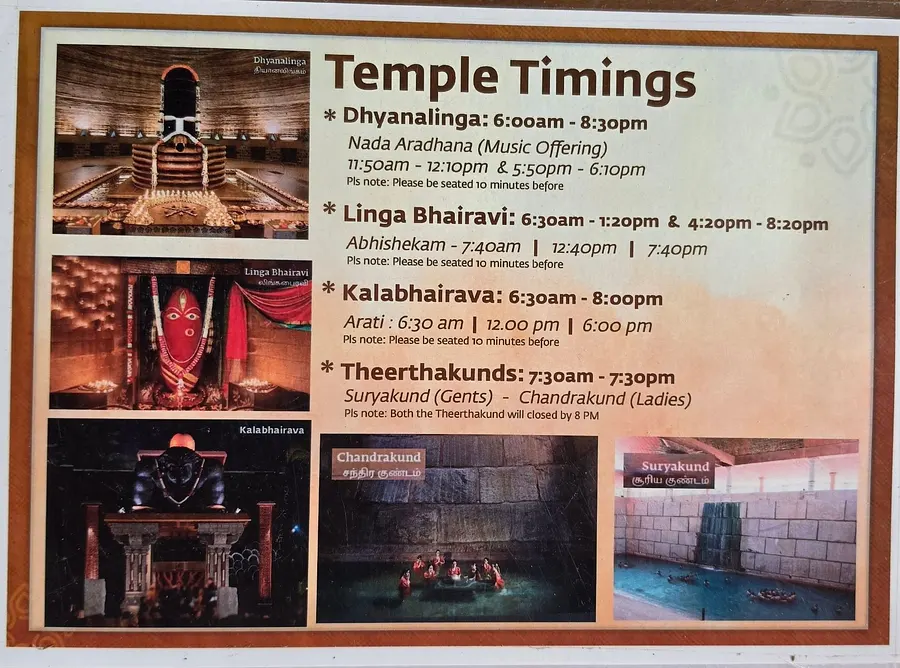
The heart of the Isha Center is three temples, and the entire rhythm of the day is built around them. Dhyanalinga is the main temple, representing the masculine aspect, and it opens at 6am. Right behind it sits the Linga Bhairavi temple, the feminine aspect, filled with tantric symbolism and yantras — so it’s less about sitting in meditation and more about being drawn into an actual dance of meaning. And the third, newest temple is Kalabhairava, “the devourer of time,” located farther away than the other two — that same 3,500-step walk. Offerings here are strictly vegetarian rather than the animal offerings used in similarly-themed traditional practices elsewhere in India.
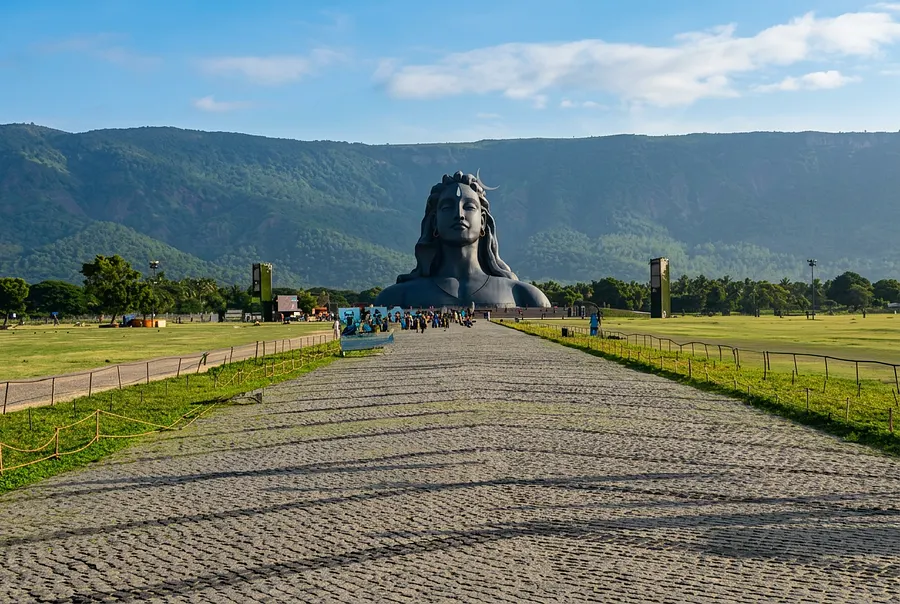
Our advice: visit the temples first thing in the morning, ideally before 9-10am, before the queues form. By midday, though, crowds gather and entry runs in 20-minute sessions, marked by a bell. In the morning, on the other hand, you’ll likely be nearly alone, and the practice goes far deeper.
Before entering Dhyanalinga or Linga Bhairavi, it’s recommended to take a dip in the bathing pool first — separate ones for men and women, and the water is genuinely invigorating. It’s believed that after this immersion, you become more receptive to the temple’s energy.
Beyond the temples, a free group yoga session also runs every day at 9:30am in a large hall. You don’t need to be a yogi or any kind of expert here, either — just grab a mat, also available for purchase on site, and join in.
Volunteering and service
Volunteering here takes different forms. There’s kitchen and dining-hall service, and there’s also service directly inside the temples. One important detail, though: before you’re allowed to serve in a temple, you need to complete one day of Mauna, or full silence, along with certain inner practices.
There’s also a full volunteer program, running from months to as long as a year. It requires submitting an application on the website in advance, followed by a video interview. All of this is described on the site.
It’s worth knowing that you can serve in the temples without an official volunteer status too, simply as someone spending time there. Even so, you still need to register in advance and complete the day of silence.
Rituals and programs
Beyond a self-directed stay, the Isha Center also runs dozens of programs — from spiritual development, Inner Engineering, for instance, to addiction recovery. One of the most intensive programs here runs for over 40 days of fairly demanding psychological discipline aimed at breaking addiction, and there are Ayurvedic treatment programs as well. Program schedules are published in advance, sometimes three months out, sometimes just one or two, so if you want to attend a specific program, you need to plan your trip around it, not the other way around.
The rituals tied to the lunar calendar deserve special mention. Amavasya, the new moon, is a time for honoring departed relatives and clearing ancestral patterns. If someone close to you passed away less than 48 days ago, you can request a particularly powerful ritual by the lake near the Kalabhairava temple. Milk offerings to the sacred lingam also take place on new and full moons.
We wrote about this ritual in detail in a separate article — Kalabhairava: How to Cleanse Ancestral Karma on the New Moon. It covers what ancestral karma actually is, why the new moon is chosen for this ritual, and how the Kalabhairava Shanti ceremony itself unfolds.
Another practice, available almost daily, is an aura-cleansing ritual. You’ll need to join a waitlist, but the result is worth it: a feeling of being reborn. And of course, there’s an on-site Ayurvedic clinic too, where you can arrive with a specific concern, consult a genuine Ayurvedic doctor, and walk away with both recommendations and herbal remedies, all on the spot.
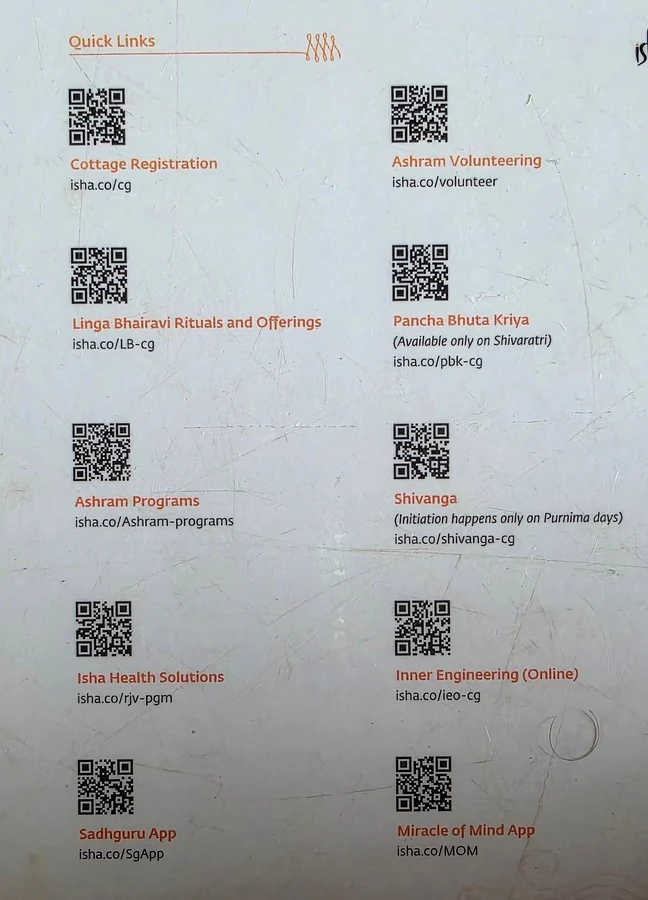
By the way, if the idea of rituals tied to the lunar calendar resonates with you, yoga-hub.club has our year-round calendar of Vedic rituals that you can practice without traveling to India, on your own everyday rhythm.
Money and shopping on site
The on-site shop stocks pretty much everything for practice: copper altar sets and altar items, genuine quartz malas, yogic toothbrushes and neem toothpaste, souvenirs — and all of it can be paid for with a regular foreign bank card.
The dining hall and ritual fees, on the other hand, are cash-only. If you run out of cash and have no ATM access, there’s a designated person on the grounds who exchanges currency at a fair rate at set times.
The best time to visit
If you have a choice, aim for the cooler season, since it can genuinely get tough in the heat, especially for women wearing fully covering clothing. The rainy season, though, isn’t a drawback — if anything, it’s often more pleasant: fresher air, less humidity.
And if you can, time your trip around a significant lunar event, too — a new moon, full moon, or eclipse. These days tend to be more crowded, but also far richer in terms of rituals and the overall energy of the place. And if you happen to be there at the same time as Sadhguru himself, you’ll feel it instantly: the vibration of the whole space shifts.
That’s the most important part of what we wanted to share from our own experience. The Isha Center isn’t a tourist destination in the usual sense, but at the same time, it doesn’t ask you to be a yogi or an initiate: you can come simply as an open, curious person, ready to feel a place with genuinely strong, real energy.
So if you’re on your own path of spiritual growth, this is somewhere worth feeling for yourself at least once, regardless of your faith or beliefs. Namaste, and see you in the next article.
We recommend also watching our video — the full livestream with details that are hard to fit into text.