There are moments when familiar words simply stop helping. A hard diagnosis, the loss of someone close, the anxious wait before surgery, or just a sleepless night when the fragility of life suddenly feels very real — and everything that mattered a moment ago quietly steps aside in front of one simple question: how do you keep living without being consumed by fear?
Thousands of years ago, Indian rishis faced this exact question — and answered it not with a philosophical treatise, but with a short, resonant formula. Just 32 syllables, addressed to the three-eyed Shiva, said to be powerful enough to make Death itself pause at the threshold. Today this formula is known as the Maha Mrityunjaya Mantra — the “great death-conquering mantra.”
In this guide you’ll find its exact Sanskrit text, a word-for-word translation, audio for practice — and, perhaps most importantly, the living stories and layers of meaning that have made this one of the most revered mantras in the Vedic tradition for over three thousand years.
What Is the Maha Mrityunjaya Mantra?
The Maha Mrityunjaya Mantra is an ancient mantra addressed to Lord Shiva. Its name translates literally as “Conqueror of Death.” It comes to us from the Rigveda (7.59.12) and later reappears in the Yajurveda. Alongside the Gayatri Mantra, it’s one of the oldest mantras in Hinduism.
One important thing to know: no guru initiation is needed to chant it. Anyone can chant this mantra, with sincerity and respect for the tradition.
It’s chanted for protection, healing, and inner strength — and, above all, for freedom from the fear of death. The mantra also goes by several other names — the Tryambakam Mantra (“the three-eyed one”), the Rudra Mantra (for Shiva’s fierce form), the Mrita-Sanjivini Mantra (“the mantra that restores life”), and simply the Immortality Mantra.
What’s in This Guide
Here’s what you’ll find below:
- Sanskrit text, meaning, and audio
- Word-by-word meaning of the mantra
- When and how to chant it
- The extended version for deeper practice
- Where the mantra comes from
- Legends of victory over death
- What science has found
Sanskrit Text, Meaning and Audio
In Devanagari:
ॐ त्र्यम्बकं यजामहे सुगन्धिं पुष्टिवर्धनम् । उर्वारुकमिव बन्धनान्मृत्योर्मुक्षीय मामृतात् ॥
IAST transliteration:
oṃ tryambakaṃ yajāmahe sugandhiṃ puṣṭivardhanam urvārukamiva bandhanān mṛtyormukṣīya mā’mṛtāt
English transliteration (for chanting):
Om Tryambakam Yajamahe Sugandhim Pushtivardhanam Urvarukamiva Bandhanan Mrityor Mukshiya Maamritat
Meaning:
We worship the three-eyed Lord Shiva, fragrant and nourishing to all life. As the ripe fruit is freed from its stem, may we be liberated from death — not from immortality.
Word-by-Word Meaning of the Maha Mrityunjaya Mantra
Om — the primordial sound that contains all of existence.
Tryambakam — “the three-eyed one”: not a physical eye, but insight beyond illusion.
Yajamahe — “we worship, we surrender” — trust in something greater than ourselves.
Sugandhim Pushtivardhanam — “fragrant, the nourisher” — an unseen grace that feeds the spirit.
Urvarukamiva Bandhanan — “like a fruit from its stem” — release through ripening, not struggle.
Mrityor Mukshiya — “free us from death” — from the fear of impermanence and the cycle of birth.
Maamritat — “not from immortality” — the mantra doesn’t deny the body’s mortality, only opens a path to the immortality of spirit.
When and How to Chant It
When to chant:
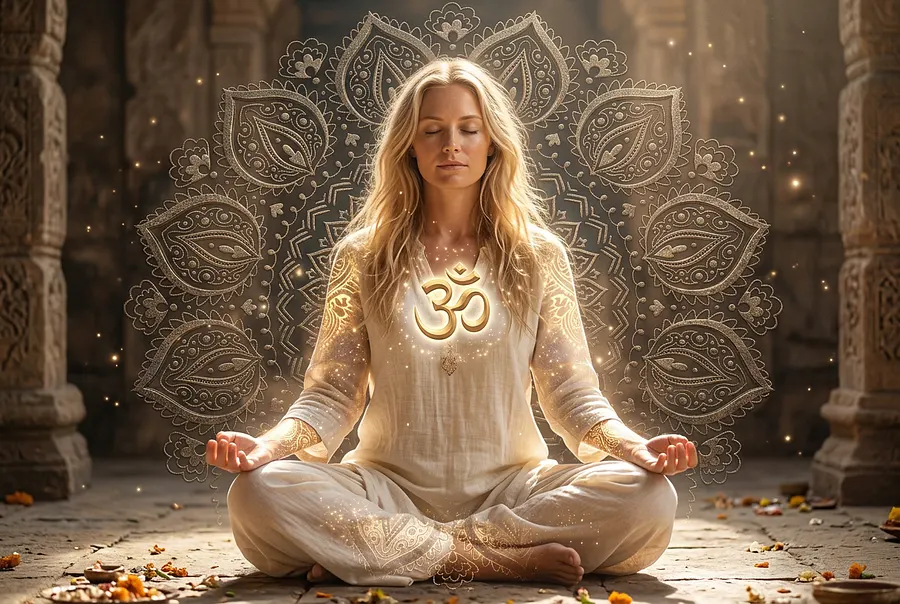
Brahma Muhurta (about ninety minutes before sunrise), Mondays, Pradosha, and the night of Maha Shivaratri are all considered especially auspicious. But there are no strict rules — chant whenever you feel the need, whether that’s during anxiety, illness, or simply for a sense of support.
How to chant:
- Sit comfortably in a quiet place, ideally facing east or north
- Take a few calm, settling breaths
- Begin with an invocation to Ganesha and the sage Vasishtha (“Om Ganeshaya Namah,” “Vam Vasishthaya Namah”), then move into the mantra
- Use a mala of 108 beads, ideally rudraksha, to keep count
- Start out loud, gradually lowering to a whisper, then to silent, internal repetition
- The traditional counts are 11, 21, or 108 repetitions. For deeper practice, the Puranas recommend 8,000 repetitions over forty days
- Chant syllable by syllable, without rushing: Tryam-ba-kam, Ya-ja-ma-he — clarity matters more than speed
- Close with a few minutes of silence, offering gratitude to Shiva
The Extended Version: For Deeper Practice
In the tantric tradition, there’s a richer form of the mantra, framed by bija (seed) syllables at the beginning and end:
ॐ ह्रौं जूं सः भूर्भुवः स्वः त्र्यम्बकम् यजामहे सुगन्धिम् पुष्टिवर्धनम् । उर्वारूकमिव बन्धनान् मृत्योर्मुक्षीय मा मृतात् भूर्भुवः स्वरों जूं सः ह्रौं ॐ ॥
Om Hraum Jum Sah Bhurbhuvah Svah Tryambakam Yajamahe Sugandhim Pushtivardhanam, Urvarukamiva Bandhanan Mrityormukshiya Mamritat Bhurbhuvah Svarom Jum Sah Hraum Om.
There are also short, “condensed” forms of the mantra, used by those already deeply familiar with the practice:
| Form | Sanskrit | Transliteration |
|---|---|---|
| Ekakshara (single syllable) | ह्रौं | Hraum |
| Tryakshara (three syllables) | ॐ जूं सः | Om Jum Sah |
| Chaturakshara (four syllables) | ॐ ह्रौं जूं सः | Om Hraum Jum Sah |
| Navakshara (nine syllables) | ॐ जूं सः पालय-पालय | Om Jum Sah, Paalaya-Paalaya |
These shorter forms are traditionally used as a more concentrated version of the same mantra — a kind of spiritual shorthand for the full prayer.
Where the Mantra Comes From
The Maha Mrityunjaya Mantra belongs to the oldest layer of Vedic knowledge. It first appears in the seventh mandala of the Rigveda (hymn 7.59.12), traditionally attributed to the sage Vasishtha, one of the seven great rishis. It later reappears in the Taittiriya Samhita of the Yajurveda, within the Rudra Sukta — a hymn dedicated to Rudra, the fierce yet compassionate form of Shiva.
The mantra addresses Rudra-Shiva as Tryambaka, the three-eyed lord who perceives past, present, and future at once. And unlike many other Vedic formulas, it requires no formal guru initiation.
Legends of Victory Over Death
Markandeya and the Hour Death Stepped Back
The most famous legend connected to this mantra comes from the Markandeya Purana. The forest-dwelling sage Mrikandu and his wife Marudvati had long been childless. After years of severe austerity and devoted prayer to Shiva, Shiva appeared before them with a choice: a son gifted with extraordinary wisdom but destined to live only sixteen years, or a son who would live long but lack any spiritual depth. The parents chose wisdom, and soon their son was born — they named him Markandeya.
For years his parents kept his fate hidden, and his childhood was untroubled. But as his sixteenth birthday drew closer, their grief became harder to hide, until one day the boy demanded the truth — and learned everything.
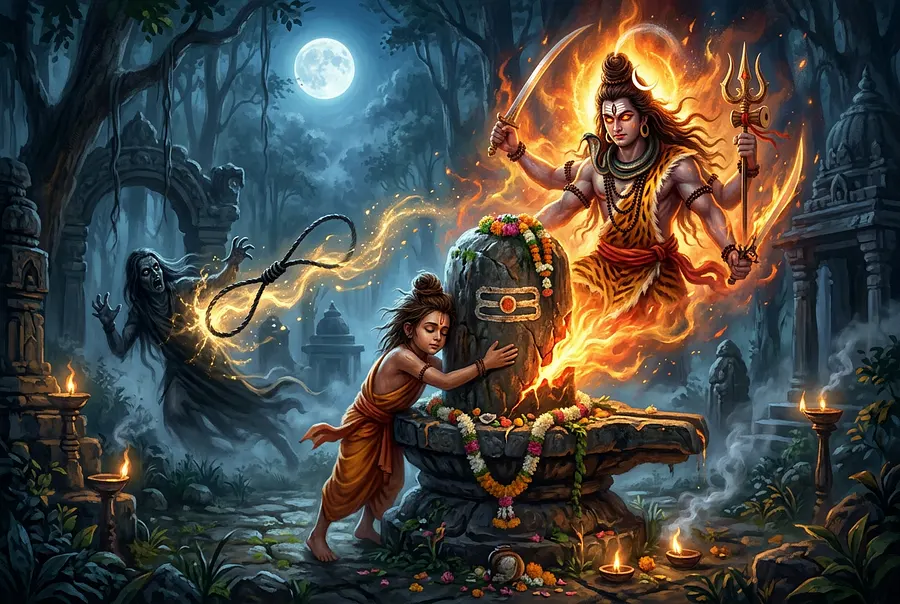
By then, Markandeya had already mastered the practice of yoga. On the day death was to claim him, he didn’t hide or beg for mercy — he went to Shiva’s temple, wrapped his arms around the stone lingam, and began chanting the Maha Mrityunjaya Mantra with complete devotion. When Yama’s messengers came for him, they found the young man so deep in meditation that they couldn’t bring themselves to touch him. So Yama, the god of death, came himself — but the noose he threw wrapped around the lingam instead, and the stone split open as Shiva emerged in his fierce form, Bhairava, to protect his devoted follower.
Afterward, once the order of the universe had been restored and Yama brought back to life, Shiva declared that Markandeya’s unwavering devotion had become his shield — and that he would remain forever sixteen, beyond the reach of time and death.
Shukracharya and the Mantra That Restores Life
There’s a second, lesser-known but equally powerful legend — about the sage Shukracharya. Having accepted a challenge from Indra, lord of the gods, Shukracharya undertook an extraordinarily severe penance: he hung upside down over the smoke of a fire for years on end, testing his body and spirit to their absolute limit. When his penance was complete, Shiva appeared before him, moved by his resolve, and gave him the Maha Mrityunjaya Mantra as a means of restoring his strength and his very life. This is why the mantra is sometimes called Mrita-Sanjivini — “the mantra that revives the dead.”
Both stories, told in the language of myth, point to the same truth: real protection is born not from fleeing death, but from turning, fully and fearlessly, toward something greater than death itself.
The subject of death can feel frightening — and that’s natural, since we so rarely talk about it and so often fear it. But the more calmly we allow ourselves to look in that direction, the less power that fear holds over us. If you’d like to go deeper, we have a dedicated article — «The Stages of Death as Described in Tantra and Buddhism» .
If these stories of facing fear head-on and returning to your truest self resonate with you, you might want to look at our spiritual tour to Kailash. It’s a journey to the mountain that four of the world’s religions consider the center of creation — the same mountain thousands of pilgrims have circled with this very mantra on their lips. As those who’ve made the journey often say: life divides into “before” and “after” Kailash. Enrollment for an upcoming group is currently open — if this speaks to you, take a look at the tour page.
What Does Science Say?
Interestingly, this ancient mantra has drawn the attention of modern researchers too. In one clinical observation at Ram Manohar Lohia Hospital in Delhi, the mantra was chanted for patients with severe head injuries and low scores on the Glasgow Coma Scale — and those who received regular chanting over the course of a week showed noticeably greater improvement than the control group. Similar observations have come out of international conferences, where instruments were used to measure the body’s response during group chanting, with both participants and those simply present nearby reporting a tangible sense of calm. None of this replaces medical care, of course — but it’s a lovely reminder that even from a scientific angle, this ancient practice still has something to offer.
By the way, we also have a program called Vedic Rituals of the Year — it helps you meet the year’s solstices, equinoxes, eclipses, and the night of Maha Shivaratri with awareness, rather than let them pass by.
There’s a quiet irony in the fact that a mantra devoted to conquering death isn’t really about living forever at all. It’s about something else: the capacity to meet the inevitable without terror, the ripeness of a fruit that lets go of its stem on its own, without struggle, when its time comes. May these ancient syllables, chanted with sincerity, become for you not a spell against death, but a quiet support for living — right here, right now, in all its fragile and precious fullness.
Om Namah Shivaya