What happens to the soul of a person who has committed suicide?
In Tibetan teachings, suicide is considered an extremely negative evolutionary act and one of the gravest sins. From the Buddhist point of view, a person’s physical body is recognized as a form of deity and the abode of the divine principle (and for a tantric practitioner, the abode of hundreds of micro-deities), so prematurely cutting life short is equated with killing them and violating sacred vows.
After committing suicide, a person’s consciousness (soul) faces severe consequences in the posthumous intermediate state (bardo):
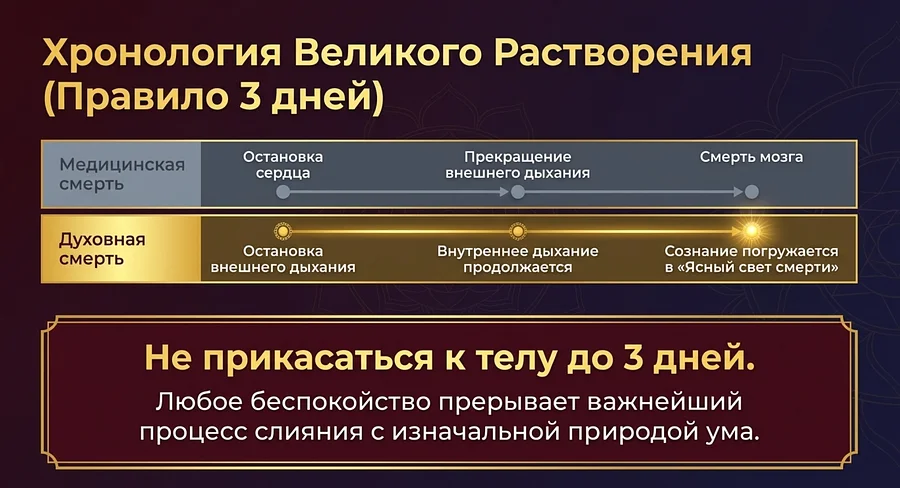
- Following negative karma and the danger of being seized by spirits. As Dilgo Khyentse Rinpoche explained, the consciousness of a suicide has no choice but to strictly follow its negative karma. In such a vulnerable state, it may well happen that some malevolent spirit seizes the life-force of the deceased and takes possession of it.
- The trap of suffering. Suicide victims can easily fall into the trap of their own pain, despair, and fear. They risk becoming “stuck” in the painful reliving of their own death, which blocks their further progress through the process of rebirth.
- The illusion of complete oblivion. People often take this step believing their illnesses or emotional pain are unbearable, and believing that the destruction of the brain will bring them “instant liberation” and total non-existence. The texts call this a tragic mistake: such people will suffer cruelly in the whirlpool of bardo, and they will have very little chance of escaping it into favorable conditions.
Urgent Need for Help
Because of the severity of their situation, the souls of people who have taken their own lives are in especially urgent need of spiritual help. To ease their fate, the living should perform the phowa practice (transference of consciousness) with far greater strength and diligence than in ordinary cases of death. For the final liberation of a suicide’s consciousness, special ceremonies are required (for example, a fire ritual), which must be conducted by a teacher possessing great spiritual power.
Exceptions and Nuances
Tibetan tradition considers suicide not to be a sin only in one exceptional case: when a person has already attained a high level of liberation and is absolutely certain they will be able to transfer their consciousness into a pure dimension during the bardo.
Suicide should also be distinguished from refusing artificial life support (passive euthanasia) in cases of hopeless and agonizing illness. Kalu Rinpoche explained that if a terminally ill person asks to be allowed to die because they have suffered enough, this act is considered karmically neutral. The motivation in this case is the basic wish of all living beings to escape suffering, rather than a desire to end life as such.
You say the body must not be touched for 3 days. Why is this important?
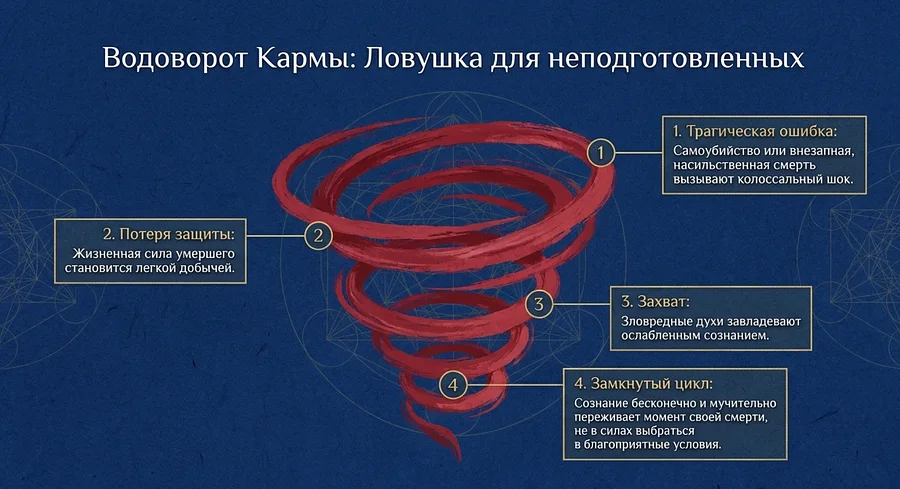
According to Tibetan tradition, it is strongly recommended that the body of a deceased person not be touched or disturbed for three days after death.
There are several important spiritual and physiological (from the point of view of Tibetan yoga) explanations for this rule:
- The Incompleteness of the Dying Process
It is believed that after the heart stops and external breathing ceases, the “inner breath” and subtle consciousness may still remain in the body. The deceased may be in a state of deep meditation and merging with the primordial nature of mind (the “Clear Light of Death”). Any touch or disturbance can interrupt this crucial process, which is especially critical for practicing yogis.
- The Risk of the Consciousness Exiting Incorrectly
In Tibetan Buddhism, it is believed that a person’s next rebirth directly depends on which opening the consciousness leaves the body through. The ideal path is exiting through the crown of the head (the fontanelle), which leads to a favorable birth. However, if the deceased’s body is touched in a certain place (even simply to reposition it or give an injection), this can distract and draw the consciousness there. The consciousness will then leave the body through the opening nearest to that spot, which can lead to an unfavorable rebirth in lower realms.
How to Act Correctly?
- Phowa Practice: The most important thing is to perform the phowa ritual (transference of consciousness), which must be carried out before anyone touches the body or moves it anywhere.
- Preserving Stillness: Ideally, autopsy, cremation, or burial should only be carried out after three days have passed. An atmosphere of silent calm should be maintained around the body. Famous masters forbade anyone to touch them after death: for instance, the great yogi Milarepa instructed that his body not be touched until the arrival of his beloved disciple Rechungpa.
- In Modern Hospital Conditions: Teachers acknowledge that in modern hospitals or in hot climates, it is practically impossible to leave the body untouched for three days. In such cases, one should try to leave the deceased in peace for as long as the doctors will allow, ask that the monitors be switched off, avoid carrying out any procedures, and be sure to perform spiritual practices (or at least sincerely pray) before the body is touched for the first time.
History offers examples of these rules being observed even in Western clinics. For instance, after the death of the 16th Karmapa in a hospital in Chicago, ordinary medical procedures were set aside: his body remained untouched for three days, during which his skin retained its elasticity and the area around his heart continued to radiate warmth — something that could not be medically explained.
What do the sources say about methods of disposing of the body? Which is better — burial in the ground or cremation?
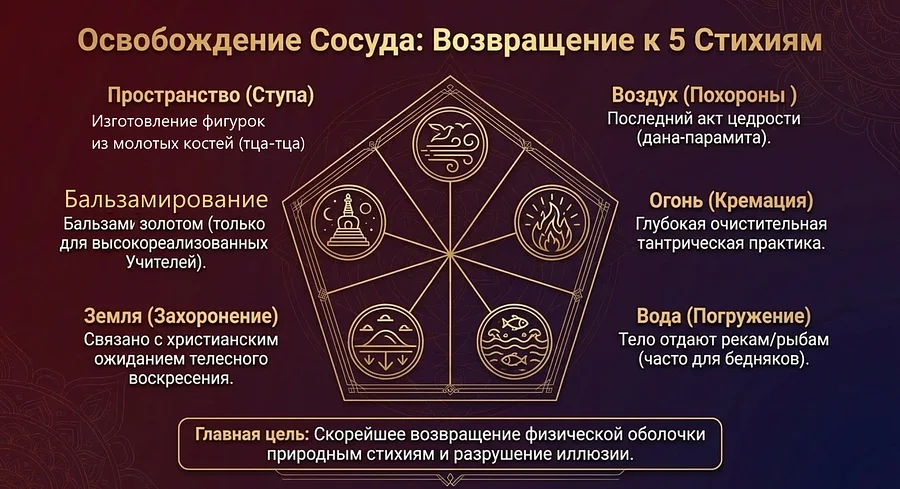
In Tibetan tradition there are several main ways of disposing of the body after death. The main goal of most of these rites is the swift return of the physical shell to the natural elements that compose it.
The Main Methods of Disposal Mentioned in the Sources:
- “Sky Burial” (the element of air): This is the most common method for ordinary Tibetans and wandering yogins. The body is dismembered in designated places and given as food to birds of prey (eagles, vultures) and wild animals. From a spiritual point of view, feeding one’s flesh to animals is considered the deceased person’s final act of generosity (dana paramita).
- Cremation (the element of fire): The body is given to fire; this method is often chosen depending on location, the circumstances of death, and the social standing of the deceased.
- Water Burial: Bodies (most often of the poor, since other methods can be expensive) are lowered into rivers or lakes, where their flesh is eaten by fish and crustaceans.
- Burial in the Ground: This method is mentioned, but it is emphasized that it is more characteristic of Christian traditions than of Tibetan ones.
- Embalming (Preservation in a Stupa): Used in exceptional cases for Dalai Lamas and highly realized spiritual teachers. Their bodies are dried using salt and camphor, covered in gold, and placed inside a stupa, where they become sacred relics and objects of veneration.
Which Is Better: Burial in the Ground or Cremation?
From the point of view of Tibetan Buddhism, cremation is considered a significantly more favorable and beneficial method than burial in the ground. There are several compelling spiritual explanations for this:
- Purification of Negative Karma: In Tibetan Buddhism, cremation is not merely a way of disposing of a corpse, but a profound tantric practice. The funeral pyre is visualized as a mandala of deities (for example, Vajrasattva). As the body burns, it is believed that the deities absorb all of the deceased’s negative karma, and all their defilements are purified in the blazing fire of wisdom.
- Spiritual Liberation: Cremation, especially when performed in holy places or pilgrimage sites, contributes far more to the spiritual liberation of consciousness and to a happier subsequent incarnation.
- Creating Favorable Conditions for Rebirth (Tsa-Tsa): After cremation, the ashes and remaining bone fragments are not discarded. They are ground, mixed with clay, and used to make small relief figurines or miniature stupas called tsa-tsa. These figurines are consecrated and serve for the benefit of the deceased, creating powerful favorable conditions for a good rebirth.
The biography of the great Tibetan yogi Milarepa describes how he returned to his homeland and found only his mother’s bones. After performing meditation, he ground her remains, mixed them with clay, and made miniature stupas (tsa-tsa) from them to save his parents from the torments of unfavorable rebirths. As payment for the work of making them, he gave away his sacred books.
- Attitude Toward the Physical Body: Tibetans regard the physical body simply as an earthen vessel, a temporary illusion and product of the four elements, which must inevitably disperse and disappear after death. There is therefore no point in preserving an ordinary corpse in the ground. The sources note that the concept of preserving the body intact in a grave (a prohibition on cremation) was historically characteristic specifically of Christianity, which awaited the bodily resurrection of the dead on Judgment Day. Buddhists, however, believe in reincarnation, in which consciousness leaves the old body forever to acquire a new one.
Thus, if we compare these two methods, cremation or “sky burial” bring the deceased invaluable spiritual benefit within the Buddhist paradigm, whereas burial in the ground deprives them of the opportunity to quickly return the body’s elements to nature and transform the remains into sacred relics.
You’re invited: a journey through Vedic rituals
If the theme of rituals and spiritual guidance through life’s important transitions resonates with you, we invite you to explore the course “Vedic rituals in the year” at our Yoga Hub Club — a year-long cycle of sacred practices that helps you align your life with cosmic rhythms and natural forces.
What does the Tibetan Book of the Dead say about sudden deaths (car accidents, accidents)?
Tibetan sources regard sudden death (as a result of an accident, car crash, disaster, or violence) as a critical situation requiring special and immediate spiritual help, since the consciousness of the deceased faces tremendous shock.
Here are the main points that Tibetan tradition highlights regarding sudden deaths:
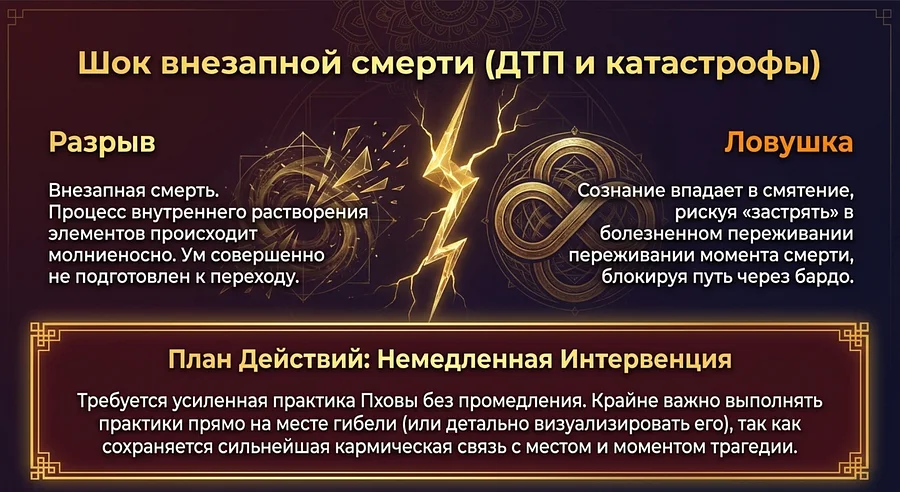
- The Dissolution Process Still Occurs, but Instantaneously
Even in the case of the most sudden death or an instantaneous accident, the process of the inner dissolution of the elements of body and mind (the stages of dying) still takes place, but it unfolds with lightning speed. Victims of car crashes or plane crashes, as a rule, do not expect death and take life for granted, so their minds are completely unprepared for the transition.
- Shock and the Trap of Suffering
People who have died a sudden or violent death are in especially urgent need of spiritual help. The terrible shock of a sudden death leaves the deceased’s consciousness in dreadful confusion and bewilderment. The main danger is that accident victims can easily fall into the trap of their own pain and fear, or become “stuck” reliving the painful moment of their death, which blocks their ability to move on through the process of rebirth in the bardo.
- Intensified Phowa Practice and Work with the Site of the Tragedy
When performing spiritual practices for accident victims (above all phowa — the transference of consciousness), the living must do so with far greater strength and diligence than in cases of ordinary death. An experienced practitioner or lama must act without delay: first using special practices to free the deceased’s consciousness from the traumatic shock, and only afterward transferring it into a pure realm or directing it toward a favorable rebirth. It is also strongly recommended to perform the practices right at the site of death (or, at the very least, to visualize the site in detail), since in the case of a tragic death a very strong karmic connection remains between the deceased, the place, and the exact moment of the event.
- Recommendations for Grieving Loved Ones
For those who have experienced the sudden death of a loved one, the natural feeling of bitter loss is enormously intensified, often accompanied by outbursts of completely unfamiliar anger and resentment.
- Seeing the Body: Tibetan masters emphasize that it is very important for loved ones to go and see the body of the deceased. Otherwise it will be extremely difficult for the psyche to grasp and accept the new, harsh reality that death has actually occurred.
- Using a Photograph: If seeing the body is not possible, relatives are advised to take a photograph of the deceased and use it to carry out the process of farewell: to express their love, to complete the relationship in their heart, and to mentally let the person go, so as not to hold their soul back with their own suffering in the bardo state.
How should the phowa practice be performed correctly for the deceased?
The phowa practice (transference of consciousness) is considered in Tibetan tradition to be the most valuable and powerful method of spiritual help for a dying or deceased person.
According to the sources, there are two main approaches to performing this practice: essential (simplified) phowa, which any person can safely perform for their loved one, and traditional tantric phowa, which requires training and is performed by an experienced lama or yogin.
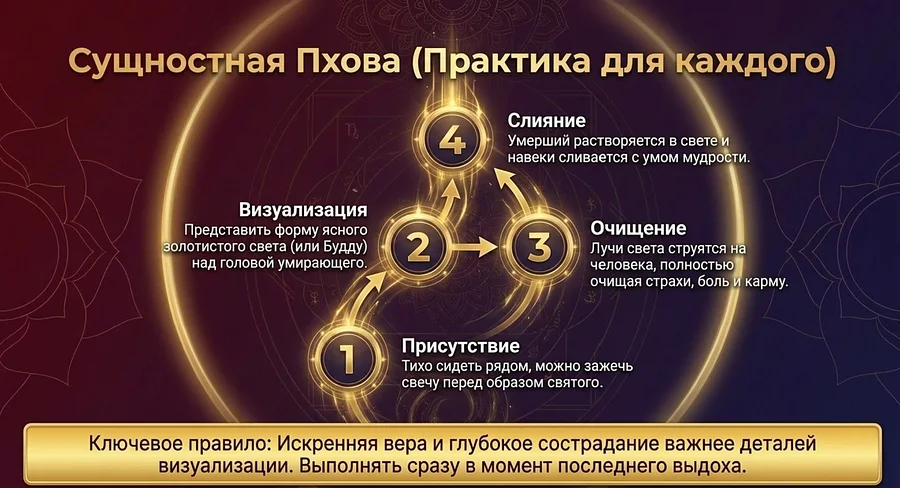
- The Essential Phowa Practice (Accessible to Everyone)
This practice can be done silently, sitting beside the dying person, or aloud, if the person is open to spiritual communication. It is completely safe and can be carried out both during the course of illness and immediately after breathing stops.
Step-by-Step Method:
- Preparation: Sit quietly beside the person. You may light a candle before an image of the Buddha, Christ, or another saint you believe in.
- Visualizing a Presence: Imagine the Buddha, another spiritual being, or simply a form of clear golden light directly above the head of the dying (or deceased) person.
- Purification with Light: Sincerely pray for this person. Imagine rays of light streaming from the spiritual being onto the person lying before you. This light permeates them and completely purifies their entire being of fears, pain, and negative karma.
- Transference (Merging): Then, with your whole being, imagine that the deceased dissolves into this light and merges forever, as one, with the spiritual being (the wisdom mind of the Buddha).
This practice should be repeated as often as possible throughout the course of the illness and, most importantly, immediately at the moment of the last exhalation, before anyone touches the body.
- The Traditional Phowa Practice (For Experienced Practitioners)
Traditional phowa involves detailed work with the subtle channels and energies and must be performed by a trained yogin.
The Mechanics of the Traditional Ritual:
- The practitioner visualizes the deceased’s central energy channel (white outside and red inside), which begins below the navel and opens at the crown of the head (the “Aperture of Brahma”).
- The deceased’s consciousness is visualized in the form of a red syllable HUM in the region of their heart.
- Above the crown of the deceased, a Buddha (for example, Amitabha) or the Root Teacher is visualized.
- Upon uttering the syllable HIK, a blue syllable HUM descends from the Buddha’s heart, seizes the red syllable of the deceased’s consciousness, and pulls it upward: first to the throat, then to the crown.
- With a loud shout of PHAT, the deceased’s consciousness shoots out through the crown and merges inseparably with the Buddha’s heart.
- Highly realized yogins are able to directly merge their own consciousness with that of the deceased and then carry them both together into the state of Dharmakaya.
The Most Important Rules and Precautions
- Timing: Essential phowa can be done at any time. However, traditional phowa must not be brought to completion prematurely (before natural death occurs), as doing so is equated with the karma of killing or suicide. The ideal moment for it is when external breathing has already stopped (clinical death), while the “inner breath” of the energies is still continuing.
- Inviolability of the Body: After breathing has stopped, it is strongly advised not to touch or move the deceased’s body, ideally for up to three days. Under modern conditions, if this is not possible, one should at least avoid touching the body until the phowa practice has been performed. If the body is touched (for example, to give an injection) before the transference, the consciousness may be distracted to that spot and leave the body not through the crown but through another opening, leading to an unfavorable rebirth.
- Sincerity Matters More Than Detail: If you are unable to visualize the channels and syllables, do not worry. Sincere faith, deep compassion for the deceased, and prayer that they pass in peace and tranquility possess exceptional power and in themselves serve as a successful transference of consciousness.
If you would like to explore the stages of dying and the bardo in more depth, see the article “The Stages of Death as Described in Tantra and Buddhism”.