
Hello, friends! Today, I decided to touch on an interesting topic. At first glance, it’s about rest and energy—nothing new. But when you dig deeper, you realize: most of us simply don’t know how to truly rest. And this isn’t a criticism—it’s just how our lives are structured.
Look at it this way: it’s evening, you’re tired, and you just want to exhale. You pick up your phone—and off it goes. Scrolling through feeds, videos, stories… An hour flies by unnoticed. It seems like you weren’t doing anything, just relaxing. But why do you get up from the couch feeling even more drained?
The thing is, your brain isn’t resting at all at that moment. It’s processing hundreds of images, headlines, faces, emotions. It’s like trying to recharge while standing in the middle of a noisy intersection. Your body is still—but inside, everything keeps spinning.
True recovery works differently. And today, I want to talk about a simple practice that really helps you reboot—without complicated techniques or hour-long rituals. In 2026, this might be the only “legal” way to “reprogram” your biological hardware.
Wait, meditation? Seriously?
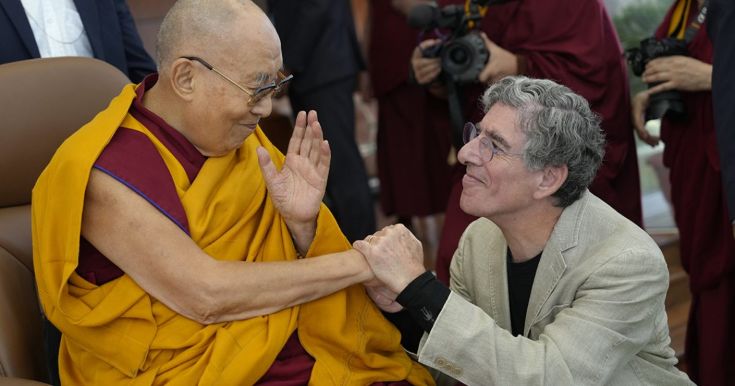
Yes, we’re talking about meditation. Hold on, don’t close this—I used to roll my eyes at the word myself. Incense, lotus pose, hours of sitting motionless… It sounds like something for people with way too much free time.
But here’s what’s interesting: in 2026, tech company executives, doctors, athletes—even those who used to call it nonsense—are starting to meditate. Not because it’s trendy. But because science has finally explained why it works—without any mysticism or esotericism.
Put simply: meditation is a way to give your brain something it doesn’t get anywhere else. Silence. Not external—internal. When the stream of thoughts slows down, the brain switches from “fight or flight” mode to recovery mode. And that’s where the real magic begins—only now it’s biological.
What Happens to Your Body and Brain

Let’s skip the poetry and go straight to the facts. When you meditate, measurable processes kick off in your body.
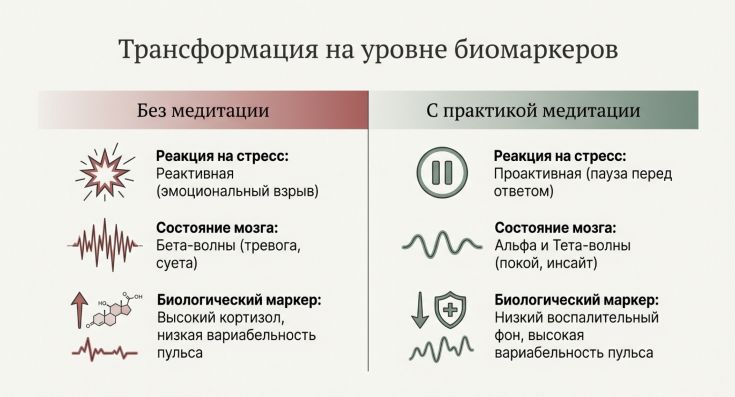
First, cortisol—the stress hormone—drops. The same one that makes you feel cornered even on a day off. Meditation activates the vagus nerve, and your body shifts from anxiety mode to recovery mode. This isn’t a metaphor—it’s physiology.
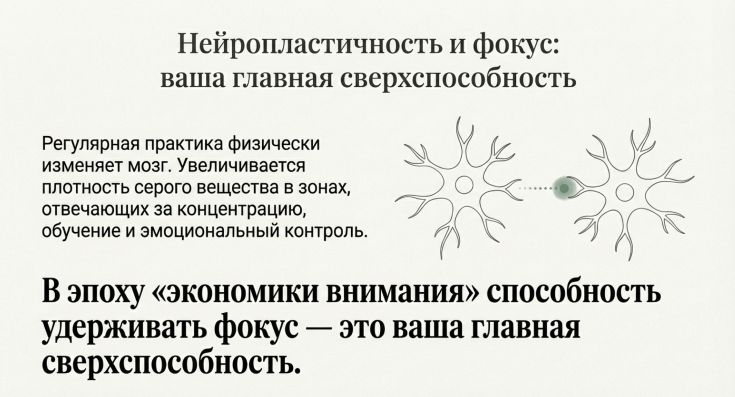
Second, the brain itself changes. Studies show that after just eight weeks of regular practice, the density of gray matter increases in areas responsible for memory and learning. And the amygdala—our internal “panic center”—literally shrinks. You don’t just feel calmer. You become calmer on a biological level.
And third: the brain stops wasting energy. There’s this thing called the default mode network. It’s when you’re supposedly doing nothing, but your head is filled with endless dialogue: “What if…”, “I should have said it differently…”, “What if it doesn’t work out…”. For those who meditate, this chatter quiets down. And the freed-up resources go toward something useful—focus, creativity, solutions.
Is This Made Up? What Does Science Say?
I know it sounds too good to be true. “Sit with your eyes closed—and your brain rewires itself.” So let’s look at the research.
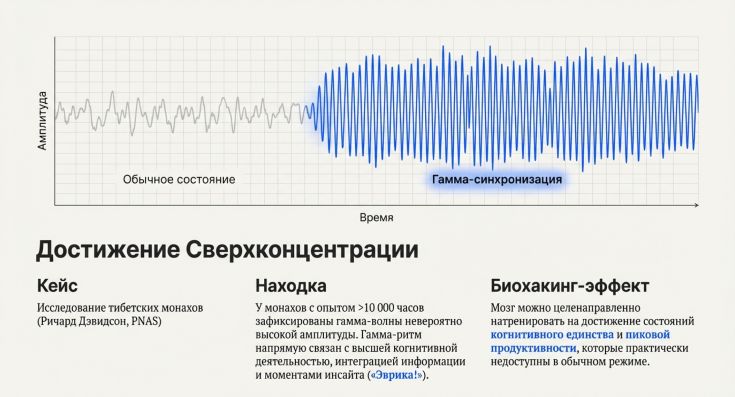
Tibetan Monks and Gamma Waves. The most famous study was conducted by neuroscientist Richard Davidson at the University of Wisconsin—in collaboration with the Dalai Lama. Scientists examined the brains of monks with over 10,000 hours of meditation experience. The results stunned everyone: during practice, they showed gamma waves of incredible amplitude. This is the rhythm responsible for insights, information integration, and “moments of clarity.” An average brain rarely produces such bursts. For the monks, it was the norm. The conclusion? The brain can be trained to achieve states that seem unattainable to most.
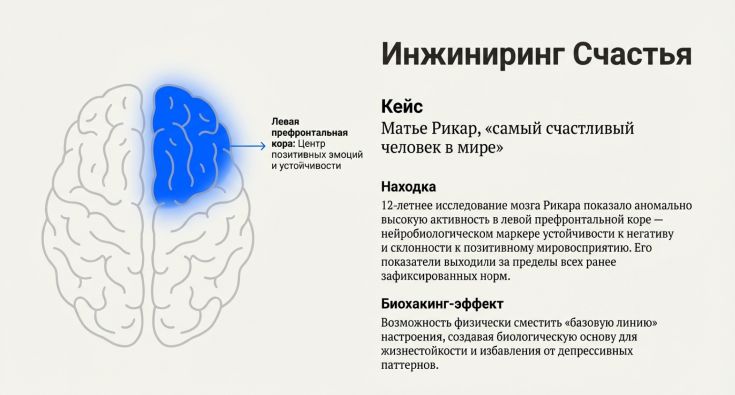
“The Happiest Man in the World.” This isn’t clickbait—scientists called Matthieu Ricard that. A French biologist who became a Buddhist monk, he participated in a 12-year brain study. MRI scans showed abnormally high activity in the left prefrontal cortex—a direct marker of resilience to negativity and a predisposition to positivity. His “happiness” metrics went beyond all norms the researchers had seen before. Meditation literally shifted his baseline mood.
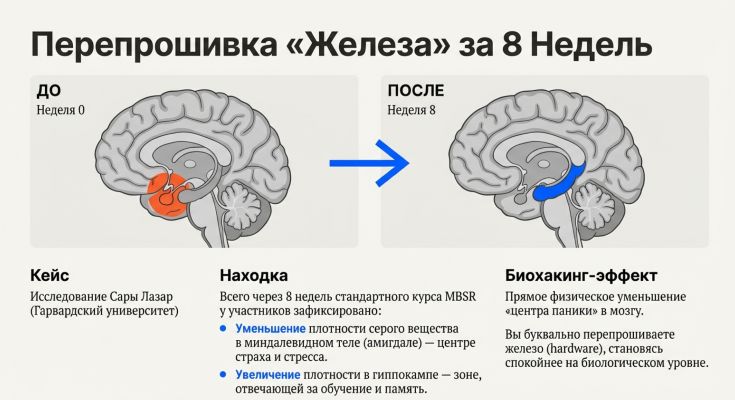
Harvard: Changes in 8 Weeks. Neuroscientist Sara Lazar took a group of beginners and put them through an eight-week course. Before and after—brain MRIs. Results: increased gray matter density in the hippocampus (memory and learning), reduced amygdala (fear center). In just eight weeks. Not years in a monastery.
Yale: Shutting Off the Inner Critic. Neuroscientist Judson Brewer studied the default mode network—that same “chatter in your head.” In experienced practitioners, it practically went silent. Imagine how much energy is freed up when the voice that’s always criticizing and worrying finally quiets down.
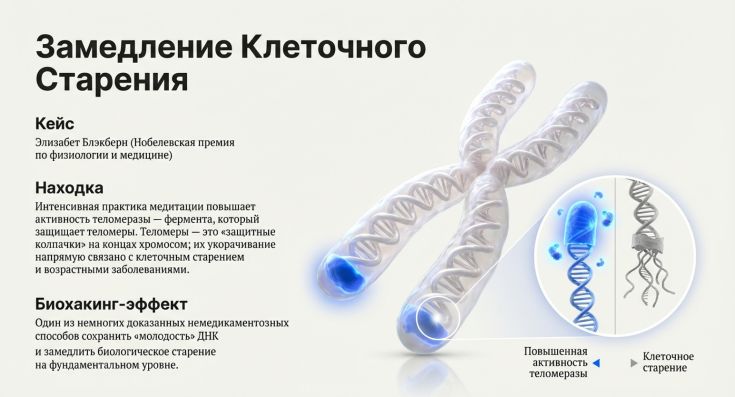
Nobel Prize and Aging. Elizabeth Blackburn won the Nobel for discovering telomerase—the enzyme that protects chromosomes from aging. Her research showed: in those who meditate regularly, telomerase works more actively. In simple terms—meditation slows aging at the cellular level.
This isn’t esotericism. It’s biology that can be measured.
And If We Dig Deeper?
Okay, we’ve covered the body. But there’s something else—and this isn’t about hormones.
Ask yourself a simple question: Who are you? No, not your name or profession. Who is the one reading these lines right now? Who is the one thinking your thoughts?
It sounds strange, but this is where meditation does something important. It helps you notice: You are not your thoughts. Not your anxieties. Not the voice in your head that’s always criticizing. You are the one observing all of it.
Why is this important in 2026? Because we live in a world where algorithms fight for our attention. Feeds shape opinions. Ads create desires. News breeds fears. And if you don’t understand where the external noise ends and the real you begin — it’s very easy to be controlled.
Meditation brings you back to yourself. Not in an esoteric sense of “finding your true self.” But in a practical way: You start noticing which thoughts are truly yours and which are just reactions to another trigger. And this gives you freedom of choice that most people simply don’t have.
Why All This? About Meaning
You can meditate for health. For focus. For calm. But there are people who continue the practice for years—and clearly not just because of cortisol.
The thing is, at some point, meditation opens access to something bigger. It’s hard to describe in words, but I’ll try.
You know that feeling when you look at a starry sky or stand on a mountaintop—and suddenly all your problems seem small? Not because they’ve disappeared. But because for a second, you felt something vast that you belong to.
Meditation gives a similar experience—only from within. In the silence of the mind, sometimes a strange feeling arises: Everything is in its place. You don’t need to prove anything or run anywhere. Just being is enough.
Philosophers call it “numinous.” Psychologists call it a “peak experience.” But the name doesn’t matter. What matters is that after such an experience, minor setbacks no longer throw you off track. An inner resilience appears—not because you’ve become stronger, but because you now have a foundation that doesn’t depend on external circumstances.
And that’s when life turns from a chaotic race into a conscious path. Where even difficulties are part of something meaningful.
Where to Start? Without Fanaticism
Okay, suppose you’ve decided to try it. What to do? Sit for an hour in lotus pose and think about emptiness? No.
Here’s a minimal start that really works:
10 minutes a day. Not an hour. Not thirty minutes. Ten. In the morning before checking your phone or in the evening before bed — choose what’s convenient. The key is regularity over duration. Ten minutes every day is better than an hour once a week.
Just breathe. Sit comfortably, close your eyes, and observe your breathing. Inhale — notice it. Exhale — notice it. Thoughts will come — that’s normal. You’re not trying to stop them. Just gently return your attention to the breath. Again and again.
Don’t expect miracles right away. The first few times will feel weird. Your head will buzz, you’ll get distracted every three seconds. That doesn’t mean you’re doing something wrong. That’s the practice — noticing you’ve wandered off and softly coming back.
If you want structure — try MBSR (Mindfulness-Based Stress Reduction). This is the “gold standard” that most studies are based on. You can start with 10-15 minutes a day, as regularity is more important for biohacking than length.
What Changes: Before and After
To make it visual—here’s a simple comparison:
| Aspect | Before Meditation | After Regular Practice |
| Stress Response | Constant “fight or flight,” high cortisol | Quick recovery, vagus nerve activation |
| Thoughts | Endless inner chatter and rumination | Ability to observe and let go |
| Focus | Easily distracted by notifications | Deeper concentration, less mental fatigue |
| Emotions | Reactive, mood swings | Greater resilience and baseline calm |
| Overall | Feeling controlled by external chaos | Inner freedom and sense of meaning |
Result: Three Reasons—One Tool
Let’s sum it up.
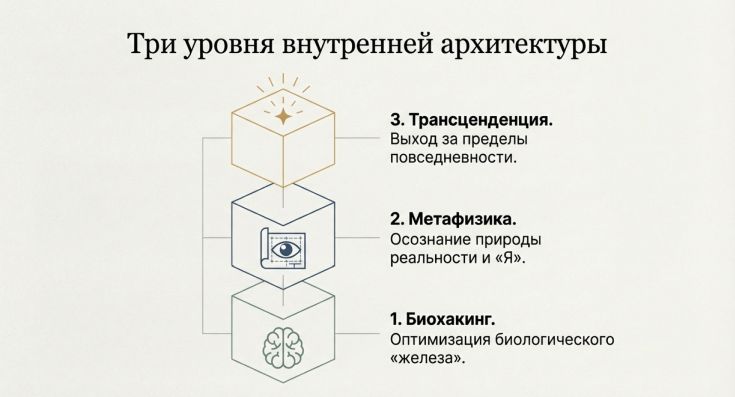
Meditation isn’t about becoming a monk or escaping reality. It’s a specific tool that works on three levels:
- Body — Reduces stress, literally rewires the brain, slows aging.
- Mind — Stops you from being a hostage to your thoughts and others’ algorithms. Returns control to you.
- Meaning — Provides a foundation that doesn’t depend on what’s happening around you. Turns life into a conscious path, not an endless race.
And all it takes is ten minutes a day and a willingness to try.
Want to not just try, but master the practice with support?
I invite you to the course “Inner Foundation 1.0“—a gentle start for those just beginning. A step-by-step system, clear techniques, no esotericism—just what works and is backed by science.
And if you’ve already completed “Inner Foundation” and feel ready to go deeper—there’s “Inner Wisdom 2.0.” This is the next level: more subtle practices, work with attention and awareness, leading to that transcendent experience we talked about above.
Maybe today is a good day to start?
Sources for the Curious:
- Lutz, A., et al. (2004). Long-term meditators self-induce high-amplitude gamma synchrony during mental practice. PNAS.
- Hölzel, B. K., Lazar, S. W., et al. (2011). Mindfulness practice leads to increases in regional brain gray matter density. Psychiatry Research: Neuroimaging.
- Brewer, J. A., et al. (2011). Meditation experience is associated with differences in default mode network activity and connectivity. PNAS.
- Epel, E., Blackburn, E., et al. (2009). Can meditation slow the rate of cellular aging? Annals of the New York Academy of Sciences.