
For many years we have been studying the cultural and social differences between the West and the East. Each parenting paradigm may have its emphasis, but we can confidently confirm that all people when solving personal problems, resort to typical forms of conflict processing. If we have a problem, we get angry, feel overwhelmed, or misunderstood. We live in constant tension or do not see any meaning in our lives.
All these difficulties can be expressed in the following four forms of conflict processing, corresponding to the four dimensions of cognitive ability. They allow us to understand how a person perceives the world around him, and through what paths of knowledge he masters reality.
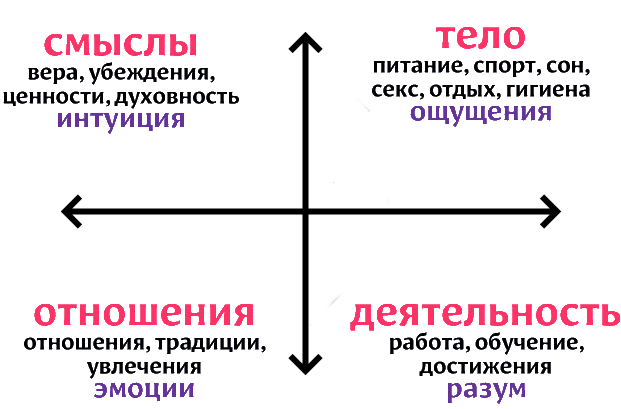
These forms of conflict processing are relatively broad categories that everyone fills with their personal ideas, desires, and conflicts. Each person develops his preferences in dealing with conflicts that arise. When one form of conflict processing is hypertrophied, others are relegated to the background. Which forms of conflict processing are preferred depends to a large extent on the experience acquired, primarily on what a person received in his childhood. The four forms of response are modeled in a specific life situation with the participation of specific concepts.
Symptoms of overload or dysfunction of each sector of the balance model
- Sleep disorders, loss of appetite, organ diseases, irritability, uncontrolled eating, vital depression, sexual disorders, fatigue, pain, adynamia, acoustic and optical hallucinations, hypochondriacal ideas, as well as disturbances of perception and drive and affective disorders can be presented as symptoms in body/sensation sphere.
- Disorders of thinking and intelligence, disturbances of attention, memory, difficulties in making decisions, the tendency to rationalize, daydreaming, obsessions, derealization, etc. relate to the mind and at the same time to the activity.
- Fixations, prejudices, stereotypes, fanaticism, weak judgment, fear of the truth, feelings of hatred, feelings of guilt, marginality, and one-sidedness are associated with tradition and thus with contacts.
- Uncontrollable fantasies, detachment from reality, suicidal fantasies, sexual fantasies, fears, obsessions, delusions of relation, and persecution can be classified in the realm of fantasy/intuition and at the same time in the dimension of the future.
For example, to excite and even satisfy the need for creative exploration and sexual fantasies. As a “personal world,” fantasy fences off the traumatic and painful interventions of reality and creates a temporarily comfortable atmosphere (for example, alcohol, and substance abuse). She may not perceive the “evil deed” and the painful breakup with her partner as accomplished; it can, however, also frighten, and become powerful, making reality intolerable, due to the projection of its fears.
In this way, imagination mixes with perception and leads to symptoms that occur in schizophrenia in the form of delusions. To tame the frightening, dynamic power of fantasy, some people develop compulsive behavior, as if wearing a corset, which helps them keep threatening fantasies in check and protect themselves from uncontrollable outbursts of feelings. In this area, actual abilities as the content of fantasies also play a major role.
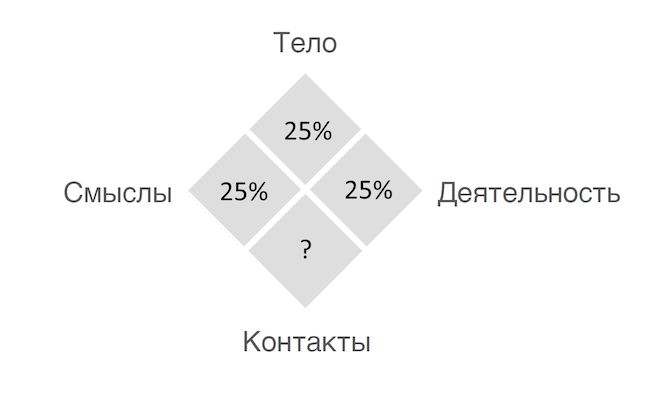
Application of the four forms of the balanced model
This “four” is comparable to some scales, the scales of which should always have 25% to maintain peace of mind. Decisive for a balanced state of mind is the ability to think positively and creatively.
Body or sensations: in the foreground is the body – Self-perception. How do we perceive our body? How do we experience various sensations and information from the world around us? With the help of his sensations, from the very beginning of development, the child establishes contact with the outside world. General activity is controlled by sensations. Sleep and eating rhythms can be critical in regulating this.
The defeat of a particular organ can be determined through psychosomatics. Through the concepts that you adhere to about the body as a whole, its organs and their functions, as well as health and illness. They determine, in general relationship with the content of the conflict, why one person reacts with his heart, another with his stomach, respiratory organs, skin, etc., and why some people “run” into illness, while others do their best to deny physical weakness and illness.
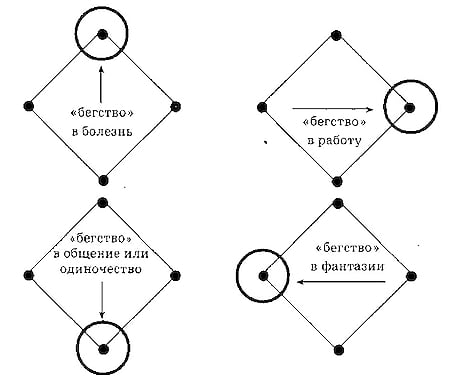
Activity or mind: the measurement of this is of particular importance in industrial society, especially in American-European circles. This also includes ways of establishing norms of activity and their inclusion in the concept of the Self. Thinking and reason make it possible to systematically and purposefully solve problems and optimize activities. Two differently directed flight reactions are possible: a) “flight” to work; b) “escape” from the demands of activity. Typical symptoms are self-esteem problems, overload, stress reactions, fear of dismissal, attention problems, and “deficit” symptoms such as retirement neurosis, apathy, decreased activity, etc. Concepts: “If you can do something, then you are something”; “When you’ve finished the job, go for a walk with confidence” “You can’t even pull a fish out of the pond without difficulty”; “Time is money”, etc.
Contacts or tradition: this area involves the ability to establish and maintain relationships with oneself, partner, family, other people, groups, social classes, and foreign cultural circles; attitude towards animals, plants, and things. Social behavior is formed under the influence of acquired experience and received inheritance (tradition), especially about the development of our abilities to establish contacts. There are socially conditioned selection criteria that govern them: for example, a person expects politeness, sincerity, fairness, accuracy, common interests, etc. from a partner. and chooses a partner according to these criteria.
Fantasies or intuition: One may respond to conflicts by activating fantasy, imagining solutions to conflicts, mentally imagining desired success, or punishing and even killing in dreams people who have accumulated anger because someone has been unfaithful, wrong, or holds different beliefs. Fantasy and intuition can
The ability to find balance has been lost by many people these days, but it is very easy to regain. If you leave one of the 4 undeveloped, then “escape from yourself and your life” occurs.
Each of the 4 aspects in the balance model can be divided into sub-items and given a score from 1 to 10. This way you can determine how well you balance. If you are interested in this technique, write a comment and we will send you a scheme for individually working on yourself using this method. If you honestly take the test and start balancing your life, then it will be filled with new and previously unknown colors and emotions.