Sometimes anxiety with no obvious cause settles into the heart on the very days when the sky holds no moon at all. Or the same pattern keeps repeating itself through a family, generation after generation, as if someone invisible were rewriting the same script each time. The Vedic tradition explains this through the concept of ancestral karma — unfinished bonds and accumulated weight that continue living in a family’s field long after our loved ones have passed. One of the deepest and most effective ways of working with this inheritance is the ancient tantric ritual of Kalabhairava Shanti, performed specifically on the New Moon, which helps free both the living and the departed from the burden of the past.
In this article you’ll find:
- What Ancestral Karma Is, and Why It’s Addressed on the New Moon
- Who Is Kalabhairava, and Why This Ritual Calls on Him
- How the Kalabhairava Shanti Ritual Unfolds
- How Kalabhairava Shanti Differs from Kalabhairava Karma
- Does the Ritual Work If the Departed Wasn’t Connected to the Vedic Tradition
- Kalabhairava Shanti Dates in 2026 and the Power Behind Each One
- How Often the Ritual Can Be Performed
What Ancestral Karma Is, and Why It’s Addressed on the New Moon
In the Vedic tradition, a person’s destiny is never viewed apart from the destiny of their lineage. Between relatives — living and departed — exists a particular energetic bond known as runanubandha (from Sanskrit, roughly ‘the bond of debt’ or ‘karmic knot’). If a departed relative was unable, during their lifetime, to release a fear, a resentment, or an unfulfilled desire, that weight doesn’t vanish along with the body — it continues to live in the subtle field of the family and can show up in living descendants as unexplained anxiety, repeating patterns, or a sense of being ‘stuck’ in certain areas of life.
The New Moon, or Amavasya (the day the moon is entirely invisible in the sky), is considered in Vedic cosmology to be the moment when the boundary between the physical and subtle worlds grows thinnest. This is why most rituals dedicated to ancestors are traditionally performed on these days — nature itself seems to open a window for this kind of work.
Who Is Kalabhairava, and Why This Ritual Calls on Him
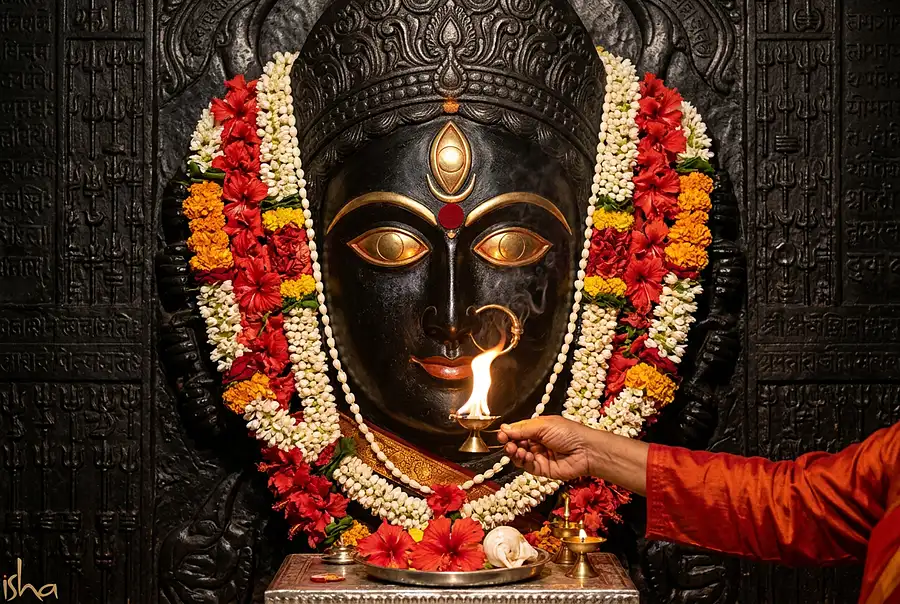
Kalabhairava is a fierce yet deeply compassionate aspect of Shiva, known as the ‘Lord of Time.’ In Vedic iconography he is depicted as the destroyer of illusion and fear, the one capable of instantly and mercifully ‘burning through’ the heaviest karmic knots. When the work concerns departed relatives, it is traditionally Kalabhairava’s energy that is called upon for help — because it is he who can free a departed consciousness from the inertia of its strongest attachments, fears, and unfulfilled desires, the very things that keep it in a state resembling being stuck.
The word ‘Shanti’ translates from Sanskrit as peace. So Kalabhairava Shanti can be translated, quite literally, as ‘peace through Kalabhairava’ — a ritual that offers the departed the very release and stillness they can no longer find on their own.
How the Kalabhairava Shanti Ritual Unfolds
Every detail of this process is carefully built toward one purpose — establishing precise contact with the departed person’s subtle body and gently releasing them from accumulated weight. The ritual takes place on the night or day of Amavasya and usually lasts several hours. Here’s how it unfolds.
Preparation and Energetic Attunement
Before the main part begins, the priestesses (Bhairagi Maa) prepare the space: a photograph of the departed is placed on the altar, and their full name, date of birth, and date of death are spoken aloud — establishing a precise energetic ‘address’ that the entire process will be directed toward. From rice and a few consecrated elements, the priestesses shape a pinda — a small symbolic form that, for the duration of the ritual, seems to ‘hold’ the departed person’s karmic imprint, allowing the work to proceed with care and focus.
Sound: Mantras That Loosen What Has Frozen
Then begins the low, steady chanting of mantras dedicated to Kalabhairava and Linga Bhairavi — a pure sound vibration that gradually loosens frozen karmic knots layer by layer: fear, unexpressed pain, unfulfilled desire. The space slowly fills with a particular kind of dense stillness that’s hard to mistake for anything else — almost everyone who has ever been present for this process notices it.
Fire: The Heart of the Ritual
The culmination is the homa, the fire offering. Herbs, sandalwood, ghee, seeds, and other consecrated items are offered one by one into the sacred fire (kunda). Fire is believed to be capable of instantly ‘evaporating’ the densest, heaviest layers of karma — fear, the pain of a life’s final moments, unrealized attachments. At the same time, the priestesses direct the energy of Linga Bhairavi — not as a destructive force, but as an enveloping, maternal one, wrapping the departed soul in a sense of safety as the weight is lifted from it.
For Those Present
When relatives are able to attend in person, a part of the ritual is set aside for them too. At a particular moment, they carry out a simple yet symbolically profound act — dropping seeds or rice into the fire or into a special vessel, as if releasing their own grief and unspoken words along with them. At this same moment, a special black thread is consecrated and tied around the wrist as a protective token, one that helps gently loosen the heavier part of the ancestral bond while leaving love and gratitude intact.
Closing and Prasad
Once the ritual concludes, ash from the sacred fire is charged with Kalabhairava’s energy and becomes vibhuti — prasad that is given to the family. It’s traditionally applied to the point between the eyebrows and the base of the throat, while the thread is worn on the wrist for 40 days. If a photograph was brought in person, it is carefully returned to the family.
My Impressions After the Ritual
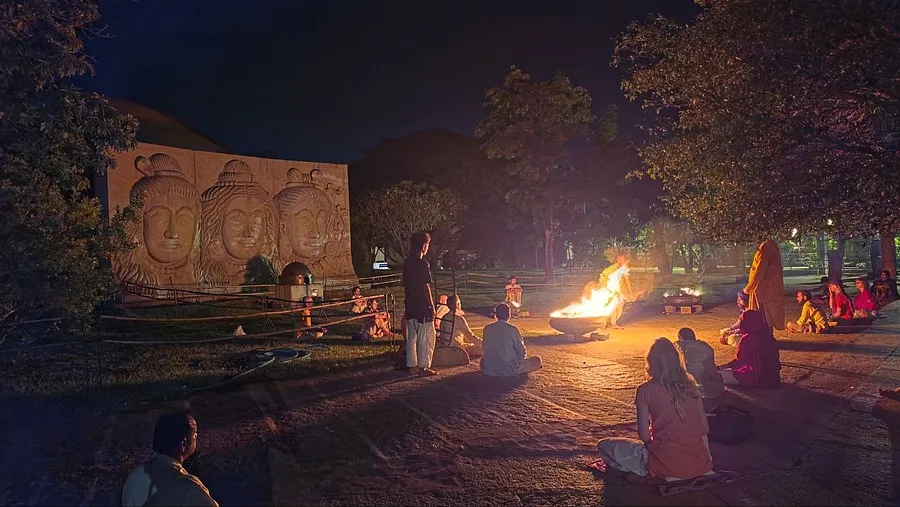
Last night I went through Kalabhairava Shanti — and I was struck by how profound this process really is.
The ritual ended past midnight: we began around eleven in the evening and finished close to one in the morning. It matters to catch the exact point of the New Moon, that narrow window when the moon is truly invisible and the boundary between worlds grows thinnest.
Performing a ritual like this not for yourself, but for someone who has already passed, is an entirely different kind of experience. On its journey, the soul needs to release its inner clichés — the imprints that accumulate in our energy and keep it from flowing freely. And as the mantras sound, as the fire receives its offerings, an extraordinary stillness rises inside you. Calm. Love. As if you’d met that person again and could finally say all the words you never got to say while they were alive.
That state is hard to put into words — a kind of otherworldly lightness, a heart filled to the brim. Looking around at the others taking part, I could see how differently this bond with the departed shows up in each person. Some trembled almost uncontrollably as the mantras played. Others wept openly. Each person carries their own thread to the soul they lost, and in that moment it becomes visible more clearly than ever.
I want to say something, too, to those who go through this ritual together with other relatives — for instance, when your whole family gathers for a Kalabhairava Shanti dedicated to one departed loved one. In that moment, you aren’t just there in the room. You become amplifiers of the energy, a living bridge between the family line and the soul that once belonged to it. That’s both an enormous responsibility and an enormous gift.
Rituals like this carry real power. Touching something this profound is a rare and precious gift — one I’m deeply grateful for.
How Kalabhairava Shanti Differs from Kalabhairava Karma
The Vedic tradition holds two similar but distinct rituals:
- Kalabhairava Karma is performed within a limited window after a person’s death (typically up to 48 days), while their subtle energies are still closely tied to the body they’ve just left.
- Kalabhairava Shanti can be performed at any time — even years after a person has passed. This makes it especially valuable for anyone wishing to care for relatives who passed long ago, or for whom the proper rites simply weren’t performed in time.
Does the Ritual Work If the Departed Wasn’t Connected to the Vedic Tradition
This is one of the most common questions — and the answer is consistently reassuring. At the moment of death, a person leaves behind not only the body but every conceptual construct along with it: belief, nationality, cultural habits, logical convictions. What remains in the subtle body is only the most basic energy — emotion, attachment, fear, unfulfilled desire. The Kalabhairava Shanti ritual works precisely at this level, which is why it is equally accessible and beneficial for any departed person, regardless of which tradition they belonged to in life.
Kalabhairava Shanti Dates in 2026 and the Power Behind Each One
Every New Moon carries its own energy and its own particular shade of power. Here are the upcoming dates for the ritual:
- September 10, 2026, Thursday — Bhadrapada Amavasya. An ordinary yet quietly powerful new moon — a good time for regular care of the ancestral line and a gentle start to working with accumulated weight.
- October 9, 2026, Friday — Mahalaya Amavasya (Sarva Pitru Amavasya). The most powerful day of the entire year for rituals dedicated to ancestors: it closes the sixteen-day period of remembrance known as Pitru Paksha and is traditionally considered the moment when the connection with departed relatives becomes especially strong and accessible. If you can only choose one date this year, choose this one.
- November 8, 2026, Sunday — Kartika Amavasya, the eve of Diwali. A new moon that precedes the Festival of Lights — it carries a distinct energy of moving from darkness into light, making it a beautiful moment for closing a heavy chapter and preparing for a new cycle.
- December 8, 2026, Tuesday — Margashirsha Amavasya, the year’s final new moon. A time for taking stock and completing karmic cycles — a symbolic moment to release ancestral weight before stepping into the new year.
How Often the Ritual Can Be Performed
For one specific person, Kalabhairava Shanti is most often performed just once — that is usually enough to give the soul the peace it needs. Repeating the ritual makes sense only in particular cases: if the passing was sudden or difficult, or if you feel your own grieving process is still unresolved. If you choose to repeat the rite for the same person, tradition recommends waiting at least a year. There is no limit, however, on how many rituals you perform for different departed relatives — each new moon, you’re free to seek peace for someone else.
Working with ancestral karma is a living process that can be supported throughout the entire yearly cycle. The Autumn Equinox, for instance, is a beautiful time to take stock and gratefully release what has already served its purpose, while a Lunar Eclipse helps gently clear deeper, subconscious layers of ancestral patterns. If you’d like to work with the sacred dates of the year in a more structured way, take a closer look at the ‘Vedic Rituals in the Year’ course — it gathers practices for every meaningful moment in the yearly cycle.
We can’t change what happened to our ancestors, but we can help their souls find peace — and in doing so, make room in ourselves for lightness, love, and gratitude. If your heart responds to this practice, trust that feeling. Ancient, powerful rituals like Kalabhairava Shanti can today be experienced through specialized ashrams that work with these energies — in person or remotely, from anywhere in the world.