Tantric Cosmology: How Sound Becomes Matter
In Tantra, the macrocosm (Universe) and microcosm (human being) are absolutely identical. The key principle to understand is this: the process of dying is not chaotic destruction.
Rather, it is an orderly return to the Source, unfolding in reverse order relative to creation. According to tantric primary sources — such as the Shiva Samhita, the Sharda Tilaka Tantra, and the Anuttarayoga Tantra texts — the Universe does not arise from nothing. It manifests from pure, undifferentiated Consciousness through vibration.
1. The Primordial Sound (Pranava OM / Anahata Nada)
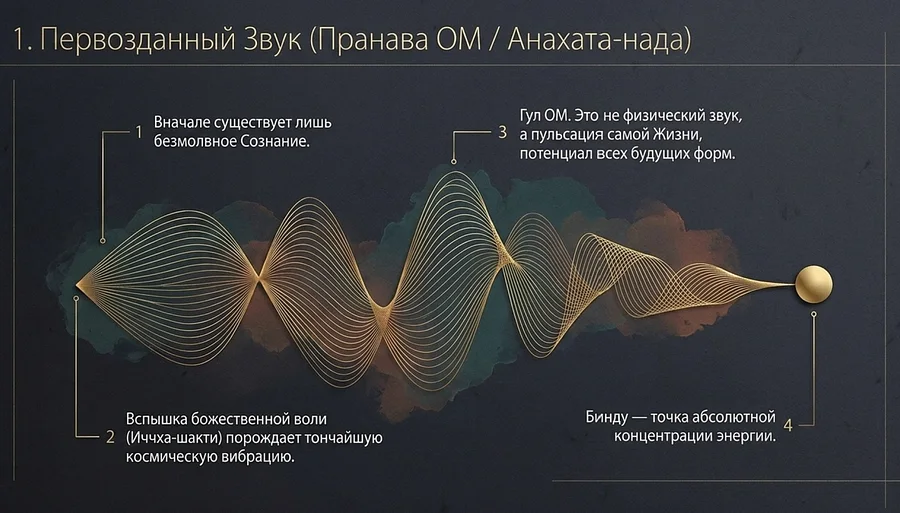
In the beginning, only silent Consciousness exists. A flash of divine will (Iccha-shakti) gives rise to the subtlest cosmic vibration — the hum of OM.
This is not a physical sound; it is the very pulsation of Life, the potential of all future forms. From this vibration emerges a point of absolute energy concentration — the Bindu.
2. Ether / Space (Akasha)
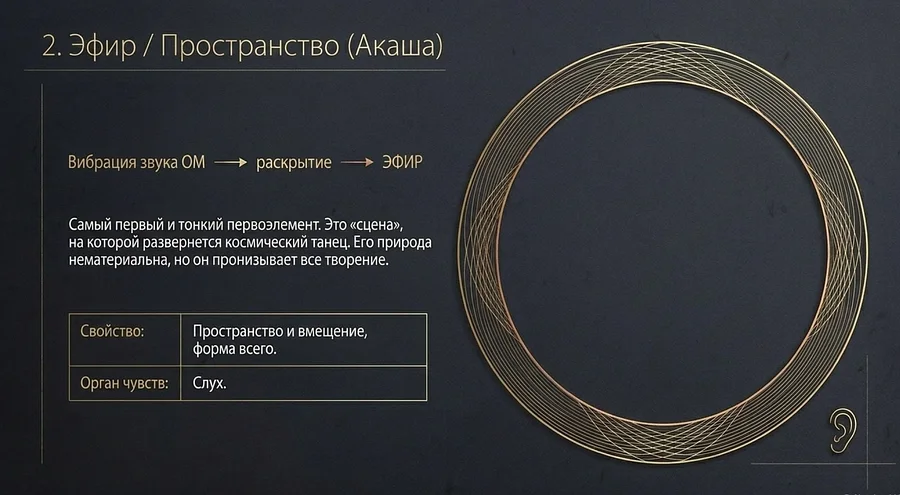
From the vibration of OM arises the first, most subtle primordial element — Ether. Its quality is space and containment. Its sense organ is hearing.
Ether is the “stage” upon which the cosmic dance will unfold. Its nature is immaterial.
3. Air (Vayu)
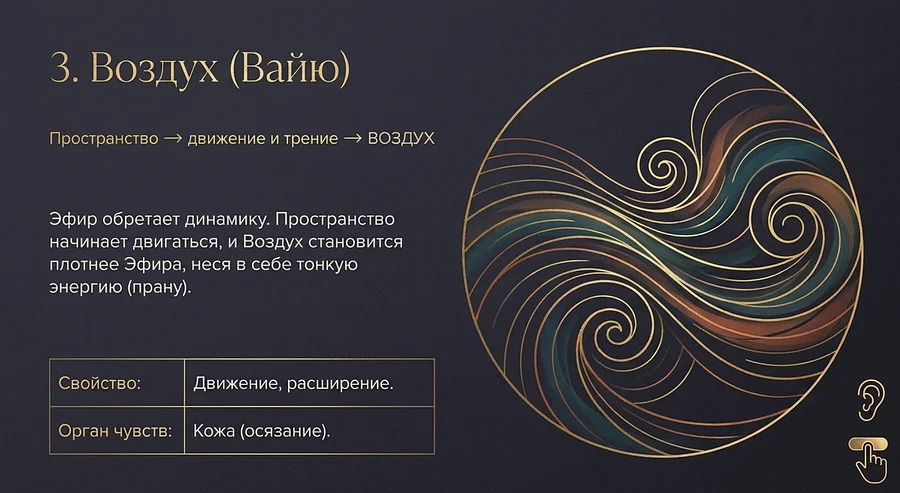
Space begins to move. From the friction and dynamics of Ether, the element of Air is born.
Its quality is movement, expansion, and touch. Its sense organ is the skin. Air is denser than Ether and carries subtle energy — prana.
4. Fire (Agni / Tejas)
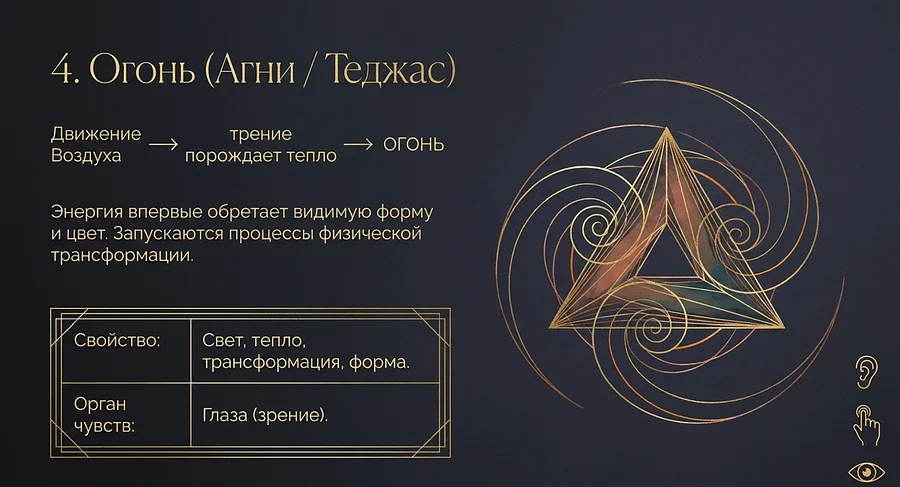
The movement of Air generates friction, and friction generates heat. In this way, Fire manifests from Air.
Its quality is light, heat, transformation, and form. Its sense organ is the eyes (sight). The Universe now has visible form and color.
5. Water (Apas)
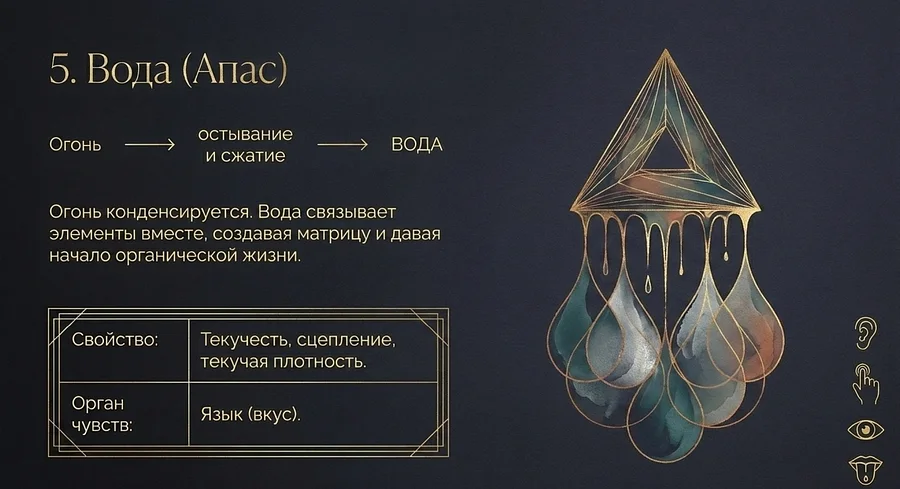
Fire condenses as it cools and contracts, and the element of Water manifests. Its quality is fluidity, cohesion, and liquid density. Its sense organ is the tongue (taste).
Water binds elements together, giving rise to organic life.
6. Earth (Prithivi)
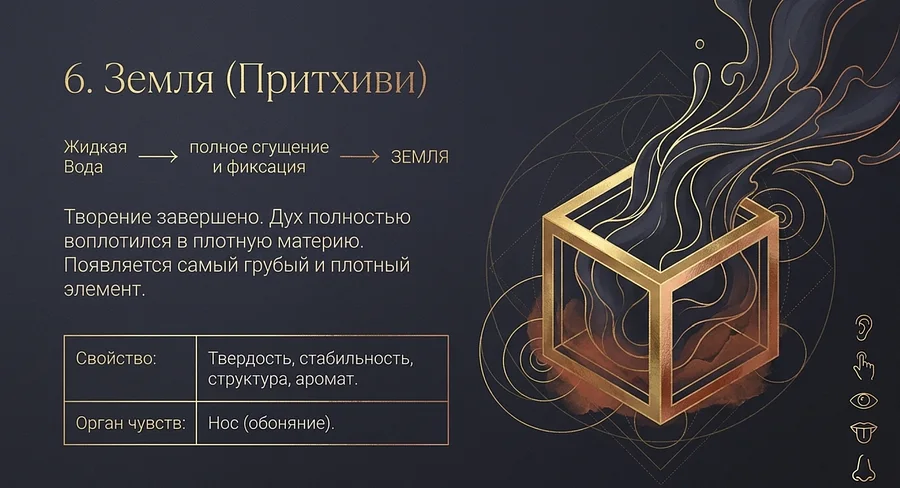
The densification of liquid Water leads to the fixation of energy. The densest, most gross element appears — Earth.
Its quality is solidity, stability, structure, and scent. Its sense organ is the nose (smell). Creation is complete: Spirit has fully embodied in dense matter, and the human body is formed.
How Does Involution Occur? Why Do the Elements Dissolve in Reverse at Death?
The Tantric axiom states: “That which is manifested later is grosser and depends on that which was manifested earlier. When form is destroyed, the effect is always reabsorbed by its cause.” To grasp this intuitively, consider the metaphor of the “Cosmic Matryoshka” or “building construction.”
Earth is the roof and walls, while Ether is the foundation and the space of the land itself. You cannot remove the foundation without destroying the roof.
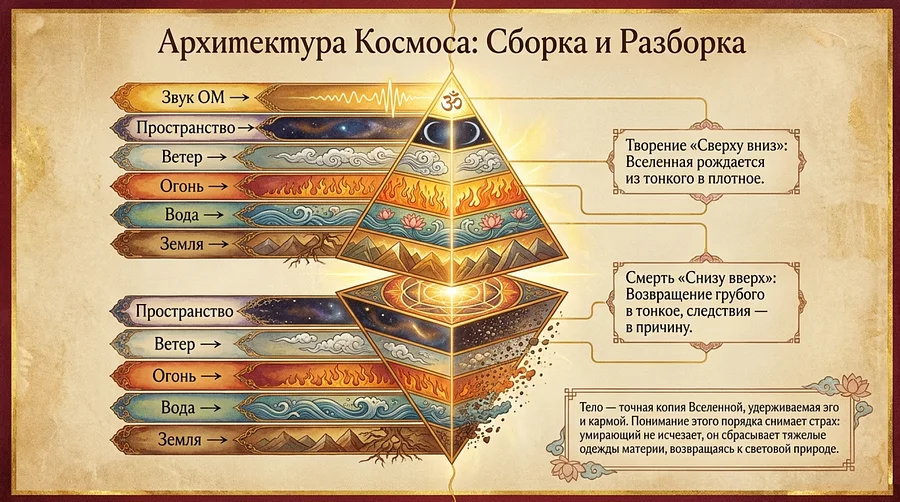
Therefore, the dying process is Involution (Nivritti) — a return home:
- Earth dissolves into Water: the dense physical body (Earth) loses stability and structure, being “washed away” and absorbed by the subtler element — fluids (Water).
- Water dissolves into Fire: fluids dry up, and all energy is drawn to the warmth (Fire) in the heart region.
- Fire dissolves into Wind: warmth leaves the body, dissolving into the final flows of breath and pranic movement (Wind).
- Wind dissolves into Ether/Consciousness: breathing stops, movement ceases, and the individual life force dissolves into the boundless space of pure mind, returning to the primordial sound of OM and the Clear Light.
In Tantra, death is not terror or an unknown catastrophe. The great Masters describe this process as the “rolling up of the canvas,” upon which the picture of our life was painted, back into a roll of pure consciousness.
A Brief Guide to the Dying Process
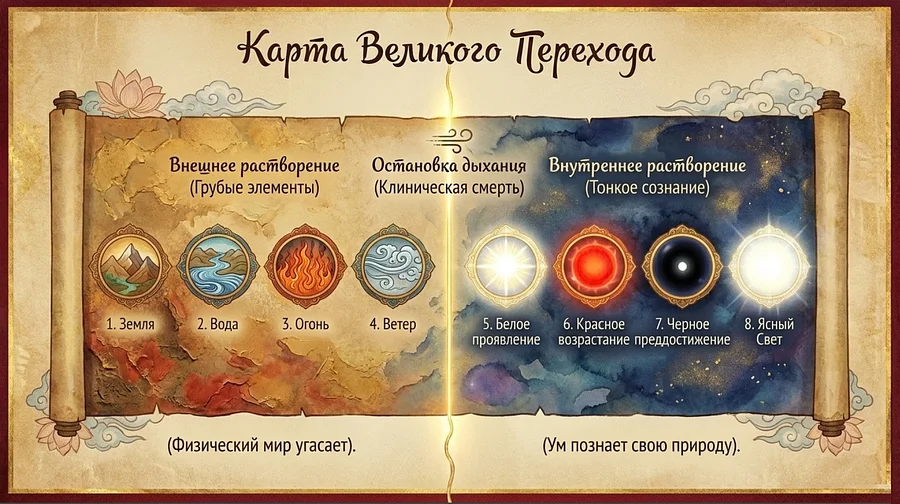
In the Tibetan Buddhist tradition — particularly within the Anuttarayoga Tantra, such as the Guhyasamaja Tantra, and the renowned text known as the Bardo Thodol (“The Tibetan Book of the Dead”) — death is not seen as an ending.
Rather, it is the greatest opportunity for the liberation of the mind. This transitional period is called Chikhai Bardo (the bardo of the moment of death).
The dying process unfolds across 8 sequential stages. First four constitute the outer dissolution (of gross elements). The subsequent four constitute the inner dissolution (of subtle levels of consciousness).
Stage-by-Stage Guide to the Dying Process
Stage 1. Dissolution of the Earth Element into Water
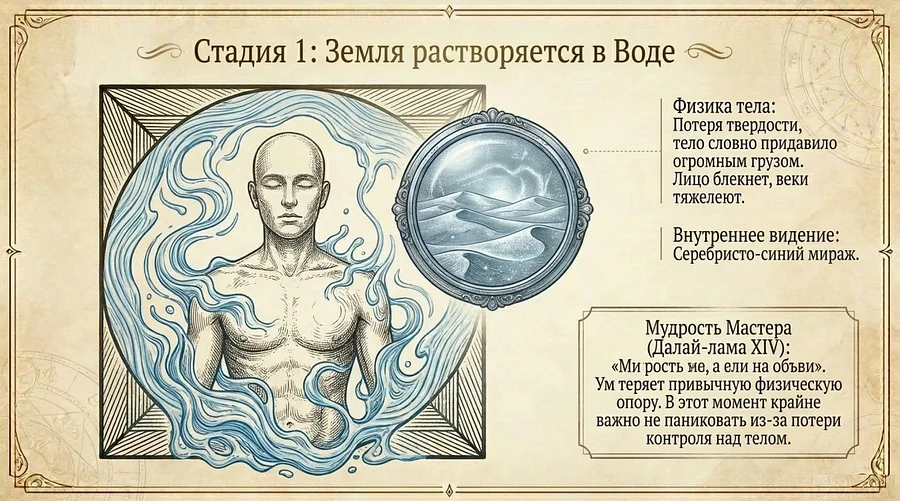
What happens to the dying person: the physical body loses solidity and strength. A sense of heaviness arises, as if the body were sinking through the earth or being crushed by a great weight.
The face becomes pale, the cheeks hollow, and the eyelids grow heavy. Inner vision of the mind: the dying person perceives a shimmering silver-blue mirage. Master’s commentary: “When the earth element dissolves, the mind loses its habitual physical support and becomes confused. At this moment, it is crucial not to panic over the loss of bodily control.” — His Holiness the Dalai Lama XIV
Guidance for those present: ensure the dying person’s physical comfort. Do not jostle them; help them adopt a comfortable position (ideally on the right side, in the “sleeping lion posture”). Speak in a calm, gentle voice, reminding them that what is happening is a natural and safe process.
Stage 2. Dissolution of the Water Element into Fire
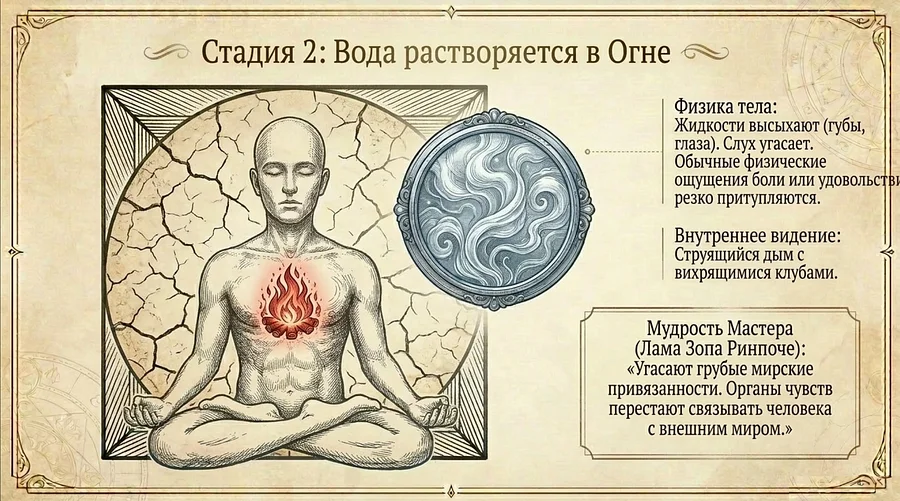
What happens to the dying person: the body’s fluids begin to dry up. The mouth becomes parched, the lips crack, and the eyes grow dry.
Hearing fades; internal sounds in the ears disappear. The ordinary physical sensations of pain and pleasure become markedly blunted. Inner vision of the mind: a vision of flowing smoke or a thin mist with swirling billows.
Master’s commentary: “At this stage, gross worldly attachments fade away, as the sense organs cease to bind the person to the outer world. Help them consciously release everything they are clinging to.” — Lama Zopa Rinpoche
Guidance for those present: gently moisten the dying person’s lips with water or a damp cloth. Remove any harsh sounds from the room. Begin softly reciting mantras — for example, the Medicine Buddha mantra or Om Mani Padme Hum.
Stage 3. Dissolution of the Fire Element into Wind
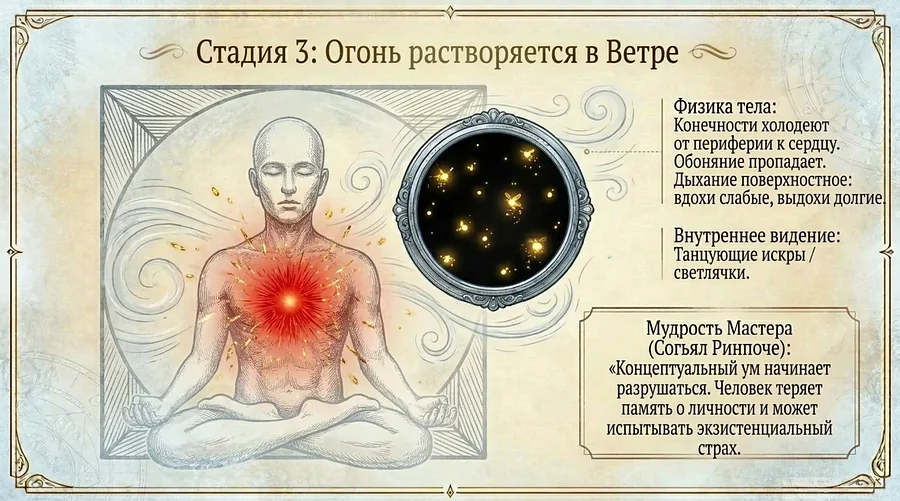
What happens to the dying person: the body loses its inner warmth. The extremities grow cold, with heat withdrawing from the periphery toward the heart.
Sense of smell disappears entirely. The dying person may stop recognizing loved ones and confuse names. Breathing becomes shallow and labored: inhalations are weak, while exhalations are long and audible. Inner vision of the mind: visions of sparks or flickering fireflies dancing through space.
Master’s commentary: “When fire departs, the conceptual mind begins to disintegrate. The person may experience a profound existential fear, losing memory of their ego-identity. Your presence must radiate absolute stability.” — Sogyal Rinpoche
Guidance for those present: under no circumstances weep or display strong emotions at the bedside. This can trigger reactive attachment or anger in the dying person, greatly worsening the karmic conditions for rebirth. Remind them of their spiritual Teacher or of the virtuous deeds they have performed in life.
Stage 4. Dissolution of the Wind Element into Consciousness
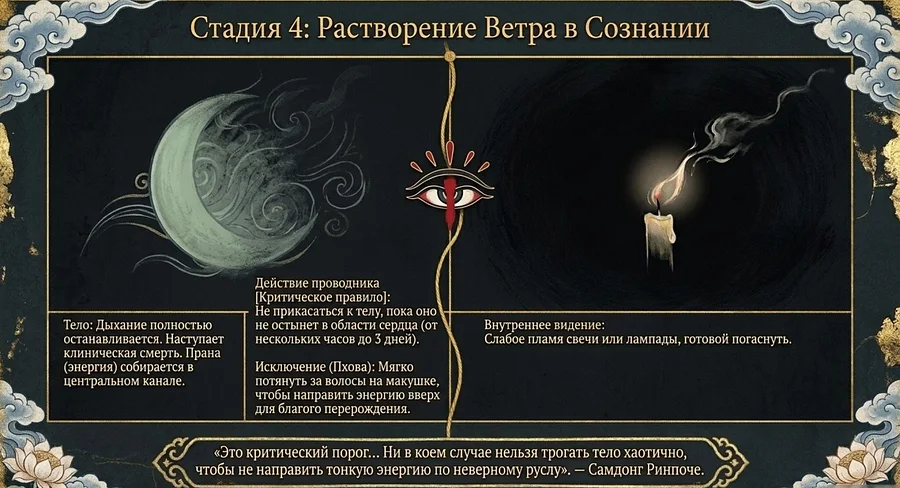
What happens to the dying person: breathing ceases entirely. From a Western medical perspective, clinical death has occurred.
However, the subtle vital energy (prana) continues to gather in the central channel (avadhuti). Inner vision of the mind: a faint candle flame or oil lamp on the verge of going out.
Master’s commentary: “This is a critical threshold. External breathing has stopped, but the inner subtle breath is still flowing. Under no circumstances should the body be touched haphazardly, lest the subtle energy be directed along an unfavorable channel.” — Samdhong Rinpoche
Guidance for those present: the strictest rule applies. Do not touch the body until it has completely cooled in the heart region (this typically takes anywhere from several hours to three days). The sole exception: immediately following the cessation of breathing, a gentle pull of the hair at the crown of the head (or a light touch to the crown) may be applied. This stimulates consciousness to exit through the highest energy center, supporting a favorable rebirth (the principle of Phowa practice).
Perhaps it’s time not just to read about the transition, but to prepare for it from within. Vipassana is an ancient practice of observing the mind, which teaches one to see the impermanence in every breath. Those who have completed this retreat say that for the first time in their lives, the fear of death has become simply a thought that can be let go.
Inner Dissolution (Subtle Consciousness)
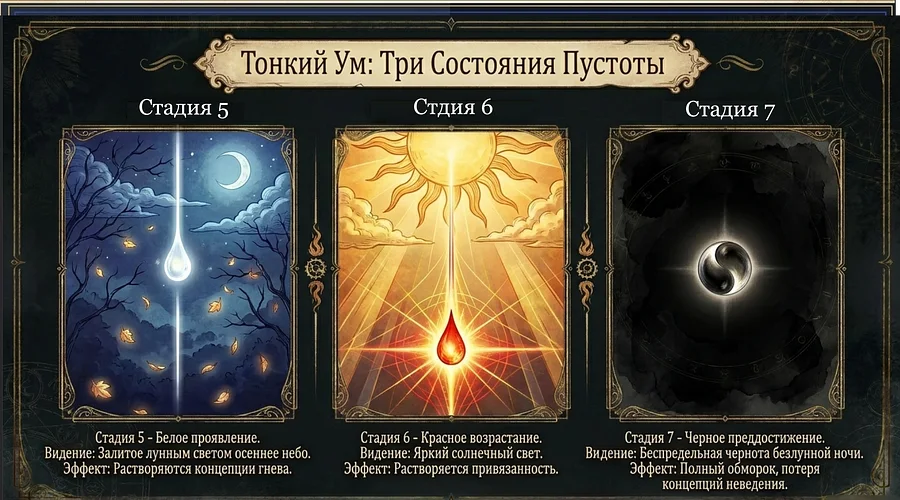
After external breathing stops, subtle mental stages begin — accessible to the dying person’s perception alone. Those present should maintain silence and mentally guide the departing.
Stage 5. White Appearance (Snang-ba)
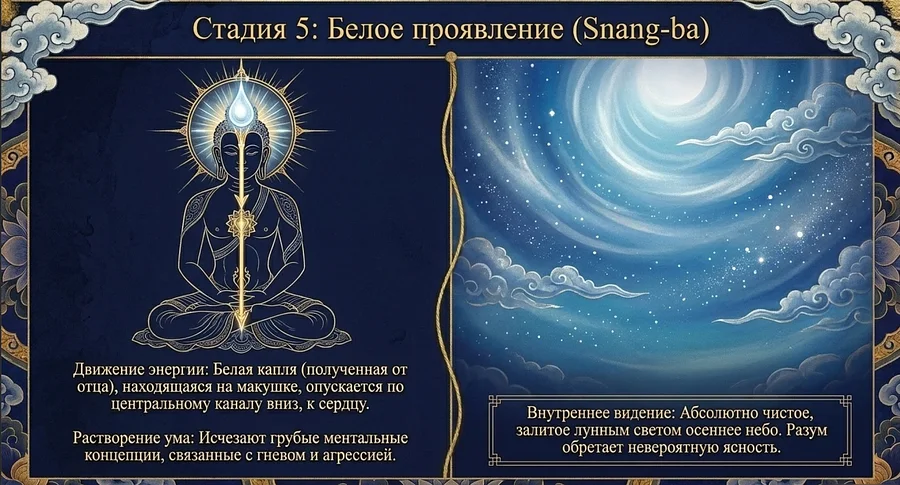
What happens: gross mental concepts associated with anger dissolve. The white drop (received from the father at conception). Residing at the crown of the head, descends through the central channel to the heart. Inner vision: a perfectly pure autumn sky bathed in moonlight.
Stage 6. Red Increase (Mched-pa)
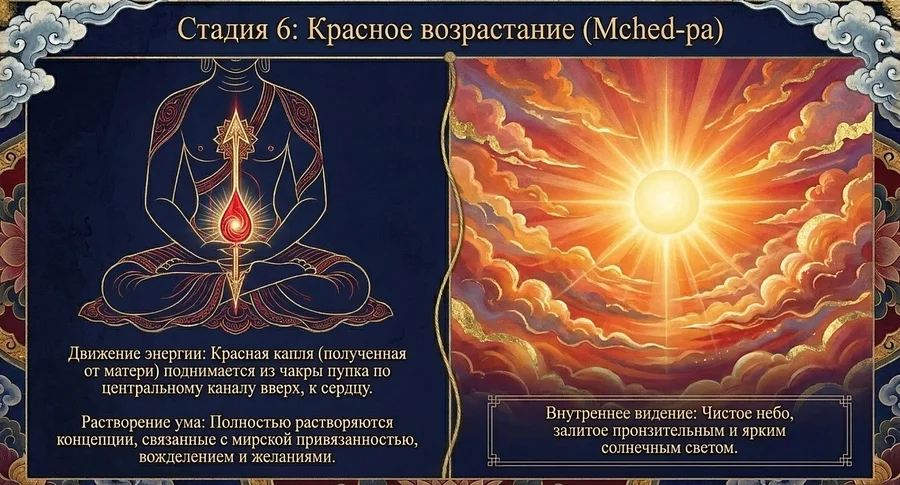
What happens: concepts associated with attachment and desire dissolve. The red drop (received from the mother) ascends from the navel chakra through the central channel to the heart. Inner vision: a clear sky suffused with brilliant sunlight.
Stage 7. Black Near-Attainment (Thob-pa)
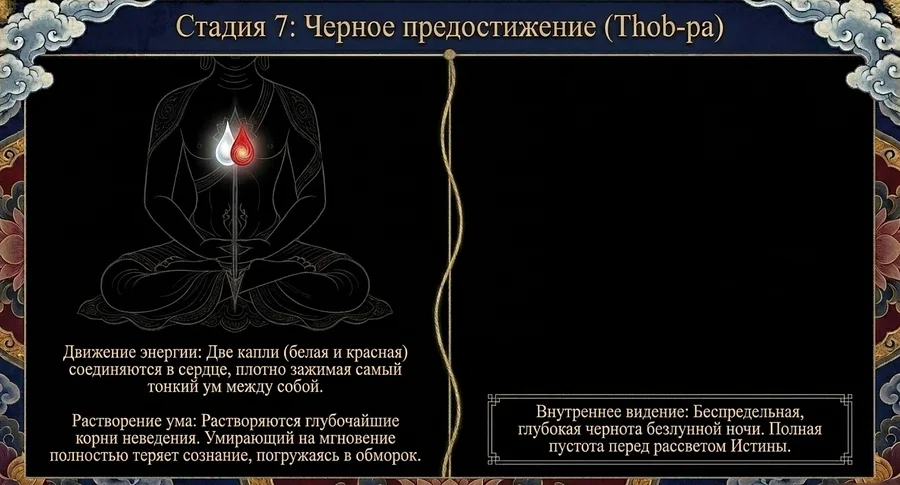
What happens: subtle concepts associated with ignorance dissolve. The two drops unite in the heart, pressing the subtle mind between them. The dying person momentarily loses consciousness entirely, sinking into a deep faint. Inner vision: boundless, deep darkness — the blackness of a moonless night.
Stage 8. Appearance of Clear Light (‘Od-gsal)
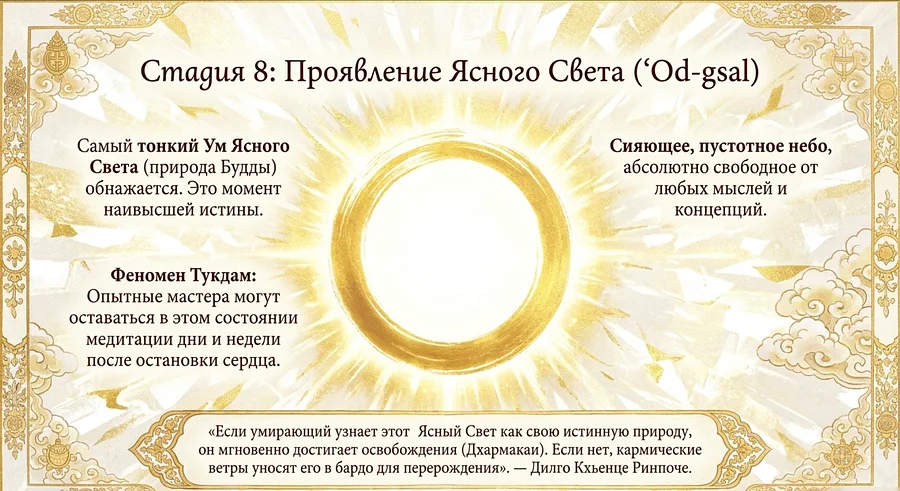
What happens: the subtlest Mind of Clear Light — Buddha-nature — is laid bare. This is the moment of supreme truth.
Experienced practitioners may remain in this state for several days (the Thukdam phenomenon), meditating upon Truth until the body begins to show signs of decay. Inner vision: a luminous, empty sky free of all thoughts and concepts — the Clear Light of Death.
Master’s commentary on Stages 5–8: “If the dying person recognizes this Clear Light as their own true nature, they instantly attain liberation (Dharmakaya). If not, the karmic winds set in motion again and carry them into the bardo space for the next rebirth.” — Dilgo Khyentse Rinpoche
General Guidance
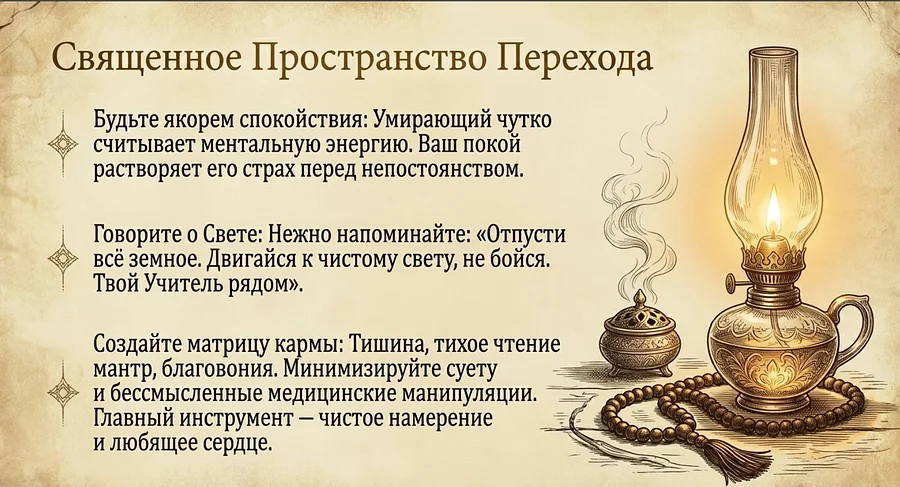
It is said that assisting a living being at the moment of their greatest transition is the highest act of compassion (Karuna) and a sacred practice. Do not fear making a mistake. Your primary instrument is pure intention, compassion, and a loving heart.
- Be an anchor of calm: the dying person is acutely sensitive to your mental energy. Your steadiness makes it far easier for them to release their fear.
- Speak of the Light: gently remind the person — even if they appear unconscious: “Release all that is earthly. Move toward the pure light; do not be afraid. Your Teacher is near.”
- Create a sacred space: minimize commotion, phone calls, and medical interventions that no longer serve a purpose. Play recordings of mantras, light incense, keep the room clean. This creates a wholesome karmic matrix for their consciousness.
Want to delve deeper into mindfulness practice and prepare for the great shift, not just in theory? On our website, you’ll find courses and marathons that will help you become a true guide—for yourself and others.
Key Points of the Process
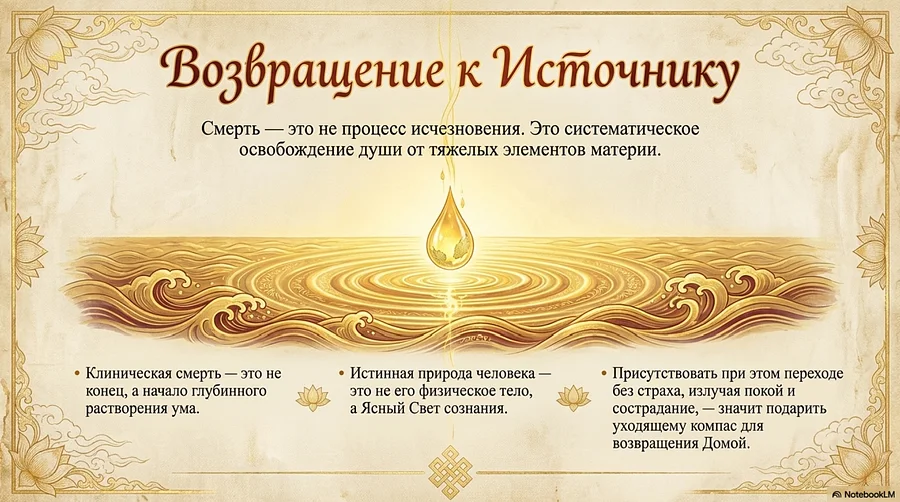
- Death is a process of dissolution. First the gross elements depart (Earth, Water, Fire, Wind), Then the subtle mental structures (the White, Red, and Black states).
- The point of no return: the cessation of external breathing (Stage 4) does not mark the end of the mind’s journey. The inner stages of consciousness’s transformation are only just beginning.
- The guide’s primary goal: to help the dying person maintain clarity. To resist fear, and recognize the Clear Light at the final, eighth stage.