An honest investigation by the experts of the Yoga Hub Club
Introduction: Why We Took On This Topic
Hi, friends.
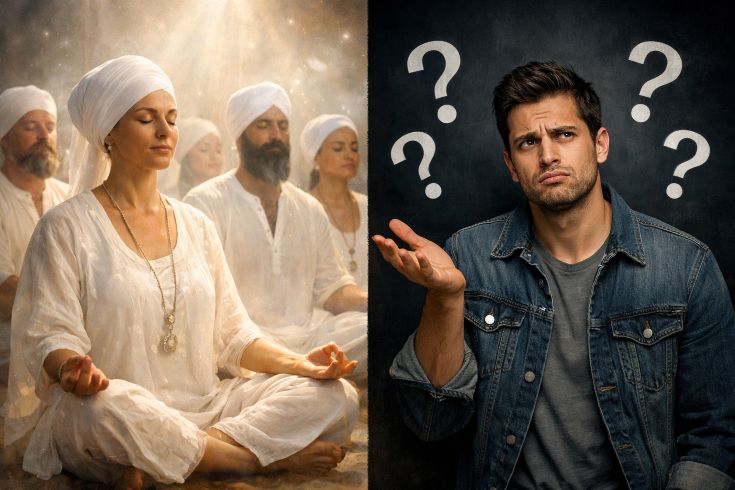
Over the past few years, dozens of people have come to us with the same story: “I practiced Kundalini yoga, and something is wrong with me.” Some couldn’t sleep for weeks. Some experienced panic attacks. And some ended up in a psychiatric hospital.
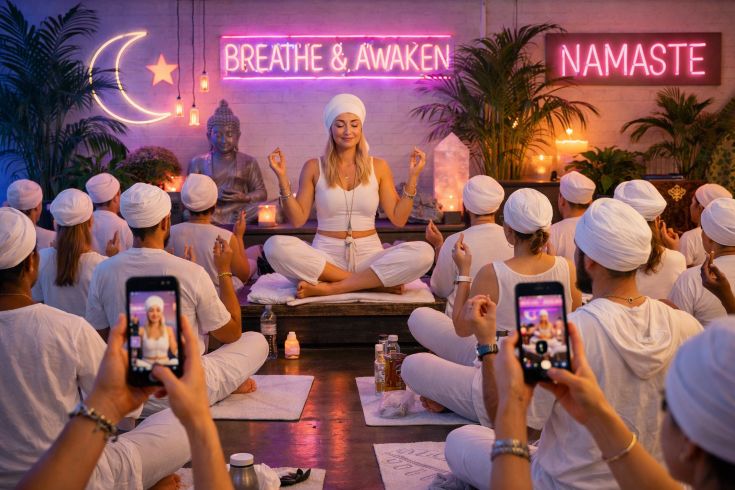
At the same time, we’re watching this practice become more and more popular. Instagram is full of snow-white turbans. Hollywood celebrities—from Russell Brand to Miranda Kerr—promote “awakening.” Studios are opening on every corner.
We decided to get to the bottom of it. We conducted a deep analysis: studied the history, scientific research, scientists’ opinions, and real-life stories from practitioners. And what we found is what made us write this article.
This is not a text against Kundalini yoga. This is a text for awareness and safety.
Part 1: Where Did “Kundalini Yoga” Come From?
An ancient practice—or an invention of the 20th century?
Here’s what most people don’t know: the Kundalini yoga taught in modern studios is an invention of the 1960s.
Yes, the concept of kundalini is ancient. It is mentioned in Sanskrit texts from the 8th century and within the traditions of Tantra and Shaktism. Classical sources describe kundalini as Shiva’s energy—a “sleeping serpent” at the base of the spine—awakened through complex practices under the guidance of a realized master.
But modern “Kundalini Yoga” (capital K, capital Y) is something else entirely.
It was created by Harbhajan Singh Puri, known as Yogi Bhajan, who arrived in the United States in 1969. He founded the organization 3HO (Healthy, Happy, Holy Organization) and began teaching Westerners on a mass scale.
As Sanskrit professor Christopher Wallis (Hareesh) writes:
“The modern practice called ‘Kundalini Yoga,’ created by the now-deceased cult leader Yogi Bhajan, is entirely a twentieth-century invention and has nothing to do with what is taught as Kundalini yoga in the original Sanskrit sources.”
This matters. You are not practicing an “ancient tradition.” You are practicing a system created by one person less than 60 years ago.
The founder’s dark side
And here begins the uncomfortable truth.
After Yogi Bhajan’s death in 2004, numerous accusations emerged. Former students spoke about:
- sexual abuse;
- manipulation and control;
- cult practices within the organization.
An independent investigation confirmed many of these allegations. The 3HO organization paid compensation to victims. We’re not saying this to smear all practitioners. Many Kundalini yoga teachers are wonderful people who sincerely want to help. But we believe you have the right to know the history of what you practice.
Part 2: Why Has Kundalini Become So Popular?
Let’s be honest—Kundalini yoga offers a very appealing “product”:
- The promise of fast results. Unlike classical yoga, where it can take years to master asanas, Kundalini promises “awakening” here and now. Breathing techniques, mantras, kriyas—and suddenly you “feel the energy.”
- Powerful experiences. Hyperventilation (Breath of Fire), repetitive movements, loud music—these really can induce altered states of consciousness. People feel “something.” And that “something” is perceived as spiritual progress.
- Aesthetic and community. White clothing, turbans, beautiful studios, the feeling of belonging among the “chosen.” In an age of loneliness, it’s a powerful magnet.
- Celebrities. When Russell Brand, Kate Hudson, and Demi Moore publicly practice Kundalini, that’s the best advertising.
The problem is that no beginner understands what they’re getting themselves into.
Part 3: What Does Science Say?
It’s not “made up”—but it’s not a safe game either
We studied dozens of scientific papers. Here’s what’s known:
Kundalini phenomena are real and measurable:
- EEG studies record specific patterns of brain activity—enhanced alpha rhythms and changes in P300 markers;
- fMRI shows activation of the prefrontal cortex and Brodmann areas associated with self-awareness and altered states;
- physical symptoms (vibrations, heat, tingling) have a neurophysiological basis.
But science also documents serious risks:
- The term “physio-kundalini syndrome” or “kundalini syndrome” appeared in medical literature precisely because doctors began seeing patients whose symptoms didn’t fit standard diagnoses, but were clearly linked to the practice.
- A 2022 PubMed study describes cases of “kundalini psychosis”—a condition almost indistinguishable from an acute psychotic episode:
- auditory and visual hallucinations;
- paranoia and delusions;
- disorientation;
- emotional “flooding.”
Part 4: Real People’s Stories
We deliberately looked at what people write in open sources. These aren’t “scary stories”—this is documented experience.
Story 1: “My nightmare”
“My kundalini awakening turned into a nightmare after too much energy went into my brain several times. Now I barely function, I feel mentally disabled, I can’t feel emotions. How do I restore my mind and nervous system?”
Story 2: “Schizophrenia after awakening”
“My brother was ‘struck by lightning’ \[energy\] three times. He awakened and now he has schizophrenia. I believe his kundalini was forcibly opened too fast.”
Story 3: “A terrible experience”
“I had a terrible experience with kundalini when I was reading another author’s book. I did the inner fire technique and ran into blockages. The author was… \[not qualified\].”
The pattern is obvious:
- forced methods—trying to “ramp up” the energy quickly;
- no qualified mentor;
- ignoring signals from the body;
- continuing practice despite alarming symptoms.
“Seems like forced kundalini activation methods can trigger at least temporary psychosis” — discussion on Reddit
Part 5: So What Is the Real Problem?
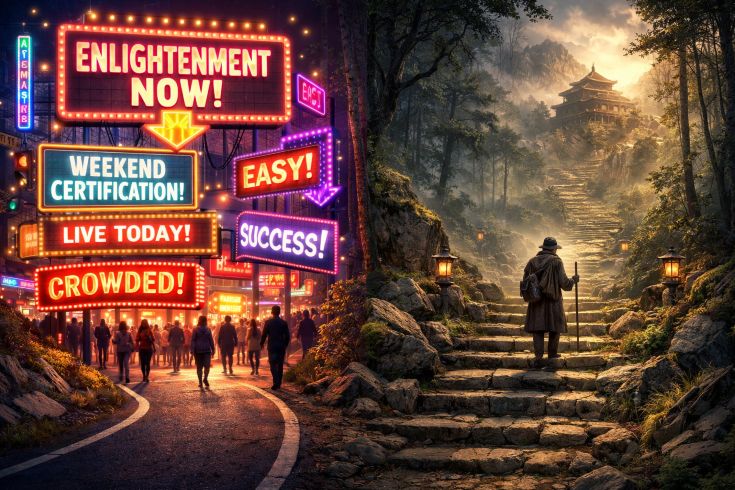
Not the energy itself. The problem is how it is taught.
Let’s break it down:
Problem No. 1: Weekend certification
Today you can get a “Kundalini yoga instructor certificate” through a 200-hour course. Sometimes online.
Compare that to the traditional approach:
“The supreme subtle Kundalini, the central goddess whose nature is consciousness, must be awakened… by yogis who have learned \[how to do it\] from the mouth of a true guru.” — Siddha-siddhānta-paddhati, ~1700
In tradition, training took years. The student lived with the master. The practice was prescribed individually, taking the person’s specific characteristics into account. No group classes for everyone indiscriminately.
Problem No. 2: No paramparā
Paramparā is a Sanskrit word meaning a lineage of knowledge transmission from teacher to student across generations.
It’s not “tradition for tradition’s sake.” Paramparā is a quality-control system. Knowledge is passed only to someone ready to receive it. The teacher is responsible for the student. The methods have been tested for centuries.
“Paramparā is knowledge transmitted from guru to śiṣya, from teacher to student, through generations. It is the heart of any lineage of succession.”
Modern Kundalini yoga is cut off from paramparā. Yogi Bhajan did not receive transmission in any recognized lineage. He created his system himself.
Problem No. 3: A mass approach to an individual practice
In a class of 30 people, it’s impossible to account for:
- each person’s mental state;
- trauma history;
- physiological differences;
- readiness for certain practices.
Everyone is given the same kriyas: “Do Breath of Fire for 11 minutes.” For some, that’s fine. For others, it’s a ticket to psychiatry.
Part 6: Our Position as Experts

We’re often asked: “So is Kundalini yoga bad or good?”
Our answer: it’s like asking “Is electricity good or bad?”
Electricity can light up a home—or kill a person. It all depends on how you handle it.
What we believe:
- Kundalini is a real phenomenon. It’s not made up and not a placebo. A millennia-old tradition and modern neuroscience confirm: intense practices really do change the functioning of the nervous system and the brain.
- Popular Kundalini yoga is a “demo version” with bugs. What’s taught in most studios is a simplified, commercialized version disconnected from the context and the protective mechanisms of tradition.
- The issue isn’t the practice—the issue is the system. When powerful techniques are given en masse, without an individualized approach, without qualified mentorship, without understanding contraindications, it’s a recipe for disaster.
- Most people will be fine—but not everyone. Yes, many practice Kundalini for years without problems. But some suffer serious harm. And it’s impossible to know in advance which group you’ll end up in.
Part 7: Who Should Definitely Be Careful?
Based on scientific data, we recommend avoiding intense Kundalini practices—or practicing only under strict supervision by a specialist—if you have:
- a history of psychotic episodes or schizophrenia;
- bipolar disorder;
- severe depression or anxiety;
- a history of panic attacks;
- a tendency toward dissociation;
- recent serious trauma (physical or psychological);
- use of psychoactive substances.
This isn’t discrimination. It’s care for your safety.
Part 8: The Solution—Find a Real Master
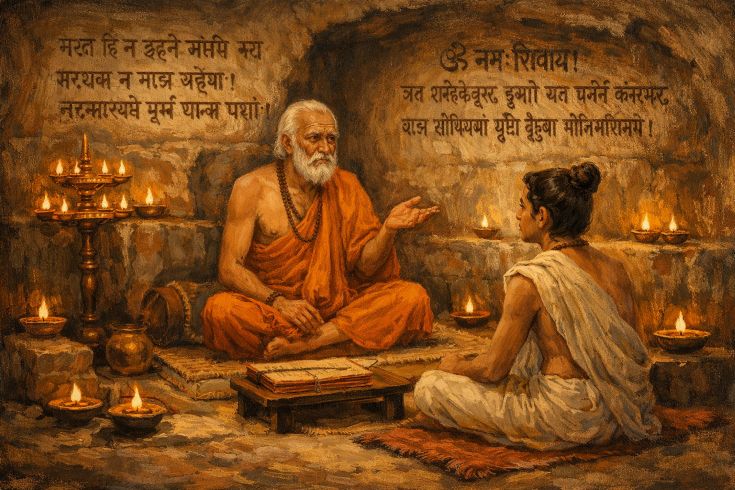
If, after everything you’ve read, you still want to explore energy practices (and we understand that desire), here are our recommendations:
Look for paramparā
A true tradition has a traceable lineage of transmission. Ask the teacher:
- Who did you study with?
- Which lineage do you belong to?
- Who is your teacher? And their teacher?
If the answers are vague (“I studied with different masters,” “it’s a synthesis of traditions”), that’s a red flag.
Look for a master, not an instructor
The difference is enormous:
| Instructor | Master |
| Completed a course | Decades of practice |
| Gives the same exercises to everyone | Sees each person’s individuality |
| Follows a program | Senses what the student needs |
| Builds groups | Limits the circle of students |
| Promotes “fast results” | Speaks of patience and gradual progress |
Red flags—run!
- Promises of a “quick awakening.”
- Pressure (“you need to go through this”).
- A cult-like atmosphere (leader worship, “we’re special”).
- Ignoring your symptoms or doubts.
- No questions about your health before practice.
Green flags—you might be lucky
- The teacher asks about your physical and mental health.
- They talk about contraindications.
- They don’t rush you.
- They’re willing to say no if you’re not ready.
- They have a clear lineage of succession.
Conclusion: Our Main Message
Friends, we wrote this article not to scare you. And not to forbid you from exploring.
We wrote it because you deserve the truth.
The truth that “Kundalini yoga” in modern studios is not an ancient tradition, but a commercial product. That its founder is a controversial figure. That the risks are real and documented. That a “certified instructor” is not a guarantee of safety.
But also the truth that real work with energy exists. That for thousands of years, masters passed this knowledge from generation to generation. And that with the right approach—with a true teacher, in the right sequence, with respect for your body and psyche—these practices can be transformative.
Enlightenment is not a commodity you can buy with a studio membership.
It’s a path. Long. One that requires patience, honesty with yourself, and—necessarily—a wise guide.
We wish you to find yours.
This article is based on an analysis of scientific publications (PubMed, neurophysiological research), Sanskrit sources, historical documents, and testimonies of practitioners.
Ready to try the real thing?
If you’re looking for a safe path to awakening inner energy with experienced mentors, we invite you to our yoga retreat in Bali “Kundalini Power.”
We understand: after everything you’ve read, a question may arise—“So how do you practice correctly, then?”
That’s exactly why we created this retreat. There are no mass classes “where everyone does the same thing.” There is an individualized approach, experienced mentors, and time-tested practices—in one of the most energetically powerful places on the planet.
What awaits you:
- Hatha yoga — a classical foundation, adapted to your level and your body’s specific needs
- Pranayama — breathing techniques to connect the physical body with inner energy
- Yoga nidra — a deep dive into the subconscious that can replace 4 hours of sleep
- Yin yoga — a slow journey inward through working with the body
- Daily meditations — including in Bali’s sacred places with special energy
- Nail standing — activation of the root chakra and awakening kundalini through the body
- Sound therapy — gongs and Tibetan singing bowls for harmonization and replenishment of strength
- Mantra chanting — cleansing energies and removing inner blocks
- Aromatherapy and aroma diagnostics — selecting supportive scents for your personal goals
Bali is not a random choice. It’s an island where spirituality is woven into daily life. Where temples breathe with thousand-year-old wisdom. Where nature itself helps you open up.
This is not “Kundalini yoga from the studio around the corner.” This is careful, conscious work with energy—in the right sequence, with respect for your body and psyche, under the guidance of those who know how to lead you safely.
You deserve a real experience. Not a commercial product—but transformation.