Introduction
In the Vedic tradition, the Moon is called Chandra—“the shining one.” Of all celestial bodies, it is the closest to the human experience. The Sun gives us vital force, but the Moon governs the mind, emotions, and the way we feel day by day. Jyotish places enormous emphasis on the Moon: Chandra’s position at birth determines your nakshatra, your lunar sign, and, in many ways, shapes your inner nature.
Each year, the Moon grants us twelve full moons—one for every month. But 2026 is special. It contains thirteen full moons, and some of them will be unforgettable.
Just consider: the year begins with a supermoon, when the Moon comes so close to Earth that it appears huge and astonishingly bright. In March, we’ll have a total lunar eclipse—the last one until the end of 2028. In May, a rare Blue Moon will rise, the first since August 2024. And in August, something especially striking will happen: a partial eclipse will cover 96% of the lunar disk, leaving only a thin glowing crescent.
But the main event comes at the very end. On December 24, Christmas Eve, a supermoon will rise over the world—one we haven’t seen in nineteen years. The Moon will approach Earth at its minimum distance, and its light will flood the holiday night like it hasn’t since 2007.
Thirteen full moons. Three supermoons. Two eclipses. One Blue Moon. It will be a packed year.
But before we walk through each one, let’s address a question I’m asked all the time.
Why do full moons have such strange names?
Wolf, Sturgeon, Beaver… where did all of this come from?
The answer takes us back several centuries, into the forests of North America. The Algonquin tribes—a vast group of peoples who lived from the Atlantic coast to the Rocky Mountains—didn’t use our calendar. They didn’t need month numbers. Instead, they gave each full moon a name that captured the main event of that time of year.
They heard January’s full moon—wolves howled louder than usual, approaching villages in search of food. They caught August’s full moon in their nets—giant sturgeon from the Great Lakes rose closer to the surface, and it was the best time for fishing. November’s full moon was a reminder: set beaver traps before the swamps freeze.
It was a living calendar—not dates in a planner, but nature’s signals.
Interestingly, India had an almost identical tradition. The Vedic calendar is built on lunar months, and each month carries the name of the nakshatra (lunar constellation) in which the full moon occurs: Chaitra, Vaishakha, Jyeshtha… These names have been used for thousands of years and still determine the dates of Hindu festivals. Two cultures on opposite ends of the world arrived at the same solution: give the Moon names to better feel time.
When European colonists came to America, they adopted Indigenous moon names and blended them with their own—Celtic and Old English. That’s how a tradition was born that has survived to this day. Now NASA publishes these names on its official website, and you and I can use them to feel the rhythm of the year a little more clearly.
Let’s go through all thirteen.
1. Wolf Moon — January 3
The year begins powerfully. The first full moon of 2026 is immediately a supermoon.
What does that mean? The Moon doesn’t orbit Earth in a perfect circle—it moves along an ellipse. Sometimes it’s closer to us, sometimes farther away. When a full moon coincides with the Moon’s closest approach, we see a supermoon—the Moon appears larger and brighter than usual by about 14%.
The name “Wolf” didn’t come from Indigenous peoples but from European colonists. On January nights, when hunger drove wolf packs closer to human settlements, their howls carried especially far through snow-covered forests. That sound became the symbol of the year’s first full moon—lonely, hungry, yet beautiful in its own way.
Jyotish perspective. In the Vedic tradition, the full moon is Purnima, the day of Chandra’s maximum power. The mind is clear, emotions are close to the surface, and intuition is sharpened. January’s Purnima is good for sankalpa—a conscious intention for the year. Not a list of goals, but one deep request to the Universe. Formulate it clearly, say it out loud under the full Moon. Chandra will hear you.
2. Snow Moon — February 1
February in the Northern Hemisphere is the peak of winter: the heaviest snowfalls, the hardest frosts. The Algonquins called this full moon not only the Snow Moon, but also the Hunger Moon—supplies were running low, hunting was nearly impossible, and spring was still far away.
This 2026 full moon comes without any special astronomical events—an ordinary full Moon in the heart of winter. But “ordinary” doesn’t mean “insignificant.”
Jyotish perspective. In February 2026, the full moon falls in a period when patience becomes the main virtue. Chandra teaches us to accept cycles—after the full moon comes waning; after winter comes spring. If this is a “hungry” time in your life, don’t panic. It’s part of the cycle. Conserve your strength.
3. Worm Moon — March 3 (Total Lunar Eclipse)
The name doesn’t sound very poetic, but it reflects an important observation. In March, the ground begins to thaw, and the first traces of earthworms appear on the surface—those winding tracks in melting snow. For Northern tribes, it wasn’t worms but beetle larvae emerging from under tree bark. Either way, the meaning is the same: the earth is waking up.
But in 2026, the Worm Moon has something more important than its name: it will be a total lunar eclipse—the last one until the end of 2028.
The mechanics are simple: Earth will stand exactly between the Sun and the Moon, and our shadow will cover the lunar disk. The total phase will last 58 minutes, and throughout that time the Moon will be tinted a deep copper-red. This is the famous “blood moon”—light passes through Earth’s atmosphere, scatters, and only the red rays reach the Moon.
This eclipse will be visible to residents of the western part of North America, Australia, New Zealand, and East Asia. Europe, unfortunately, won’t be so lucky.
Jyotish perspective. In Vedic astrology, eclipses are grahana, a time when the shadow planets Rahu and Ketu “swallow” the luminaries. It isn’t a curse, but it isn’t an ordinary day either. Ancient texts recommend refraining from major beginnings on the day of an eclipse and dedicating time to spiritual practice—meditation, mantras, contemplation. Especially powerful is Chandra’s mantra: “Om Chandraya Namaha.” An eclipse is a portal: subtle influence is amplified. Use it for inner work, and postpone external decisions for a week.
4. Pink Moon — April 1
No, the Moon won’t turn pink. The name comes from a flower—the moss phlox—which is among the first to cover North American hills with pink carpets. April is the time when spring finally wins..
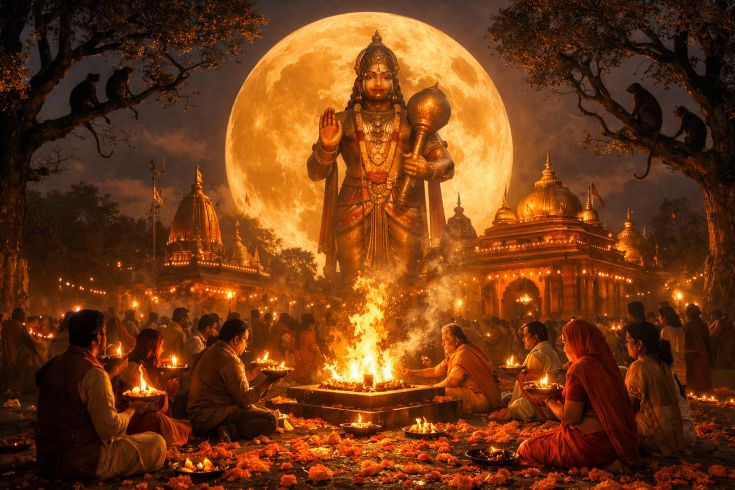
Jyotish perspective. April’s full moon often coincides with important Vedic festivals—times when nature and the cosmos synchronize. A good moment to review the first quarter of the year: three months behind you, nine ahead. Look at your January sankalpa—does it still resonate? Or has life revealed something new?
5. Flower Moon — May 1
May is an explosion of bloom. Everything that stored strength under snow and in March mud now opens. The name speaks for itself—no mystery here. Just May, just flowers, just life in full force.
Jyotish perspective. In the Vedic tradition, this time is tied to the energy of Venus—Shukra, the planet of beauty, love, and creativity. Blooming is Shukra manifested in nature. If you’re working on a creative project or want more beauty in your life, May’s Purnima is favorable. Go outside, surround yourself with flowers, and let beauty nourish you.
6. Blue Moon — May 31
Here’s a rare guest. A Blue Moon is the second full moon in a single calendar month. In May 2026 there will be two: the first on May 1 (the Flower Moon), and the second on May 31 (the Blue Moon). Because it’s uncommon, we get the English expression “once in a blue moon”—something that happens rarely.
The last Blue Moon was in August 2024. The next after May 2026 won’t be until late 2028 or early 2029.
One more interesting detail: May’s Blue Moon will be a micromoon. This is the opposite of a supermoon—the Moon is at the farthest point in its orbit, so it will look slightly smaller than usual. A funny contrast with January’s supermoon.
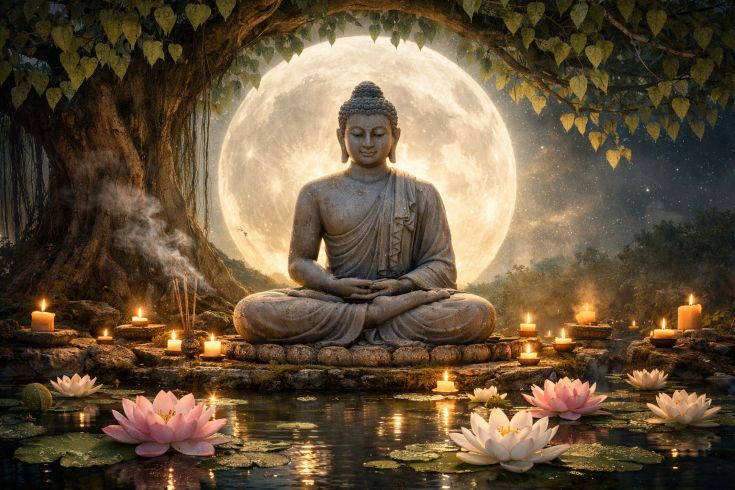
Jyotish perspective. Two Purnimas in one month are like two full breaths instead of one. May’s second Moon offers a chance to complete what you didn’t finish at the first. In Jyotish, this can be seen as an “extra window of karma.” If you started something in early May but didn’t bring it to completion—here is your second chance. Use it consciously.
7. Strawberry Moon — June 29
For the Algonquins, June meant one thing: it was time to gather wild strawberries. The season is short, the berries are delicate—there’s no time to wait. The full moon reminded everyone who might forget.
This is the first full moon of summer and the third micromoon in a row—the Moon is still far from Earth.
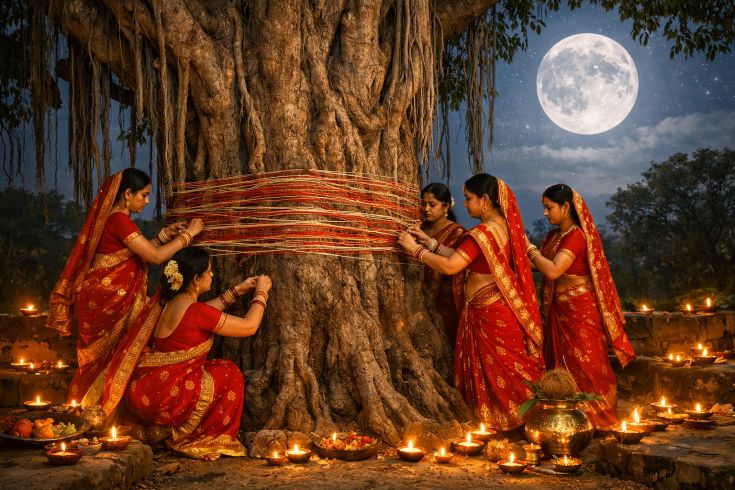
Jyotish perspective. The Strawberry Moon points to the concept of muhurta—an auspicious moment. In Jyotish we know: not all moments are equal. There is a time to sow and a time to harvest; a time to wait and a time to act. Strawberries won’t wait until you “get ready.” Ask yourself: what in my life is like that berry right now—what has ripened and demands immediate attention?
8. Buck Moon — July 29
“Buck” in English means a male deer. In July, deer begin to grow new antlers: covered in soft velvet-like skin, they reach full size within weeks. Hunters knew this cycle and used it as a marker of midsummer.
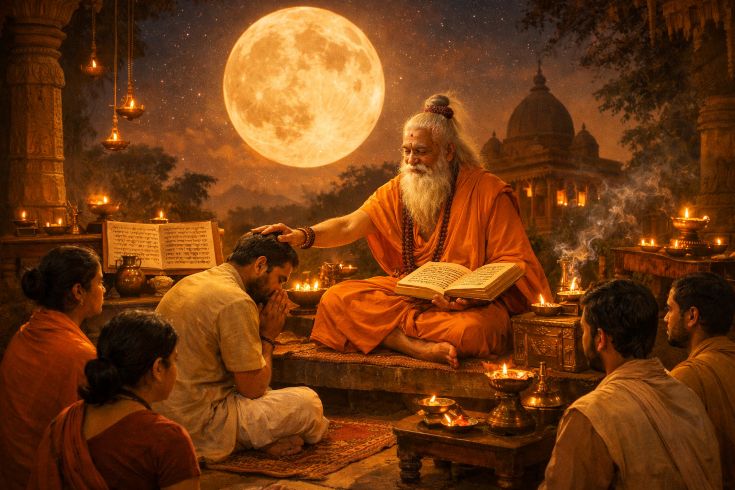
Jyotish perspective. July is the year’s equator: six months behind you, six ahead. In Vedic astrology, we work with dashas—planetary periods that unfold gradually, layer by layer. Deer antlers grow the same way: not in a leap, not overnight, but day after day. This is a good time for a dasha analysis: which period are you living through now? Which planet is leading you? Understanding your dasha brings patience and clarity.
9. Sturgeon Moon — August 28 (Partial Lunar Eclipse)
One of the most unusual names in the calendar. Tribes living near the Great Lakes and Lake Champlain knew: August is the best time to catch lake sturgeon. These ancient fish—136 million years old, survivors from the age of dinosaurs—rose closer to the surface in August. Fishermen waited for this moment all year.
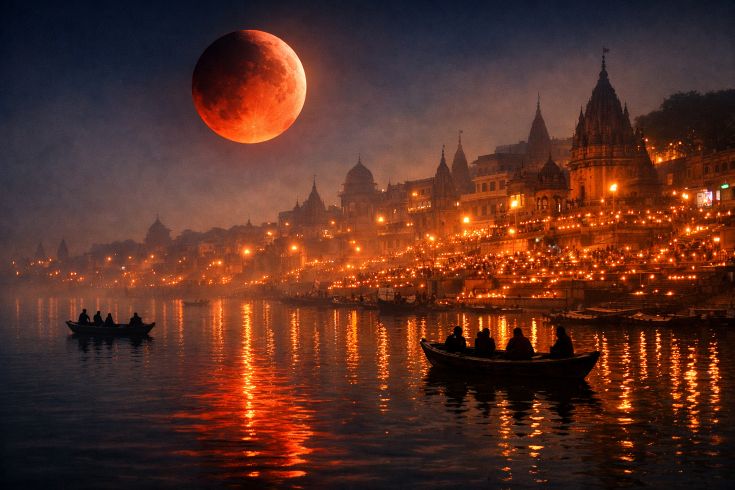
But in 2026, the Sturgeon Moon will be remembered not for fishing. That night will bring a deep partial lunar eclipse: 96% of the lunar disk will go into Earth’s shadow. It’s almost total—only a thin bright crescent will remain, while the rest of the Moon turns dark red.
This eclipse will be visible from both Americas, Europe, and Africa. For many of us, it will be the most accessible lunar eclipse of the year.
Jyotish perspective. The second eclipse of the year—again grahana, a time of shadows. Rahu and Ketu make themselves known. In Jyotish, these shadow points are tied to past-life karma and the lessons we came here to learn. August’s eclipse is a good time to ask: what lesson can I not seem to master? What repeats in my life again and again? Rahu and Ketu point to these patterns. An eclipse makes them visible—if you’re willing to look.
10. Harvest Moon — September 26
The most famous name of all. The Harvest Moon is the full moon closest to the autumn equinox, and it has a feature that made it critically important for our ancestors.
Normally, the Moon rises about 50 minutes later each day. But near the autumn equinox, the gap shrinks to 20–25 minutes. The result: for several nights in a row, the Moon appears almost immediately after sunset, giving farmers extra light for work in the fields.
Before electricity, this was a matter of survival. The harvest had to be gathered before rains and frosts, and moonlight allowed people to work late. That’s where the name comes from.
In 2026, Saturn will shine near the Harvest Moon—a beautiful sight for anyone who looks up.
Jyotish perspective. Saturn—Shani—near the full Moon is a powerful combination. Shani is the planet of karma, discipline, and time. He asks: what have you done? Not what you planned, not what you dreamed—what have you actually done this year? The Harvest Moon under Shani’s gaze is the perfect time for an honest assessment. Not judgment, not self-punishment—just a clear look. The harvest is what it is: no more, no less. Accept it with gratitude.
11. Hunter’s Moon — October 26
A logical continuation of the Harvest Moon. Fields are cleared, the ground is bare—and game is easier to spot from a distance. Deer, foxes, and rabbits come out to the stubble in search of leftover grain. Hunters used bright moonlight to track prey at night and prepare meat for winter.
Jyotish perspective. October is Mars time—Mangala. The hunter’s energy is focus, precision, decisiveness. In Jyotish, Mangala governs our ability to act, overcome obstacles, and achieve goals. What is your main goal for the remaining months of the year? Not three, not five—one. Mangala doesn’t scatter. He chooses a target and goes for it. Be like him.
12. Beaver Moon — November 24 (Supermoon)
November is when both people and animals prepare for winter. Beavers finish their dams and store branches at the bottom of ponds. Hunters and trappers knew: you must set traps before the swamps freeze. Beaver fur was a survival currency—warm, waterproof, and valuable.
This 2026 full moon is the second supermoon. The Moon will again come close to Earth, appearing bright and large.
Jyotish perspective. In the Vedic way of thinking, the beaver is an ideal image of Saturn at his best. Shani is often seen as a “bad” planet, but that’s incorrect. Shani is the wisdom of preparation—the understanding that winter will come and you must be ready. Beavers don’t wait for frost to start building. What do you need to “insulate” in your life before year’s end? November’s Purnima is the last gentle light before winter. Use it well.
13. Cold Moon — December 24
(Supermoon — the largest in 19 years!) And here we are at the main event of the lunar year.
On December 24, 2026, Christmas Eve, a supermoon will rise over the world unlike anything since 2007. The Moon will come within about 356,740 kilometers of Earth—the minimum distance in the past 19 years. It will appear enormous: roughly 14% larger and 30% brighter than an average full moon.
Such a close approach happens about once every 19 years—the next one won’t come until the mid-2040s.
The name “Cold” needs no explanation. December is the start of true winter: the longest nights, the shortest day. The Moon will reign in the sky for longer than at any other time of year.
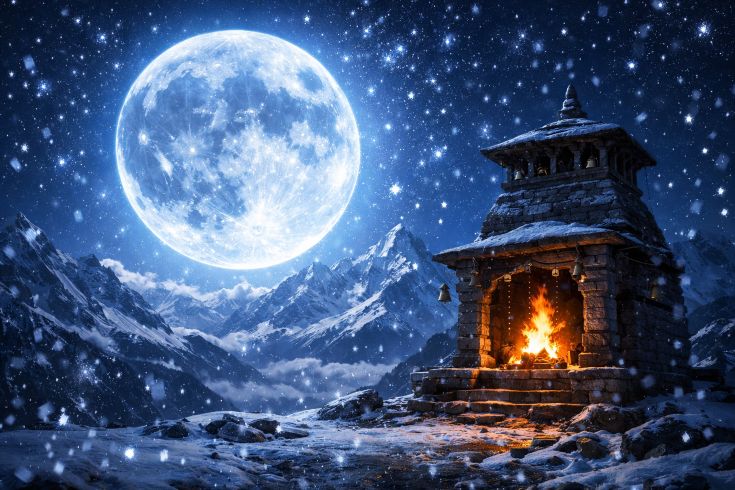
Jyotish perspective. In the Vedic tradition, Chandra is not merely a celestial body. It is a deity governing the mind (manas), the mother, care, nourishment, and emotions. When Chandra comes so close to Earth, his influence intensifies many times over. Emotions will be right at the surface. The connection to the mother (living or departed) will become more tangible. Memories will rise on their own.
I can’t recall a lunar event with a more symbolic date. Christmas Eve, the eve of Christmas—when millions gather with loved ones—and above it all hangs the brightest Moon in two decades. Chandra quite literally illuminates the themes of family, roots, and belonging.
Go outside that night. Step away from the festive table for five minutes. Look up. Say a mantra—even a simple “Om Chandraya Namaha.” Give thanks for the year. Say goodbye to what is leaving. Invite what is to come.
Thirteen full moons—thirteen chances to pause and remember that we live on a small planet spinning through space around a star. And that beside us spins the Moon, which was here long before us and will be here for a very, very long time.
Conclusion
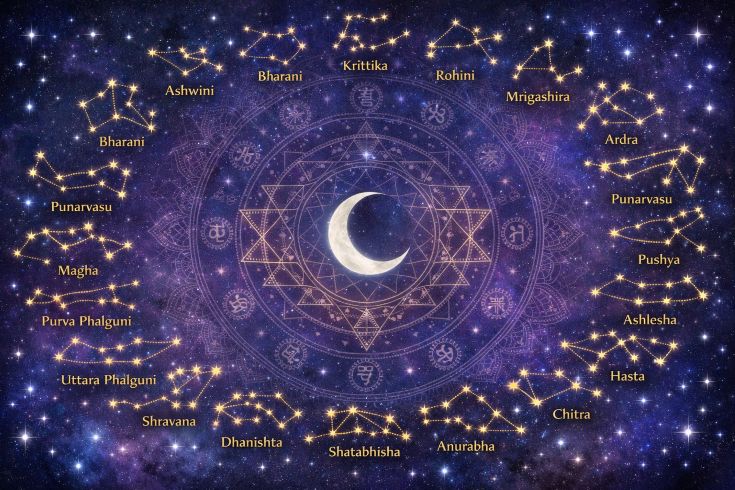
When I began studying Jyotish many years ago, I was struck by the importance Vedic sages gave to the Moon. In Western astrology, the Sun dominates—sun signs, solar horoscopes. In Jyotish, everything begins with Chandra. Your nakshatra—your birth lunar constellation—is the key to understanding your deepest nature. Not the mask you wear for the world, but who you truly are when you’re alone with yourself.
The Algonquins, living thousands of kilometers from India, arrived at a similar understanding. They named full moons not for beauty, but as a way to live in rhythm with nature—to notice its signals and belong to something larger. We may laugh at the Worm Moon or be surprised by the Sturgeon Moon, but behind these names are generations of observation, practical wisdom, and a living connection to the world.
You don’t need complex rituals to work with lunar cycles. Thirteen times a year, one simple thing is enough: pause and look up. See the full Moon. Remember its name. Say a mantra if you want. Think about what is happening in your life right now.
That’s it. That is already a practice. That is Jyotish in action.
If you want to go deeper—welcome to my website, where there is a detailed Vedic lunar calendar with nakshatras, tithis, and muhurtas for every day. But you can begin right now, with these thirteen names and one simple mantra: “Om Chandraya Namaha.”
May Chandra light your path in 2026.
Table: Full Moons of 2026
| Date | Name | Note |
| January 3 | Wolf | Supermoon |
| February 1 | Snow | — |
| March 3 | Worm | Total lunar eclipse |
| April 1 | Pink | — |
| May 1 | Flower | — |
| May 31 | Blue | Rare + micromoon |
| June 29 | Strawberry | Micromoon |
| July 29 | Buck | Micromoon |
| August 28 | Sturgeon | Partial eclipse (96%) |
| September 26 | Harvest | Near Saturn |
| October 26 | Hunter’s | — |
| November 24 | Beaver | Supermoon |
| December 24 | Cold | Supermoon — largest in 19 years! |