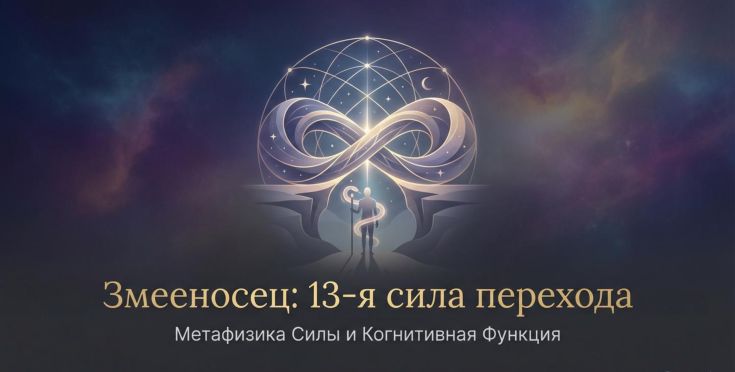
Have you ever heard of the “13th zodiac sign”? You know, that same mysterious Ophiuchus, because of whom the internet periodically starts panicking: “That’s it, now I’m not a Sagittarius, but an Ophiuchus!”
In fact, everything is more interesting and profound than it seems. Ophiuchus isn’t just an “extra” sign that astrologers supposedly “forgot” to add. It’s the key to understanding how we navigate life’s most challenging moments and emerge from them as new people.
Let’s figure out what kind of animal this is and how its energy works in real life.
What does astronomy say?
Let’s start with the facts. Astronomically, Ophiuchus is a real, large constellation located between Scorpius and Sagittarius. And yes, the Sun actually passes through it every year from approximately November 30th to December 17th.
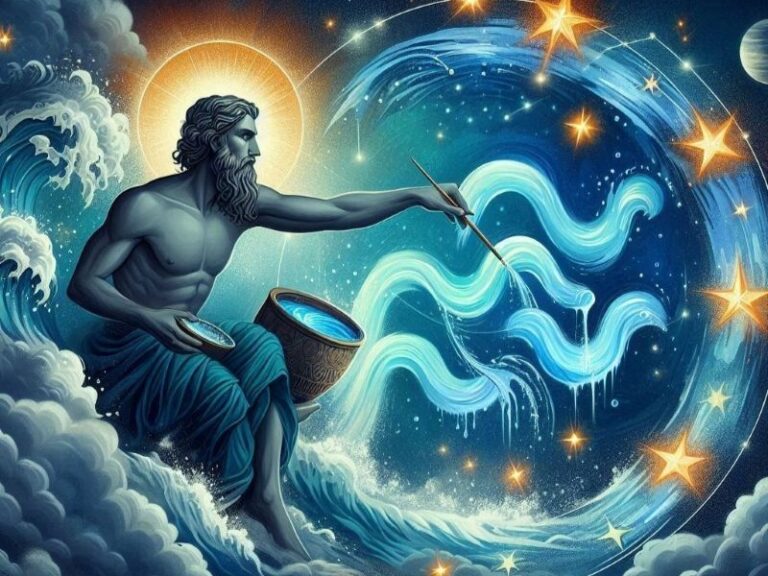
Imagine the picture: A man is depicted in the sky holding a huge snake, dividing it in half—the “Head of the Serpent” and the “Tail of the Serpent.” Ophiuchus himself appears to be standing on Scorpio, as if suppressing or transforming its poisonous power.
A beautiful metaphor, isn’t it? But what does it mean for us?
Ancient Wisdom: A Vedic Astrology Perspective
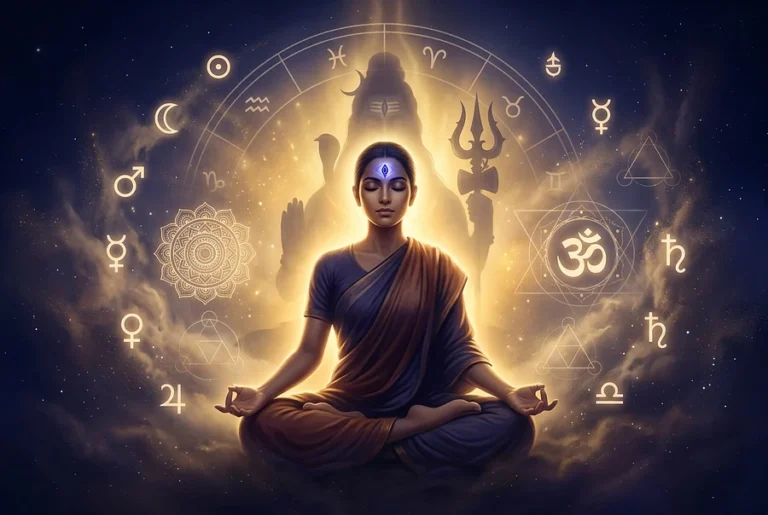
I have been studying Vedic astrology for many years and I can say for sure:If you move away from the superficial horoscopes in magazines and immerse yourself in real Jyotish, supplementing it with knowledge of modern psychology, Ophiuchus reveals himself in a completely different way. Exciting and practical.
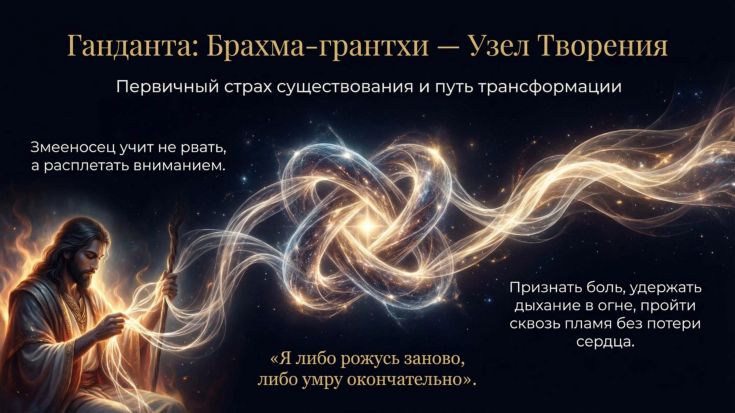
There is no “13th sign” in Jyotish, but there is a system of constellation— these are 27 lunar mansions, which describe the sky much more precisely and subtly than the 12 zodiac signs we are accustomed to. And here’s the interesting thing: the section of the sky where Ophiuchus (the transition from Scorpio to Sagittarius) is located has a special name — Gandanta.
Try to pronounce: Gan-dan-ta. Sounds mysterious? It translates as “karmic knot” or “spiritual knot.” And it truly is the most powerful and dangerous point in the entire zodiac.
Why is this place so special?
Imagine: the element of Water (Scorpio) shifts to the element of Fire (Sagittarius). What happens when Water meets Fire? Water extinguishes Fire, Fire evaporates Water. The result is steam, fog, uncertainty. Everything is shaky, nothing is clear. This is exactly how we feel at turning points in life.
Two key nakshatras are the two faces of Ophiuchus
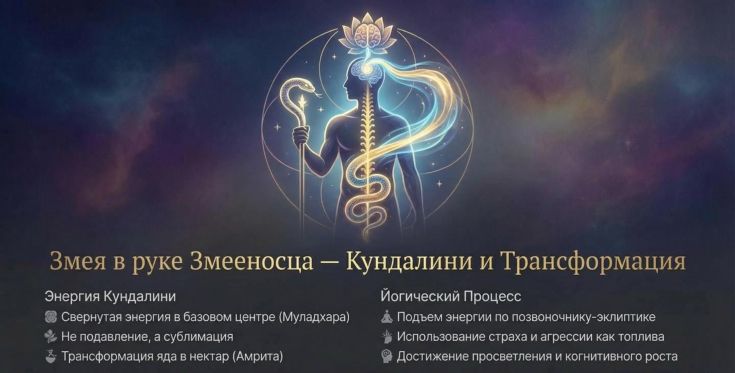
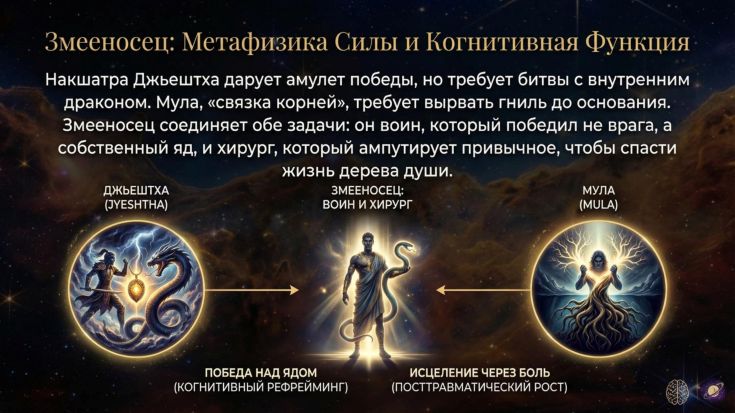
Jyeshtha — these are the last degrees of Scorpio. Its symbol is a protective amulet or an earring, and it is ruled by Indra, the king of the gods. This is a story about the struggle for power, about victory over inner chaos (the dragon Vritra, as the Vedas say). Here, Ophiuchus is a warrior who conquers his baser instincts for the sake of a higher goal.
If you are currently going through a period of transformation and feel the need for protection, pay attention to selection of a personal amulet — a properly chosen talisman becomes a real support on the path to change.
Mullah— the first degrees of Sagittarius. Its symbol is a bundle of roots. Yes, real roots! And it is ruled by Ketu, the planet of liberation and cutting off excess. The deity of this nakshatra is Nirriti, the goddess of destruction.
Sounds scary? Actually, Mula is the archetype of the surgeon. magine: to save a life, sometimes you have to inflict pain. Cut out a tumor. Pull out a rotten root to plant a new, healthy garden. It’s painful, it’s scary, but it’s the only way to heal.
Conclusion of the ancient sages: Ophiuchus is the place where the soul unties the tightest knot of its karma. The snake in the hands represents Kundalini energy, the very life force that lies dormant at the base of the spine. Ophiuchus is a yogi who has been able to raise this powerful energy from the lower centers (animal instincts) to the higher ones (wisdom and spirituality) without being burned in the process.
Do you want to understand how exactly the energy of Gandanta and the Ophiuchus archetype manifest in your natal chart? My personal astrological consultation will help you see your unique transformation nodes and find the keys to working on them.
What does modern psychology say?
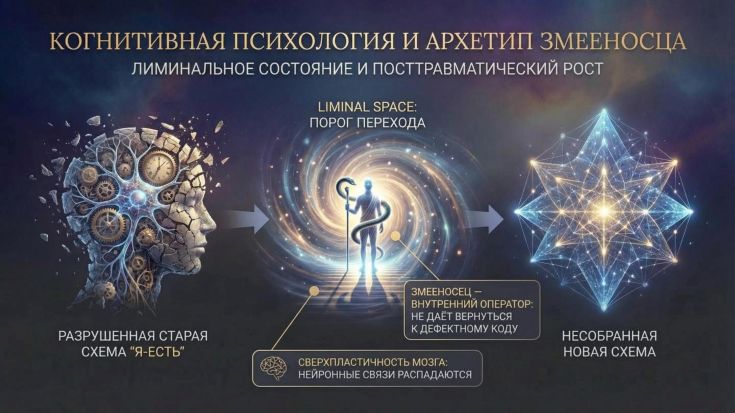
Now let’s translate all this beautiful Eastern philosophy into the language of brain and psyche science. It turns out that Ophiuchus perfectly describes the processes that psychologists call liminality(from the Latin limen – “threshold”) and post-traumatic growth.
Liminality is being stuck between floors of the elevator of life
Have you ever felt stuck between the past and the future? Your old life has ended (perhaps due to divorce, job loss, or relocation), but your new life hasn’t begun yet? That’s the liminal state—”neither here nor there.”
It’s incredibly uncomfortable. The old identity (“I’m a successful manager,” “I’m a loving wife”) is shattered, and the new one hasn’t yet formed. But here’s the amazing thing: it’s at this moment that our brain is at its most neuroplasticity – the ability to change.
In moments of life’s catastrophes, the brain switches off autopilot. Old neural connections (habits, beliefs, behavior patterns) are disrupted. And Ophiuchus is the inner operator who helps us forge new paths in this chaos.
Shadow Integration – Making Friends with Your Inner Monster
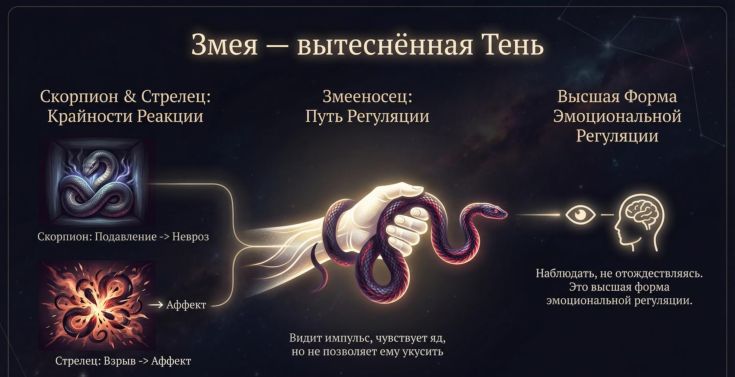
In psychology (especially in the approach of Carl Jung) there is a concept of shadow — these are all our repressed, unpleasant parts of our personality. Anger, envy, fears, aggression, “shameful” desires. Everything that we hide even from ourselves.
We usually react to the Shadow in two ways:
- we suppress her with all her might (hello, neuroses and psychosomatics);
- let her take overuse (and now we are yelling at our loved ones or doing things that we later regret).
And Ophiuchus? He’s holding a snake. He doesn’t kill it, but he doesn’t let it bite him either. It’s the perfect metaphor. Emotional regulation— the ability to acknowledge one’s “toxic” emotions but manage them. Feel anger, but channel its energy into action, not destruction.
It’s like taming a wild animal: it’s still strong and dangerous, but now it works for you, not against you.
The Wounded Healer – Turning Pain into Strength
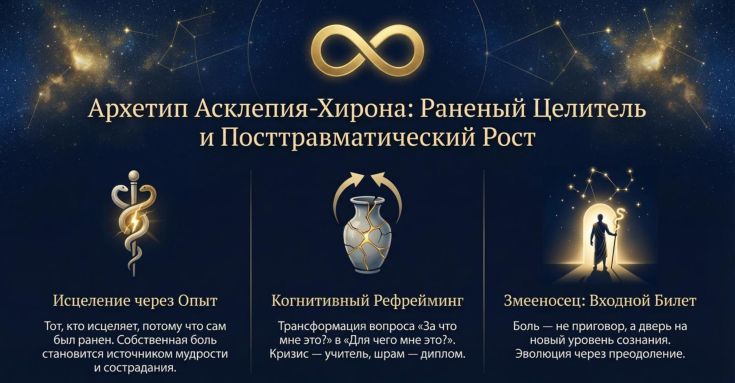
Ophiuchus is often associated with the image of Asclepius (the god of medicine) and Chiron (the wise centaur-healer). Both of them wounded healers: those who heal others precisely because they themselves have gone through pain.
In psychology, it’s called post-traumatic growth to imagine someone who survived a serious illness and now helps others with the disease. Or someone who went through a divorce and became a relationship counselor. They turned their trauma into a resource.
The key point is that such a person stops asking, “For what is this for me?” (victim position) and starts asking, “Why do I need this?” (the position of the student and the master). This is the highest form of what psychologists call cognitive reframing– a change in point of view on the situation.
What to do with this in real life?
This all sounds great in theory, but how can it be put into practice? Here are some concrete tools.
1. Dealing with crises – don’t glue a broken cup
When everything falls apart, the first impulse is to try to return to “the way things were.” To mend a broken relationship. To revive a dying business. But Ophiuchus says: stop.
Vedic advice:Let the old die. Ketu (ruler of the Mula nakshatra) is the planet of cutting off. It cuts away what is no longer viable.
Psychological advice:Embrace the state of uncertainty. Yes, it’s scary. But it’s precisely in this fog between the old and the new that you have a chance to rebuild yourself in a different, better way.
Example from life:Lost your job? Don’t jump at the first opening that comes your way. Give yourself time to think: was this really the right job? Maybe this is a chance to change careers?
Many crises can be seen in advance and prepared for. Solar (astrological forecast for the year) will show you when the energies of transformation are activated in your life, and how best to use them for growth rather than destruction.
2. Resource Management – Tame Your Snake
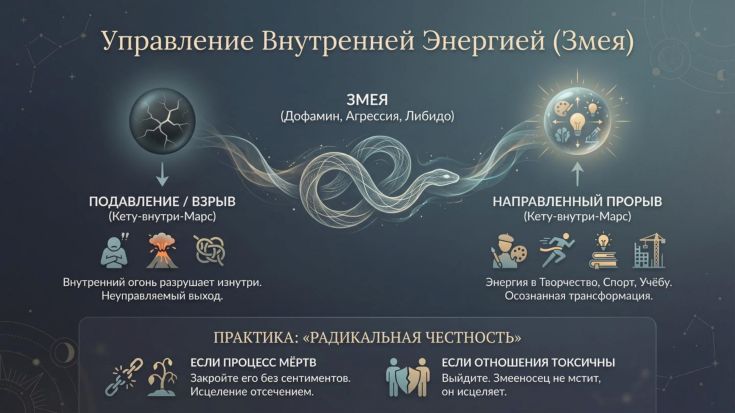
The snake in Ophiuchus’s hands represents your dopamine, your passions, your life force. Enormous energy that can both create and destroy.
Task: direct this energy in the right direction.
- Feeling angry? Don’t lose your temper in public—go to the gym, take up boxing, or write an angry post (but don’t publish it, just let off some steam).
- Overflowing with sexual energy? Don’t waste it mindlessly—channel it into creativity, sports, and ambitious projects.
It’s called sublimation — the transformation of “low” energies into “high” achievements. This is how Leonardo da Vinci worked,Nikola Tesla, many geniuses.
3. Radical Honesty – No More Agony
The Mula (root) nakshatra demands getting to the heart of the matter. No half measures. No self-deception.
In business: Has the project failed to make a profit for the third year in a row? Shut it down. Don’t drag out the agony out of pity or stubbornness.
In a relationship: Is your partner toxic and unchanging? Get out. Don’t waste years on the illusion that “he’ll fix it now.”
In self-knowledge: Are you unhappy at your job/in your city/in your role? Admit it honestly. Ophiuchus does not tolerate self-deception.
Sounds harsh? Yes. But this is the kind of surgery that saves lives. Ophiuchus isn’t about pity for a rotten root; it’s about love for the new garden you can grow.
So, what is Ophiuchus?
Putting it all together, Ophiuchus isn’t an astrological oddity or a “forgotten 13th sign.” It’s a universal archetype of transformation through crisis. It’s an internal mechanism that activates in life’s darkest moments and allows us to:
- to stand on the edge of the abyss between the death of the old and the birth of the new;
- do not lose your mind in the fog of uncertainty;
- build a bridge to the other side – to a new, more conscious version of yourself.
This is the Shakti (power) of transformation. It is the ability to take hold of your inner snake—all your fears, passions, pain—and transform their poison into medicine.
Each of us at some point in our lives becomes an Ophiuchus. When the familiar world collapses. When the pain is so great that it seems impossible to survive. When we have to cut away the rotten to save the living.
And if you’re going through such a period right now, know this: it’s not the end. It’s the most powerful evolutionary mechanism there is. You’re not being destroyed. You’re being transformed.
Hold your snake tight! It will make you stronger.
Want to embark on this transformational journey mindfully, with guidance and a clear roadmap? Join my development program “My Successful Year”, where you’ll learn to create the reality you desire, unlock your potential, and discover the inner strength to achieve your true aspirations.