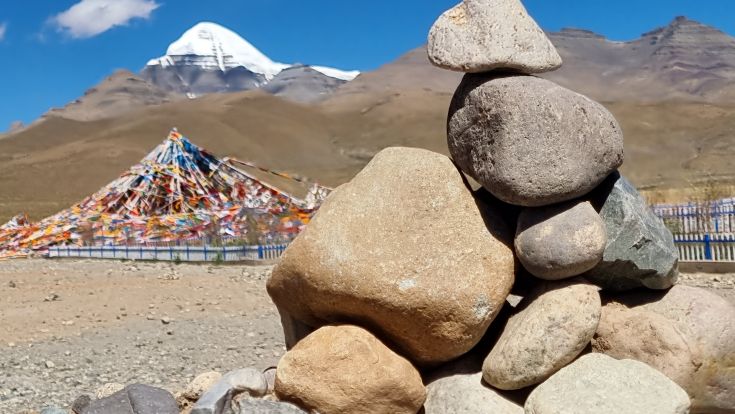
Yam Dwar — the Gate of Salvation, also known as the Gate of Death. Beyond this small stupa with a passage inside begins a 53-kilometer journey that will divide your life into “before” and “after”.
We’ve completed this sacred Kora many times, yet each circuit reveals new dimensions of the extraordinary experience awaiting anyone who dares to leave their old life behind and enter the sacred space of Kailash.
In 72 hours, you’ll live an entire lifetime in miniature. The first day brings an encounter with the unknown, the second — a confrontation with your own limits at otherworldly altitude, the third — a return home as a completely different person.
Kailash changes everyone — but each in their own way. Are you ready for what will transform you forever? Then pass through the Gate. But first, let me share what truly happens during the most mystical circumambulation on the planet.
Day One: Farewell to the Old Life
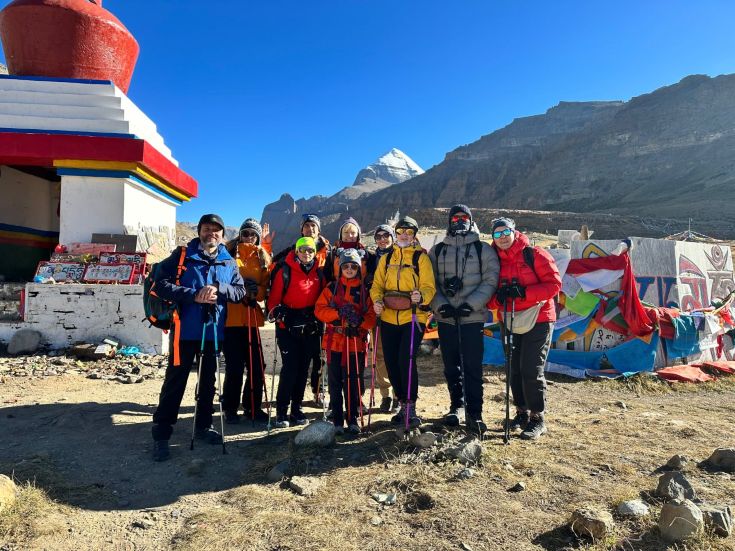
Yam Dwar greets everyone with solemnity and awe. Passing through this ancient stupa, we’ve felt goosebumps every single time — as if crossing an invisible boundary between the ordinary world and sacred space. Tibetans believe that here your past life stays behind, while ahead awaits a path of transformation.
Near the Gate spreads the Tarboche field with its giant prayer flagpole. This ancient pillar is a sacred beacon that gathers pilgrims from around the world for the main Saga Dawa festival. When you see it for the first time, you grasp the magnitude of what’s happening — you’re part of a millennia-old tradition connecting you with millions of souls who’ve walked this path.
The first kilometers are deceptive. The trail seems friendly, the air is still relatively thick, and you might fall for the illusion that this is just an ordinary mountain walk. But the energy of the place pulses beneath your feet. I remember my first time — I thought I was simply walking a trail, but I was already slipping into an altered state of consciousness.
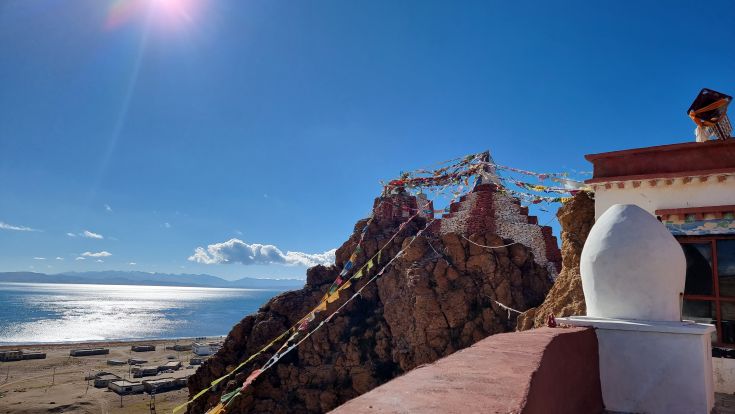
High on the cliff face, like an eagle’s nest, the Chuku Monastery clings to the sheer wall. Locals call it Nyenri, and the climb there is already a small pilgrimage within the greater one. The road winds in serpentines, and with each turn the world below grows smaller while the sky draws nearer.
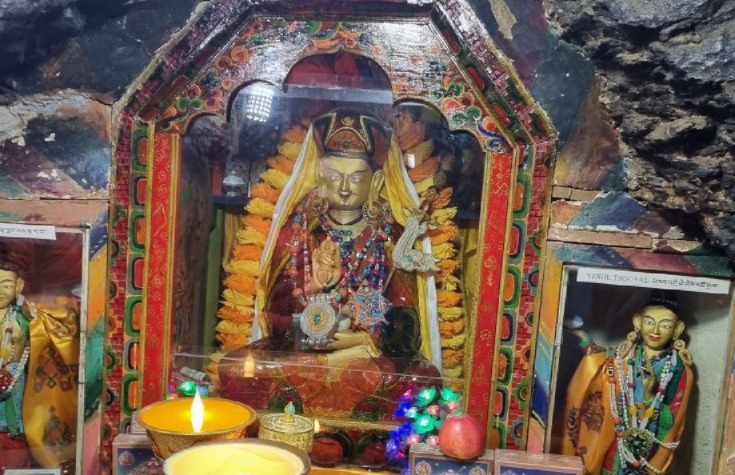
Inside this sky-high monastery are kept artifacts that locals revere as sacred. An ancient conch shell, a copper kettle, and a statue — each object shrouded in legends of miraculous healings and mystical visions. But the true treasure awaits outside — the first glimpse of Kailash’s Western Face literally takes your breath away.
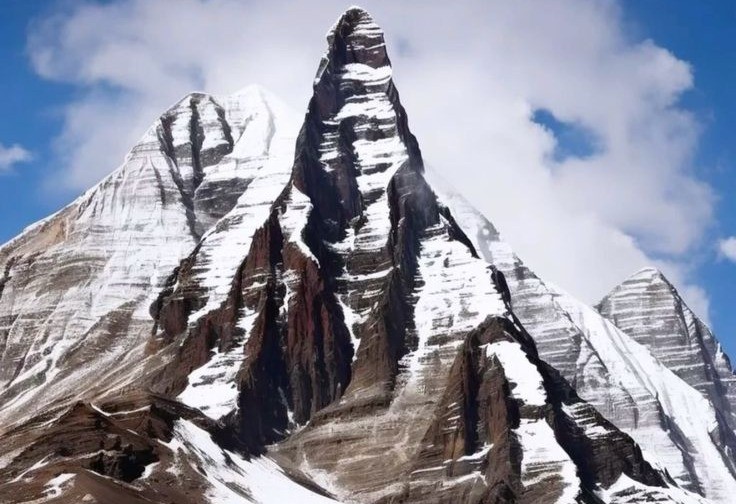
The four-sided pyramid rises from the earth with such geometric precision that doubts about its natural origin arise spontaneously. The faces are oriented strictly to the cardinal directions — this is no coincidence, but a message encoded in stone.
By sunset of the first day, we’d reach Dirapuk Monastery — the Cave of the Female Yak. The name translates literally: the cave where the yak cow led. Legend tells of Saint Gotsangpa, whom a female yak — an incarnation of the goddess — led to this sacred place for deep meditation.
The monastery’s location is staggering in its audacity — it’s built face-to-face with Kailash’s North Face. The sheer black-and-gold wall of the mountain soars directly before the windows, creating the sensation of living in a house across from the dwelling place of the Creator. The view from here is the most powerful on the entire Kora route.
Falling asleep in Dirapuk, you know: tomorrow awaits a day that will either break you or rebirth you. The pass at 5,630 meters forgives no weakness, but grants enlightenment to those ready to die symbolically in order to be born anew.
Day Two: Death and Rebirth at 5,630 Meters
The second day begins in pre-dawn darkness. A 4 AM start isn’t the guides’ whim but a vital necessity. Drolma-la Pass demands respect, and you must tackle it before the afternoon winds transform the ascent into a battle for survival.
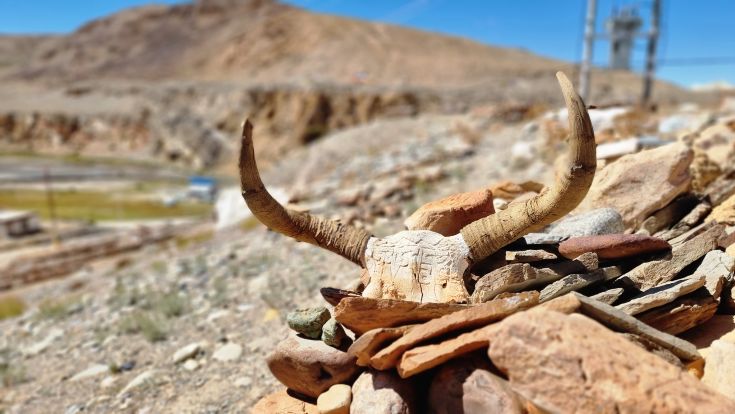
The trail leads through Shiva-Tsal plateau — the place with the darkest atmosphere on the entire route. “Cemetery of the 84 Mahasiddhas” — that’s what the name translates to, and the atmosphere lives up to it. Clothes are scattered everywhere — jackets, boots, hats. Strands of hair flutter in the wind, tied to stones.
The first time, this sight shocks you. It feels like you’ve stumbled upon a disaster site. But gradually you grasp the deeper meaning of what’s happening. Pilgrims leave here symbols of their past — a drop of blood, a lock of hair, a personal item. This is a ritual of symbolic death before rebirth at the pass.
After Shiva-Tsal, the real trial begins. The trail serpentines steeply upward, the air grows thinner and thinner, each step becomes harder. Above 5,000 meters, your body operates at its limit, and here your true strength of spirit reveals itself.
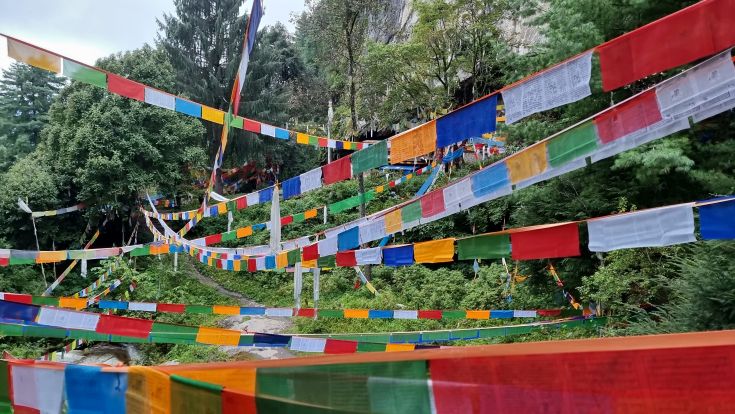
Drolma-la Pass at 5,630 meters is the culmination not only of the physical route but of the spiritual journey. The moment you reach the saddle and see thousands of colorful lung-ta prayer flags fluttering in the wind is one of the most thrilling of your life.
Tradition demands you shout here “Lha Gyalo!” — “The Gods are victorious!” And when you hear your voice echo from the surrounding peaks, you understand: you’ve passed through the symbolic gates of death and been born anew. The karma of your past life is cleansed, a new path lies ahead.
The descent from the pass offers another wonder — the emerald-green Lake Gauri Kund. Thukje Zingbu is what Tibetans call it, the “Lake of Compassion.” Hindu legend tells that in these very waters bathed Parvati, Shiva’s consort, and here she created Ganesha from soap foam and clay from her own body.
The lake mesmerizes with its unnaturally vivid color and perfectly circular form. Descending to the water is dangerous — the slopes are slippery and steep, but even the view from above leaves an indelible impression. This place seems crafted for meditation and gratitude for the journey of rebirth completed.
Day Three: Birth of Your New Self
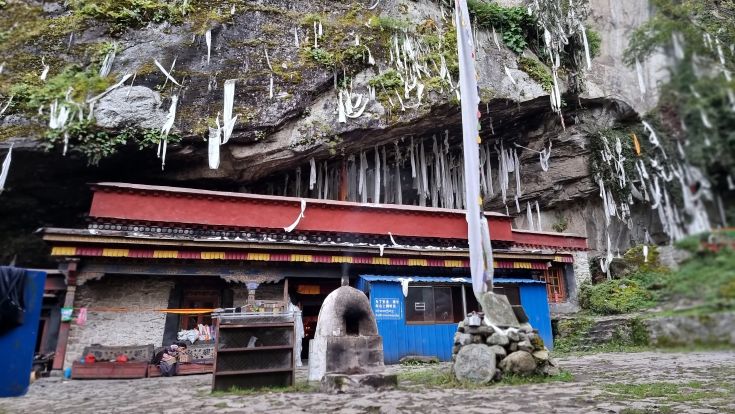
The third day begins at Zutulpuk Monastery — the Cave of Miracles. The name speaks for itself, and miracles are indeed everywhere here. The greatest among them — the handprints and head imprint of the great yogin Milarepa on the cave wall, nearly 900 years old.
Legend tells of an incredible contest between the Buddhist master Milarepa and the Bön priest Naro Bonchung. They competed not in physical strength but in magical powers. When torrential rain began, Milarepa literally parted the rock, expanding the cave for shelter. The imprints of his palms and crown of his head remained in the stone as testimony to this supernatural feat.
Touching these ancient imprints, you feel an ineffable connection with generations of masters who attained enlightenment in these sacred places. The stone beneath your fingers seems to radiate warmth — not physical, but something deeper, emanating from the very depths of time.
The morning of the third day brings a special feeling. You’re no longer the person who passed through Yam Dwar three days ago. Something fundamental has shifted inside — your gait is more confident, you’re breathing deeper, your gaze clearer. Many pilgrims note: the world around seems to have grown brighter, colors more saturated, sounds purer.
The trail of the third day gradually descends from high-altitude plateaus to the Barkha plain. The gorge widens, the mountains part, and before your eyes opens one of the most dramatic views of the entire route — the dark blue waters of Lake Rakshas Tal. The Lake of Demons — that’s what this ominous name translates to. Unlike the sacred freshwater Manasarovar, Rakshas Tal is saline and considered the dwelling place of dark forces.
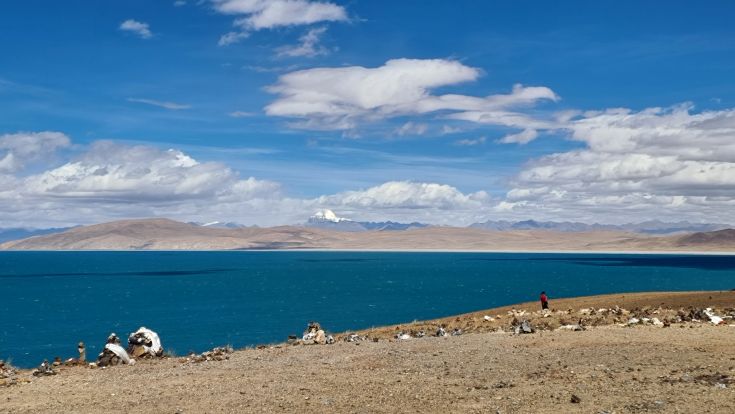
The contrast is striking: just a few kilometers separate the lake of light from the lake of darkness, the sacred from the cursed. This view becomes the final chord of the spiritual journey. You understand: in the world there always exists a balance between light and shadow, good and evil, creation and destruction. Kailash has taught you not to fear this balance, but to accept it as an integral part of cosmic order.
The final kilometers to Darchen pass in a special state. On one hand — joy of completion, pride in trials overcome. On the other — a strange sadness at parting from this place of power that in three days has become part of your soul.
The return to base camp is always emotional. People embrace, share impressions, cry from overwhelming feelings. But the deepest changes will manifest later — in ordinary life, in daily decisions, in a new understanding of your place in the world.
Four Faces of One Mystery: What Each Side of Kailash Holds
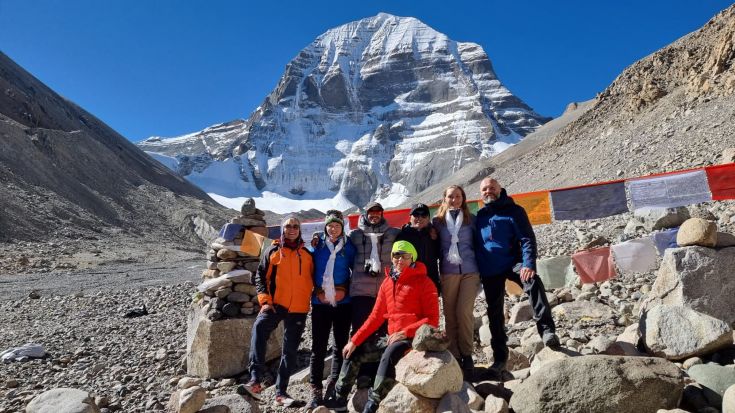
Kailash is no ordinary mountain, but a perfect four-sided pyramid oriented precisely to the cardinal directions. Each face carries its own energy, its own message, its own lesson for those ready to hear it.
The South Face is visible from Darchen, but often hidden by ridges. This is the face of encounter — the first contact with the mountain’s energy. Here you attune to the frequencies of the sacred place and make the decision about your readiness for transformation.
The West Face reveals itself on the first day of the Kora. This is the side of sunset, of endings, of farewell to the past. Gazing upon it, you feel old attachments beginning to loosen, making space for new experience.
The North Face is the most famous and impressive. The view from Dirapuk stuns with its power and majesty. This is the face of depth, wisdom, inner contemplation. Here occurs the primary preparation for tomorrow’s rebirth.
The East Face is partially visible on the third day, but fully reveals itself only during the Inner Kora. This is the side of dawn, new beginnings, renaissance. The fortunate few who are granted to behold it receive special gifts of enlightenment.
The geometric precision of the faces’ orientation continues to astonish researchers. Nature rarely creates such perfect forms, giving birth to numerous theories about the man-made origin of this wonder.
What You Need to Know: Practical Secrets
Over years of guiding groups on the sacred Kora, I’ve accumulated experience I want to share with anyone seriously planning this journey. Many things seem obvious, but in practice they determine the success or failure of the entire endeavor.
The most important advice concerns your pace. Newcomers often try to walk at their usual tempo, but at altitude different laws apply. One step — one breath — this rhythm allows your body to adapt to thin air and keeps your heart from entering critical mode.
Breathing is the key to everything. I teach people to breathe with their belly, not their chest, to make the exhale longer than the inhale. At Drolma-la Pass, proper breathing can be the difference between triumph and emergency descent. Practice this at home on stairs — the more floors you climb with correct breathing, the easier it will be on the mountain.
Clothing requires a special approach. The layering system isn’t just theory but vital necessity. Mornings can be minus ten Celsius, midday — plus twenty in the sun, at the pass — piercing wind at zero temperature. Zippers must work even with gloves on — check this in advance.
Hydration is critically important, but there’s a nuance many don’t know. You need to drink frequently in small amounts — a few sips every 15-20 minutes. Large portions of water at altitude can cause nausea and intensify symptoms of altitude sickness.
Special attention to your feet. In three days, you’ll walk 53 kilometers on rocky trails. Boots must be broken in beforehand. I’ve seen people who bought new footwear before the trip and suffered from blisters all three days. Proper socks are synthetic or wool, never cotton.
Trekking poles aren’t luxury but necessity. On the descent from the pass, knees take enormous stress, and poles genuinely save your joints. Choose telescopic ones — you can shorten them on ascents and lengthen them on descents.
Psychological moment — accept in advance that it will be hard. Don’t set yourself up for an easy stroll. The second day will test all your resources — physical, emotional, spiritual. Those mentally prepared for serious trials pass through them much more easily.
Altitude sickness can affect anyone, regardless of age and physical condition. Main symptoms — headache, nausea, dizziness. If they intensify — descend immediately. The mountain will always be here, but health is more valuable than any ambition.
Keep documents and money in multiple places. Waterproof bags are your best friends. Weather in the mountains can change in minutes, and a soaked passport becomes a serious problem.
To help you systematize your preparation, I’ve compiled a detailed checklist for the Kora around Mount Kailash (Tibet) based on years of high-altitude trekking experience. It includes all necessary equipment, medications, documents, and practical recommendations. You can download the checklist on the Kailash tour page.
And the last piece of advice — learn to listen to silence. In the mountains, it’s special — filled with meaning and energy. Many turn on music or constantly talk, but then you miss the main thing — the dialogue with the mountain, which is the true purpose of this journey.
Are You Ready for Transformation?
Dear friends, the 53 kilometers of the sacred Kora are a journey into the depths of your own soul, a discovery of inner capabilities whose existence you never even suspected.
In three days, you seemingly live an entire lifetime — from symbolic death at Shiva-Tsal to rebirth at Drolma-la Pass. Every meter of this path has been sanctified for thousands of years by prayers of pilgrims from around the world. Kailash doesn’t force transformation — it offers it. To accept or reject this gift is each person’s choice. But those who open themselves to the energy of the sacred mountain return home renewed, healed, enlightened.
Our experience shows: the mountain chooses those ready for deep changes. If this article resonated in your heart, if words about three days of transformation sounded familiar — perhaps your time has come.
Olya and I invite you to join a spiritual journey to the sacred Kora of Kailash in August 2026. This is a journey for those ready to leave the past at the Gate of Salvation and embrace new life at the pass of the gods. Are you ready for three days that will change everything?