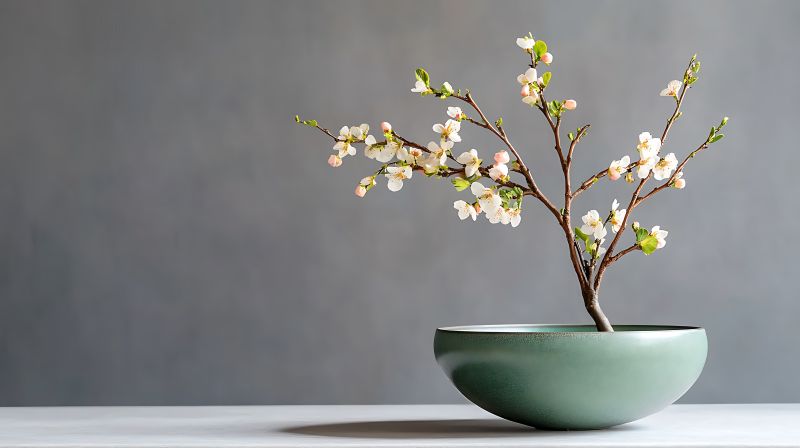
Imagine holding a single sakura branch in your hands, and at that moment you realize that it can tell more about life than a thousand words. This is how acquaintance with ikebana– an ancient Japanese art that turns the simple act of arranging a bouquet into a deep meditative practice.
More than Flowers: The Philosophy of Emptiness and Fullness
Ikebana translates as “living flowers,” but this definition does not convey even a tenth of the true meaning. It is the art of seeing beauty in imperfection, finding harmony in asymmetry, and feeling eternity at the moment a petal withers.
Unlike Western floristry, where splendor and quantity are important, ikebana teaches us to appreciate the empty space between branches. The main thing here is not what is added, but what is removed. Each cut, each bend of the stem is a conscious choice, reflecting the inner state of the master.
From Temple Altars to Samurai Swords
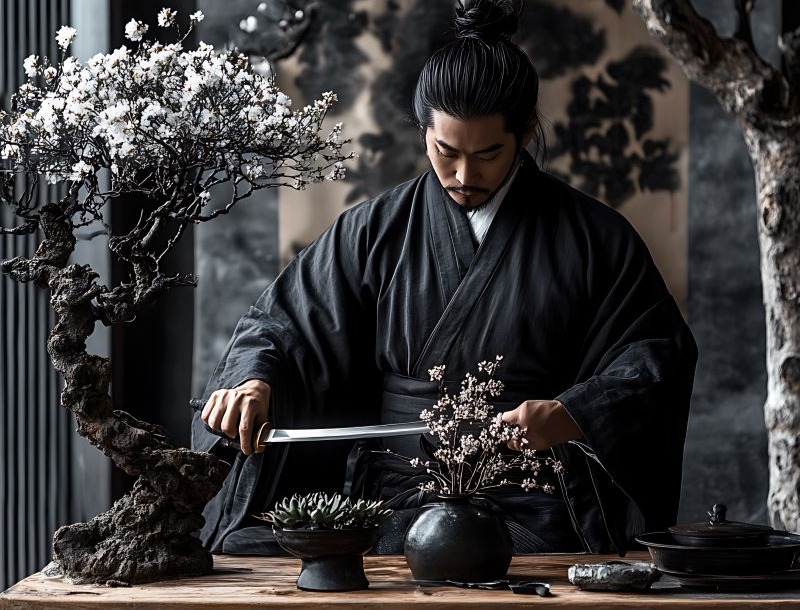
Few people know that ikebana originated in the 6th century in Buddhist temples as a sacred offering of flowers to Buddha. Monks created compositions not for decoration, but as a form of meditation and expression of reverence for nature. But the most surprising turn in the history of ikebana occurred in the 15th century, when this art began to be studied by… samurai.
The warriors believed that the ability to see beauty in simple things and achieve perfection through patience and attention to detail made them stronger in battle. Many great sword masters were simultaneously masters of ikebana. They understood: one who can find balance in a fragile branch will be able to find it in the movement of a blade.
Three lines of the universe
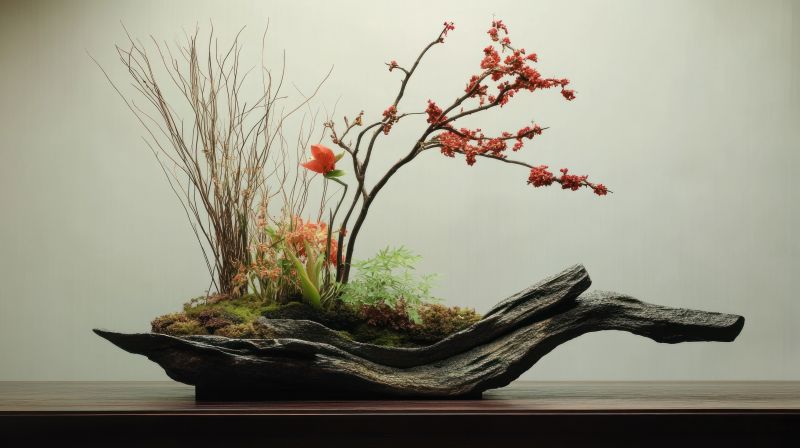
Ikebana is based on the principle of three main lines: Shin (Heaven), Soe (Man), and Hikae (Earth). This trinity reflects the Japanese understanding of balance in the Universe. When you arrange branches in a vase, you are not just creating a composition – you are designing a miniature model of the cosmos.
Shin is the highest branch, symbolizing the heavenly origin and aspiration to the divine. Soe is the middle line, representing the human desire for harmony. Hikae is the shortest, personifying earthly firmness and stability.
Meditation in motion
The process of creating ikebana becomes a form of moving meditation. When the master cuts the stem, he does not simply give it the desired length – he cuts off everything unnecessary in his thoughts. When he bends a branch, forming a curve, he directs the flow of vital energy not only in the plant, but also in himself.
In today’s world, where we are constantly in a hurry and multitasking, ikebana teaches single-tasking. Here and now, there is only you, a flower, and an empty space that needs to be filled with meaning.
Acceptance of transience
Perhaps the most profound lesson of ikebana is the acceptance of mono no aware, “the sad beauty of things.” The flowers in the arrangement are not eternal, and this transience is not hidden but emphasized. A fading petal is as beautiful as a fresh bud – it reminds us of the cyclical nature of life.
This philosophy radically changes the attitude towards losses and changes in life. Ikebana teaches not to cling to the past and not to be afraid of the future, but to find beauty in every moment of the present.
Modern Japan: Where Antiquity Meets Innovation
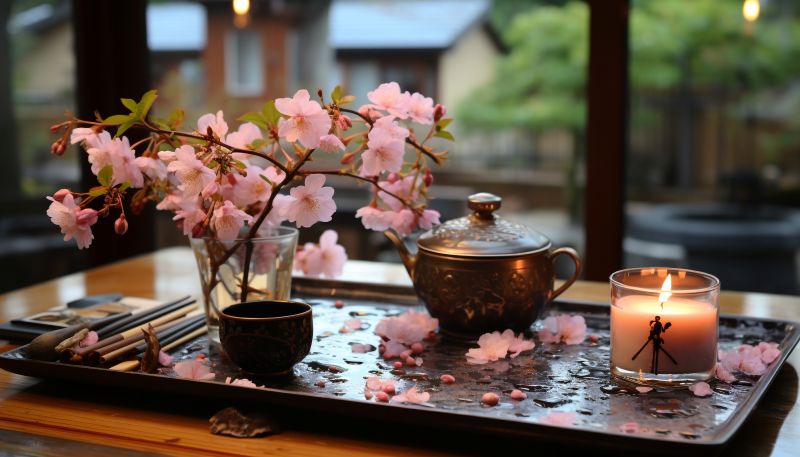
Today, ikebana is enjoying a remarkable revival in Japan. Glass skyscrapers in Tokyo host workshops for businessmen looking for ways to cope with stress. Zen cafes in Kyoto serve tea accompanied by mini flower arrangements. Young Japanese are using social media to share their work, creating a new digital community of fans of this ancient art.
Particularly impressive is how ikebana masters integrate modern materials into their work – glass, metal, non-traditional flowers, creating a dialogue between tradition and innovation.
Journey to the origins of beauty
Understand, ikebana can only be truly experienced by immersing yourself in the atmosphere of her homeland. A walk through the garden of the Kinkaku-ji Temple at dawn, when the first rays of the sun touch the golden pavilion; participation in a tea ceremony, where every movement is full of meaning; a master class with a real ikebana sensei in his own school – all this cannot be replaced by any online course.
In our Zen tour through modern Japan, you won’t just see the sights – you will touch a living philosophy that can change your view of the world. You will understand that beauty lies in the depth of the moment and in the simplicity of truth.
Are you ready to embark on a journey to your inner self? A Zen tour of Japan awaits those who are ready to discover the depth of Japanese philosophy and touch the thousand-year-old wisdom of the East.