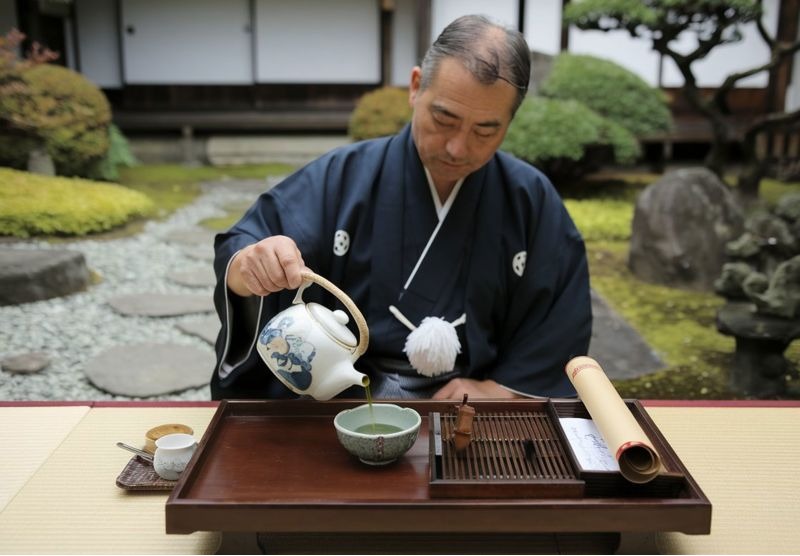
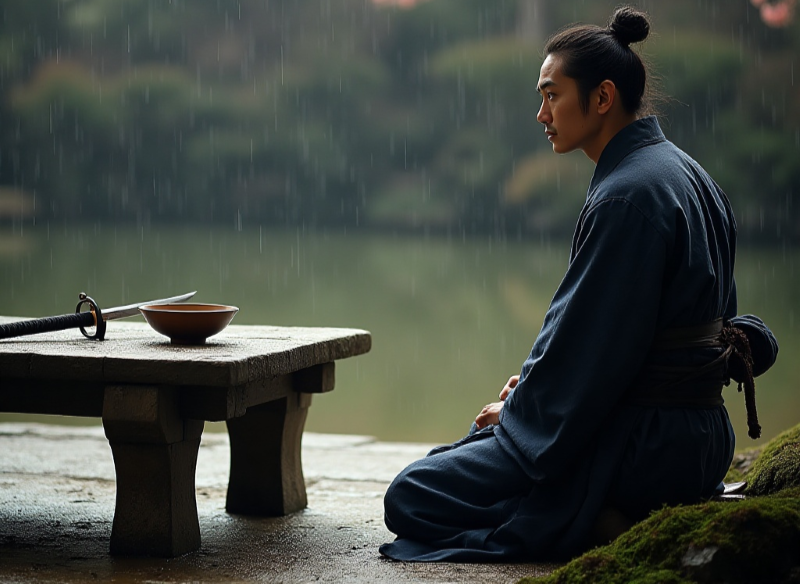
Imagine: a ray of sunlight penetrates through the paper door of a traditional Japanese house. In one room, a tea ceremony master slowly whisks emerald powder in a clay cup; in another, a warrior practices a sword movement that could determine life and death. What unites these two worlds? The answer is simple yet profound—Zen Buddhism, a philosophy that has shaped the soul of Japan for centuries.
Zen Buddhism: A Philosophy of Simplicity in a Complex World
Before diving into the world of samurai and tea ceremonies, let’s understand what Zen is. Simply put, Zen is a Buddhist teaching about finding enlightenment through personal experience and practice, rather than through book knowledge or complex rituals.
Zen came to Japan from China in the 13th century and quickly gained popularity. Why? Because it offered practical tools for living in the here and now. No complex theories—just direct understanding of reality through meditation and everyday actions.
The main idea of Zen is surprisingly simple: true enlightenment can be found in the most ordinary things—in a cup of tea, in the swing of a sword, in observing a falling leaf. One only needs to learn to truly be present in the moment.
Samurai and Monk: How Zen Entered the Martial Arts
When Zen appeared in Japan, the country was experiencing difficult times of constant wars. Samurai—warriors of feudal Japan—immediately appreciated the practicality of this teaching.
What did Zen give to warriors? First and foremost, a special state of mind is necessary in battle. A samurai practicing Zen learned to maintain clarity of thought even on the battlefield, finding calm amidst chaos. This teaching helped them act spontaneously, intuitively, without delay—a quality critically important in combat. Moreover, Zen allowed samurai to reconcile with the thought of death, making them fearless in battle. The awareness of life’s inevitable end didn’t paralyze but instead liberated the warrior, allowing them to fully focus on the present moment.
Imagine the situation: two samurai stand facing each other, ready for a duel. One of them is thinking about technique, how he will attack, about possible death. The other, practicing Zen, is completely empty—there are no thoughts in his mind, only pure awareness of the moment. Who will win? According to the Japanese, the second samurai has an enormous advantage—he acts lightning-fast, without the delay caused by thinking.
The great sword master Miyamoto Musashi said: “A warrior must act like water, which always finds a path but has no permanent form.” This is Zen in martial arts—being fluid, adaptive, and present in the moment.
From Sword to Tea Cup: The Birth of the Tea Ceremony
Now imagine a completely different picture: a quiet room, minimalist interior, a host preparing tea for a guest, performing each movement with absolute concentration. This is the Japanese tea ceremony, or “the way of tea” (chado), another child of Zen Buddhism.
The tea ceremony was born in the 15th century when the monk Murata Juko combined Zen practice with the art of tea drinking. Later, master Sen no Rikyu perfected it, establishing principles that are still followed today. The first principle—harmony, or “wa”—involves creating a special space where humans, nature, and objects exist in complete accord. This is a sense of unity where the tea room, the garden outside, guests, and the host become parts of a whole, complementing each other without contradictions or tension.
The second principle—respect, or “kei“—goes far beyond simple politeness. It is a deep recognition of the value of each person and each moment. In the tea room, everyone is equal: both noble guests and common people receive the same attentive treatment. The host prepares tea with genuine care, as if it’s the most important task in their life, and it is this sincerity that fills an ordinary action with profound meaning.
Purity—”sei”—refers not only to the physical cleanliness of the tea room and utensils. It is primarily purity of heart and mind, freedom from vain thoughts and worries. Before entering the tea room, guests pass through a small garden and wash their hands, symbolically cleansing themselves from the dust of the outside world. This prepares them for a special experience where there is no place for everyday concerns and anxieties.
Tranquility, or “jaku”—the pinnacle of the tea path, a state of inner silence and peace that emerges when all previous principles are observed. This is not simply the absence of agitation, but a positive state of mental balance, serenity, and complete presence in the moment. In this state, a simple cup of tea can become a source of a profound experience of beauty and the fullness of life.
In the tea room, there is nothing superfluous. The tea master says: “All I need is a cup, hot water, and tea leaves. Everything else is vanity.”
This is Zen—seeing beauty in simplicity, finding deep meaning in ordinary things. Each item in the tea room is selected with special care, but without a hint of luxury or ostentatious wealth. An old cup, darkened by time, may be valued more highly than a new and shiny one if it carries history and character. This ability to see the extraordinary in the ordinary, to appreciate imperfection and transience—this is the essence of Zen aesthetics, which found its complete embodiment in the art of the tea ceremony.
What Do a Warrior and a Tea Master Have in Common?
At first glance, a samurai with a sword and a tea ceremony master are opposites. One embodies destruction, the other—creation. But Zen shows that these are two sides of the same coin.
What unites the way of the sword and the way of tea:
- Complete concentration. Both the samurai and the tea master are fully focused on their actions, without distractions.
- Refined movements. In both practices, each movement is perfected, with nothing superfluous.
- Acceptance of the present moment. Both practices teach living here and now, without regrets about the past or anxieties about the future.
- Simplicity and naturalness. Zen rejects everything artificial and ornate, valuing simplicity and naturalness in actions.
The famous tea ceremony master Sen no Rikyu was once asked about the secrets of the tea path. He replied: “Boil water, prepare tea, drink it—that’s all.” When the student expressed disappointment at such a simple answer, Rikyu added: “If you can truly do this, I will become your student.”
This story perfectly illustrates the essence of Zen—true wisdom lies in doing simple things with full awareness.
Zen in Everyday Life: Japanese Lessons for the World
What makes Japanese culture so attractive to the world? Perhaps it’s the influence of Zen—the ability to find beauty in simplicity, depth in the ordinary, calmness amid chaos.
The Japanese have long understood what the West is only beginning to realize: happiness is not in things, but in one’s attitude toward them. A small apartment can be a space of harmony if it contains nothing superfluous. Simple food can be a source of deep pleasure if eaten with full awareness of its taste. Ordinary work can become a path to mastery if done with complete dedication.
An Invitation to Journey: Discover the World of Zen
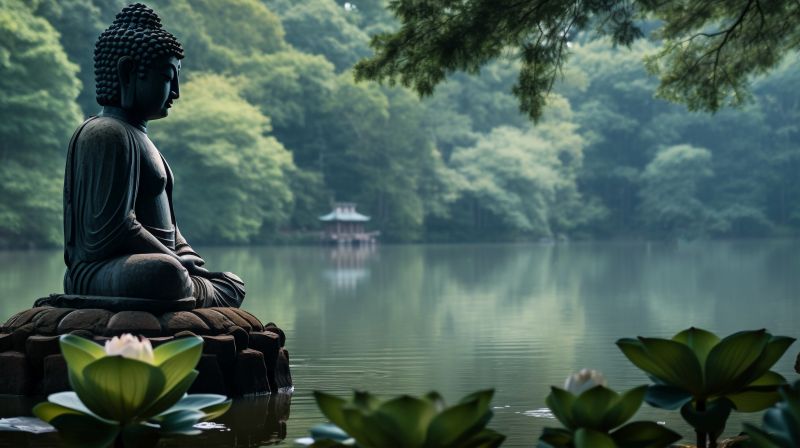
You can read dozens of books about Zen Buddhism, but you can truly understand it only through experience. Japan offers a unique opportunity to see how Zen philosophy is embodied in real practices—from martial arts to tea ceremony, from rock gardens to calligraphy.
Our Zen tour of Japan is not just sightseeing. It’s an immersion in seeing the world. You will be able to:
- Try zazen meditation under the guidance of a real Zen monk;
- Participate in a tea ceremony in a traditional tea house;
- See Zen gardens created for contemplation and meditation;
- Try calligraphy and other traditional arts.
Perhaps upon returning home, you’ll discover that you’ve brought back not only souvenirs but also a new outlook on life—more calm, mindful, and harmonious. This is the true value of traveling to a country where the way of the sword and the way of tea unite into a single philosophy of life.
Join our Zen tour and discover Japan, where ancient wisdom meets modernity, and simplicity reveals amazing depth.