
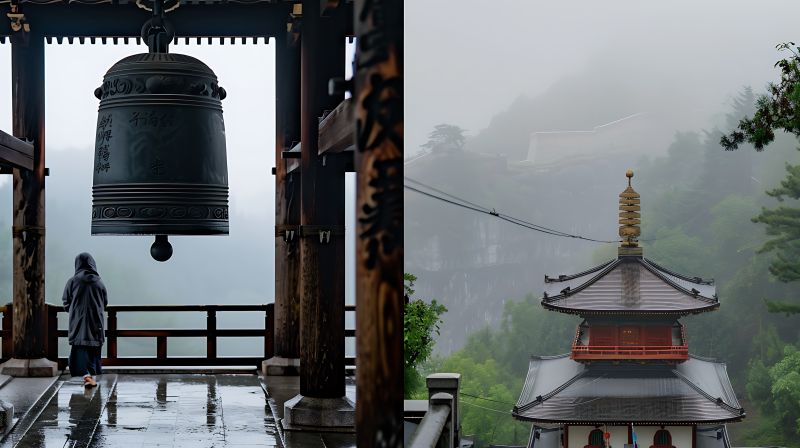
Imagine an early morning in an ancient Japanese temple. Soft mist envelops centuries-old trees, gentle birdsong carries from afar. Suddenly, the space fills with the deep, vibrating sound of the temple bell–bonshō. This sound seems to awaken not only your consciousness, but the Universe itself. Its echoes slowly dissolve in the air, leaving behind a special silence – not just an absence of noise, but a living, full presence that opens the door to inner peace.
In this ancient art of working with sound lies remarkable wisdom. Sound in Zen Buddhism is not merely air vibration, but a direct path to the heart of meditation. Each sound here becomes a teacher, each moment of silence an opportunity for deep insight.
In everyday life, we rarely think about how sound affects our state of being. Yet even simple observations show: a gentle melody can calm a troubled mind, rhythmic music helps concentrate, and nature’s sounds return us to natural harmony. In Zen Buddhism, this understanding has been elevated to the level of high art.
The Sacred Symphony of the Temple
In a traditional Japanese temple, each sound has its special purpose. There are no random sounds here – for centuries, Zen masters have created a unique acoustic environment where every element helps practitioners find their path to enlightenment.
The majestic bonshō – the main voice of the temple. Its deep, prolonged sound penetrates the most hidden corners of consciousness. Monks say that one strike of this bell can cleanse the mind of one hundred and eight earthly desires that cloud our true vision.

In temple gardens, you can hear the gentle singing of furins – wind chimes. Their crystalline voice, swayed by the wind, seems to remind us: “be here and now.” When you listen to their sound, busy thoughts naturally retreat, giving way to clear awareness of the present moment.
During sutra readings, the space fills with rhythmic strikes of the mokugyo, a wooden drum shaped like a fish. This instrument helps practitioners maintain attention and synchronize breathing with ancient texts. They say the fish shape wasn’t chosen by accident—as a fish never closes its eyes, so must the practitioner maintain unwavering vigilance.
And when shōmyō – traditional monastic chants – sounds in the temple, it seems as if the air itself begins to vibrate in unison with ancient mantras. These chants bridge the singer’s physical breath and the subtle vibrations of spiritual practice.
Silence as the Art of Sound
In Zen Buddhism, silence is not merely the absence of sound. It is alive, full, speaking. After the last echo of the temple bell fades away, a special mystery begins – the practice of listening to silence.
In this silence, a whole world of subtle sounds reveals itself. The rustle of bamboo in the wind, a distant crane’s cry, the fall of a water drop into a stone bowl – all these sounds exist on the edge of audibility. They seem to invite us into a space of deeper perception, where the boundaries between listener and sound begin to dissolve.

Zen masters say: “True silence sounds louder than thunder.” Deep wisdom lies in these words. When the mind becomes so calm that it can hear silence, an amazing transformation of consciousness occurs. You are no longer just a listener – you become the process of listening itself.
In our modern world, overflowing with noise, the art of listening to silence becomes especially valuable. This is not just a way to relax or rest. It is a path to a deeper understanding of oneself and the world around, an opportunity to hear what is usually hidden behind the veil of everyday noise.
When Ancient Wisdom Meets Science
What Zen masters discovered through centuries of practice, modern science confirms through precise measurements and research. Remarkably, ancient knowledge about the healing power of sound finds increasing scientific validation.
Take, for example, the sound of the temple bell bonshō. Research shows that its vibrations, ranging from 50 to 120 hertz, have a special effect on our brain. These frequencies help switch brain activity from beta waves, characteristic of stress and anxiety states, to alpha waves, which accompany deep meditation and inner peace.
Even the architecture of ancient temples, as it turns out, creates ideal conditions for sound practice. High ceilings, special placement of wooden beams, thoughtful arrangement of resonating surfaces – all this forms a unique acoustic space. In some temples, such as the famous Tōdai-ji, the bell sound can resonate for up to fifteen minutes, gradually transitioning into a barely perceptible but very deep vibration.
Modern research in neuroacoustics confirms: regular practice of mindful listening helps reduce stress levels, improve concentration, and even strengthen the immune system. What monks call “purification of consciousness,” scientists describe as the process of neuroplasticity – the brain’s ability to restructure neural connections under the influence of external stimuli.
Ancient Wisdom in Modern Life
It might seem that sound and silence practices are only available in ancient Japanese temples. But this isn’t true. Zen wisdom is surprisingly practical and can be applied in any conditions, even in a noisy modern city.
Each morning can begin with a moment of mindful listening. This could be the sound of the awakening city, rustling leaves outside your window, or even the hum of passing cars. The key is not to judge sounds as pleasant or irritating, but simply to be an attentive witness to the sounding world.
Throughout the day, you can create small islands of silence. Five minutes without phone, television, and conversation – this is already the beginning of practice. Gradually, you’ll notice how the quality of perception changes: sounds become more voluminous, and silence becomes more alive and full.
Even the simple ring of a teacup during tea time can become a moment of meditation. Zen masters say: “When you truly listen, the whole world becomes music.” This isn’t a poetic metaphor, but a practical guide to a more conscious life.
In our Club, we’ve created programs based on ancient sound practices. They help people cope with stress, find inner balance, and discover new facets of perception. Ancient wisdom takes on new life, helping modern people find their way to themselves through the art of listening.
The Path of Sound and Silence: Towards Enlightenment

In our fast-paced world, where each day is filled with an endless stream of information and noise, the ancient wisdom of Zen becomes especially valuable. It reminds us of a simple truth: true harmony begins with the ability to listen – to listen to the world around and the silence within.
From the majestic ring of the temple bell to the gentle rustle of leaves in the wind – each sound can become a door to a deeper understanding of life. This practice requires no special conditions or lengthy preparation. Only one thing is needed – a sincere desire to hear what usually remains beyond our perception.
A Zen tour in modern Japan is a unique opportunity to immerse yourself in the world of ancient tradition. We will guide you through sacred places where the art of listening has been practiced for centuries. In the ancient temples of Kyoto and mountain monasteries, you will not just hear, but feel with your entire being that special atmosphere created by Zen masters throughout the centuries.
This journey will be more than just a tourist trip. It’s an opportunity to touch a living tradition where each sound becomes a teacher, and each moment of silence reveals new facets of understanding yourself and the world.
Perhaps now is the time to stop, listen, and allow the ancient wisdom of Zen to open the path to inner harmony for you. This path begins with the first conscious breath, with the first moment of true listening.
Welcome to a world where sound and silence merge into a single symphony of enlightenment.