“The entire Universe is reflected in a drop of water” – whispers ancient Zen wisdom, touching the strings of our soul. In a world where we daily lose ourselves in a flood of words and images, there exist extraordinary spaces of silence – Japanese rock gardens (枯山水, karesansui). Here, simplicity becomes the language through which eternity converses with the human heart.
Created by monks centuries ago, these gardens harbor a remarkable paradox: the fewer physical elements they contain, the more they can reveal to an attentive heart. In these spaces, stones transform into words of a silent poem about the essence of being, while sand becomes a blank canvas on which time draws its patterns.
When touching a rock garden, we open a door to a world where grains of sand reflect the depths of our consciousness, and silence teaches us to hear the voice of our own soul. This is not merely the art of landscape design – it is a path to self-discovery through the contemplation of simplicity and perfection.
The Birth of Silent Wisdom
In the quiet mountain monasteries of medieval Japan, an art was born that could speak to the soul without a single word. It emerged naturally, as dawn follows night, as spring succeeds winter.
Time flowed unhurriedly. Monks observed the changes in nature, the flow of clouds, and the play of light on water’s surface. In this contemplation, a new understanding of beauty was born. Zen Buddhism, having come from China, brought with it a special vision of the world, where emptiness meant more than fullness.
Like fine threads of a silver web, connections stretched between ink painting and the art of garden creation. Masters learned to “paint” entire worlds with several precise strokes, where each stone became a living hieroglyph in nature’s book.
Among those who left a profound mark on this art was monk Musō Soseki. His gardens were born from deep meditation, where each element naturally found its place as stars arranged in the night sky.
The Art of Creating Silent Harmony
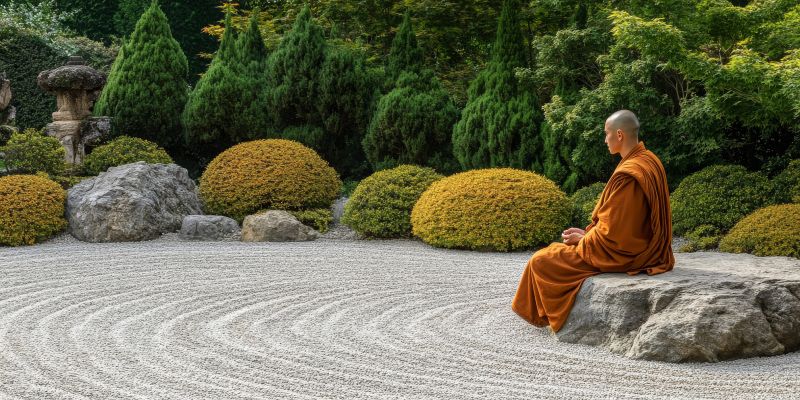
Creating a rock garden is an ancient art that requires technical mastery and a special state of spirit. Every action of the master is filled with meaning and a deep understanding of nature. It is a path where hands follow the movement of the heart, and the mind dissolves in contemplation.
The foundation of composition is built on the principle of natural asymmetry. In nature, there are no perfect forms or flawless geometry – each leaf, each branch is unique in its imperfection. Following this wisdom, masters create spaces where lines are slightly irregular, and distances between stones are subtly unequal. It is this natural imperfection that creates the inner tension that brings the garden to life under the contemplator’s gaze.
The selection and placement of stones require special mastery and intuition. A master might spend months searching for a single stone that will sing the right note in the garden’s silent symphony. Each stone carries a history written by time on its surface – in patterns of cracks, in patches of moss, in traces of rain and wind. Their arrangement follows not only aesthetic laws but also the ancient teaching about “ki” energy flows. These invisible lines of force must flow freely between the stones, creating a harmonious energy field.
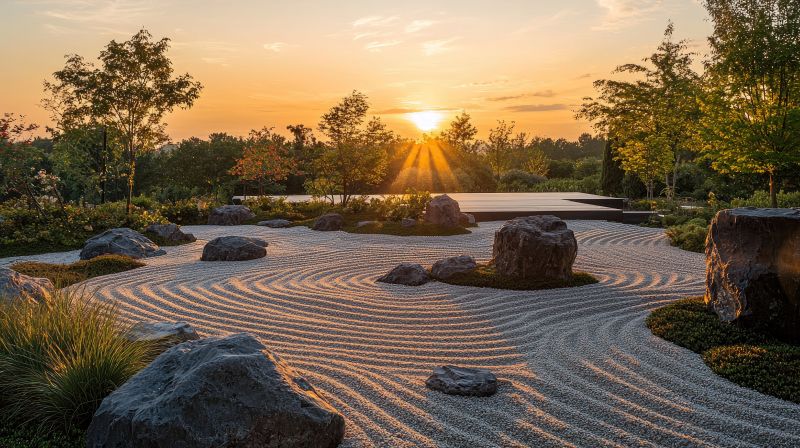
Working with sand becomes a special form of meditation. Each movement of the rake must be filled with mindfulness and inner silence. The patterns appearing in the sand are like traces of time – they tell a story of eternal movement and eternal peace. Concentric circles around stones, straight lines, and wavy strips create an illusion of a frozen flow, where each grain of sand finds its perfect place.
The viewpoint plays a crucial role – the place from which one will contemplate the garden. All elements of the composition are arranged to create a special space for dialogue between the garden and the observer’s soul. In traditional gardens, this is usually the temple veranda, from where the entire composition can be viewed. From here, each element of the garden finds its meaning and place in the overall picture.
In the process of creating a garden, the master must remember the essential: this space is not meant for the entertainment of the eyes, but for immersion in meditation. Each element, each line must contribute to calming the mind and opening the heart to a deeper understanding of the nature of things.
Famous Rock Gardens of Japan
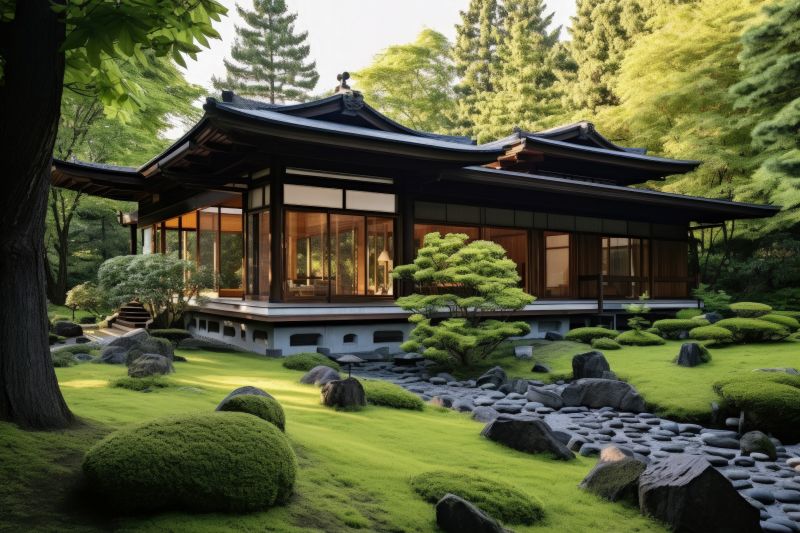
Among the many rock gardens, there are those that have become symbols of this art, true jewels of Japanese culture. Each tells its unique story through the language of stones and sand.
The garden of Ryoan-ji Temple in Kyoto is considered the pinnacle of karesansui art. Fifteen stones, arranged in groups on white gravel, create a composition of unfathomable depth. The mystery of this garden lies in the fact that from any viewing point, only fourteen stones can be seen – the fifteenth always remains hidden. This feature reminds us of the limits of human knowledge and the infinite path to wisdom. The waves of gravel surrounding the stones create an illusion of a frozen ocean, where island-stones float in eternity.
At Daisen-in Temple, there is an amazing “landscape stream garden” that tells the story of life through the metaphor of flowing water. Beginning with a small waterfall symbolizing birth, the stream, expressed through lines of gravel, flows through narrow youth gorges, expands into the full-flowing river of maturity, and finally flows into the ocean of enlightenment. Each stone here marks a milestone on the path of spiritual development.
The garden of Tofuku-ji Temple, created by master Shigemori Mirei in 1939, represents a remarkable synthesis of tradition and innovation. Its famous composition of square and rectangular stones, arranged in a sea of moss, creates an abstract pattern reminiscent of a chessboard. The garden changes its appearance with the seasons: in spring, the moss shines with emerald green, in autumn it’s covered with red maple leaves, and in winter it’s dusted with snow.
The Konoma-in garden at Tofuku-ji Temple is famous for its unique composition, “tiger crossing the river.” Stones, arranged in a special way, create a dynamic picture where one can discern the outline of a mighty beast crossing the water flow. This is a rare example of a narrative subject in karesansui art.
At Ginkaku-ji Temple, there is the famous “Sand Cone Garden.” Here, the art of working with sand reaches incredible heights: a cone-shaped form resembling Mount Fuji is created from pure white sand. The surface of the cone is so perfectly leveled that it appears to glow in moonlight, which gave the garden its second name – “Platform for Moon Viewing.”
Each of these gardens is not just a monument of landscape art – it is a living book of wisdom written in the language of stones and sand. They continue to teach us the art of contemplation and help us find the path to inner harmony.
The Modern Resonance of Ancient Wisdom
In our fast-paced age, where every minute is scheduled and gadgets constantly demand attention, rock gardens acquire a new, particularly important meaning. They become islands of silence in an ocean of urban noise, where modern humans can pause and hear their own heartbeat.
In business centers of megalopolises, among glass skyscrapers and concrete squares, modern interpretations of karesansui are emerging. Architects create spaces where ancient wisdom meets contemporary materials. Here you can see traditional gravel combined with metal structures, while ancient stones neighbor mirrored surfaces, creating a remarkable dialogue between times.
In the corporate culture of large companies, a new tradition is emerging – the creation of meditative zones inspired by Zen garden philosophy. Even a small space designed in karesansui style becomes a place where employees can find a moment of peace during an intense workday. The simplicity and minimalism of these gardens help clear the mind of informational noise and restore inner balance.
Modern artists and designers find an inexhaustible source of inspiration in rock garden philosophy. They create installations where traditional karesansui elements are reinterpreted through the lens of contemporary art. In their works, sand might transform into light projections and stones into geometric abstractions, but the essential remains unchanged: the ability to create space for reflection and self-discovery.
Even in private interiors, people increasingly turn to rock garden aesthetics. Miniature desktop compositions appear, where a few stones and a handful of sand create a microcosm of tranquility. These small gardens become personal altars of silence, helping maintain a connection with eternal values amidst everyday hustle.
In an era of ecological crisis, rock garden philosophy teaches us an important principle: beauty doesn’t require excess. Minimalist compositions requiring no watering or complex maintenance become examples of a sustainable approach to space organization. They demonstrate how much can be created using the simplest and most natural materials.
In Search of One’s Own Silence
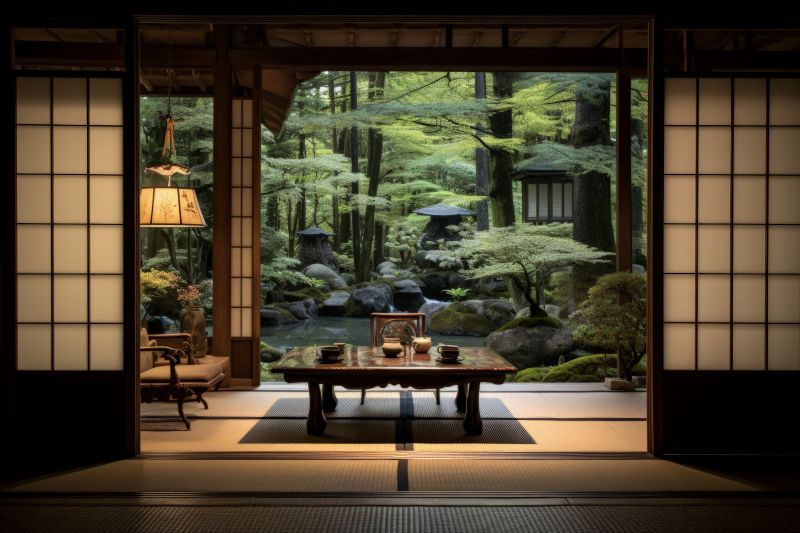
Through the centuries, rock gardens remain silent teachers, revealing to us the path to inner harmony. Their wisdom is both simple and profound: true beauty requires no multitude of words, and the most important discoveries happen in silence.
In an era when the world becomes increasingly noisy and bustling, the significance of these sacred spaces only grows. They remind us of the importance of stopping, taking a deep breath, and allowing ourselves to simply be. In this simplicity lies the deepest wisdom of ages.
But to truly hear this silence, one must walk the ancient paths of Zen monasteries oneself, feel the coolness of morning air in the garden, and sense the roughness of ancient stones under one’s fingers. This is precisely the experience we offer to those ready to embark on a journey not only through Japan but also into the depths of their own soul.
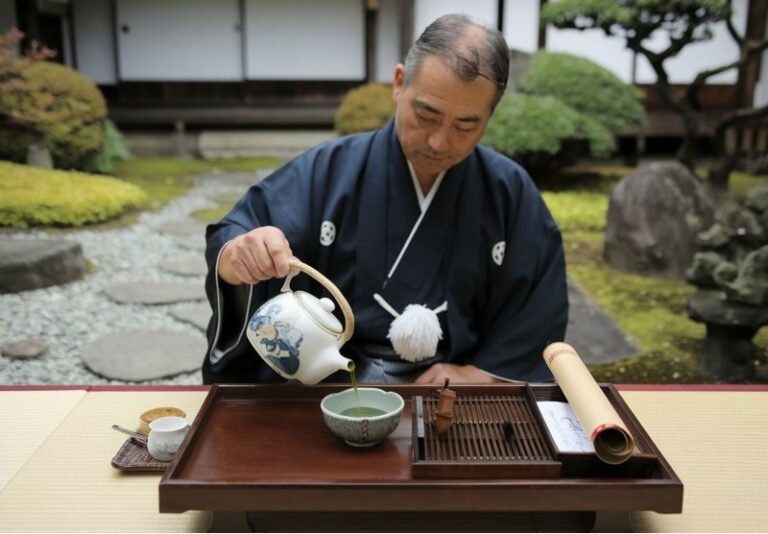
In our Zen tour of Japan, each day becomes a discovery. Morning begins with meditation in ancient gardens, where rays of the rising sun create an amazing play of light and shadow on the surface of stones. The day fills with deep meaning through calligraphy practice, where each brush stroke teaches understanding of the beauty of imperfection. And in the evening, during the tea ceremony, time seems to slow its pace, allowing us to realize the value of each moment.
Staying in real monasteries becomes not just a tourist experience, but a true immersion in centuries-old tradition. Here, under the guidance of experienced monks, you will learn the art of sutra copying, master the basics of Zen meditation, and become acquainted with ancient practices of working with consciousness. Every minute spent within these walls is a step toward a deeper understanding of yourself and the world around you.
In a world where everyone seeks their own way to find balance, rock gardens offer wisdom tested by centuries. They teach us the essential – beauty exists not in complexity but in simplicity, not in verbosity but in silence, not in the external but in the internal. This wisdom becomes especially relevant today, when we increasingly lose connection with our own nature in pursuit of external goals.
We invite you to share this amazing journey into the world of Zen wisdom with us. In rock gardens, you will find not only peace and tranquility but also, perhaps, answers to the most important questions that have long been resonating in your heart.