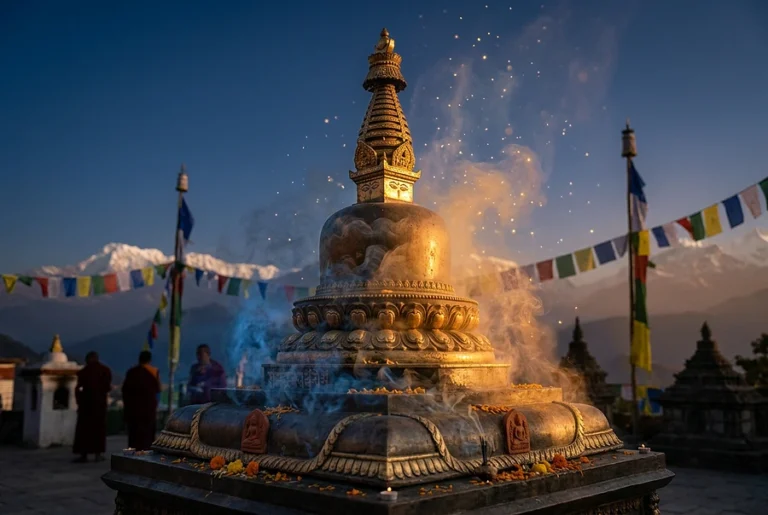
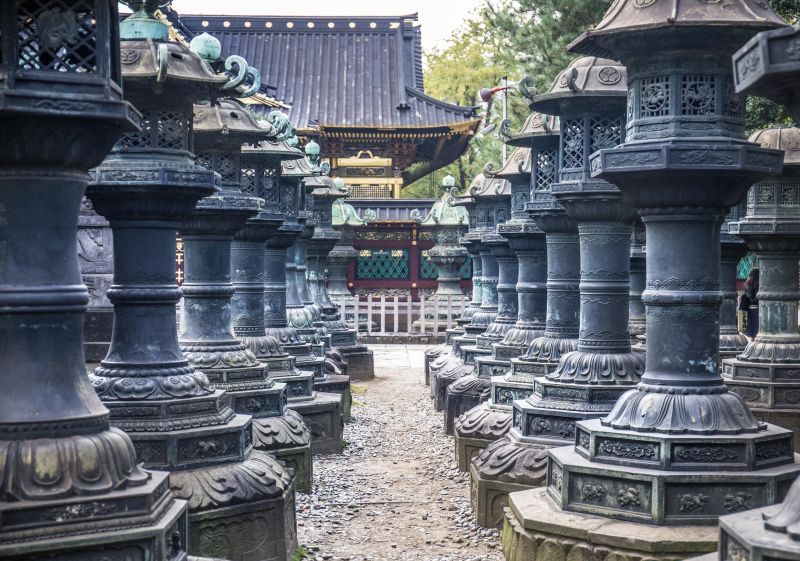
Imagine an early morning in the mountains of Japan. The sound of the temple bell cuts through the pre-dawn silence, dissolving into the fog between the centuries-old cryptomeria. The same sound was heard here a thousand years ago. This is the fantastic magic of the ancient Japanese monasteries – they exist as if outside of time, preserving age-old wisdom and peace within their walls.
Today, when the world moves at the speed of light and our phones are filled with endless notifications, these ancient abodes offer us something priceless – the opportunity to stop and look into the depths of our souls.
There are hundreds of Zen monasteries in Japan, but there are five special ones among them. Five ancient monasteries, each of which is not just a historical landmark, but a living organism, pulsating with the same energy as centuries ago. Here they still practice meditation according to the canons established by the ancient masters of Japan, and morning and evening services are held according to the same schedule, as they were a thousand years ago.
These Zen monasteries of Japan survived wars and natural disasters, saw the rise and fall of empires, but retained the main thing – their spirit and purpose. They remain beacons for those who are looking not just for ancient architectural monuments, but for places of power where they can come into contact with eternity.
Why Zen monasteries?
Imagine a place where every stone in the garden, every curve of the tiled roof, and every bell ring carries a deep meaning. Zen monasteries of Japan – these are not just temples, these are entire Universes, where simplicity becomes a revelation, and silence becomes a teacher.
In a world where we are used to looking for answers on Google, Zen offers something revolutionary – looking within ourselves for answers. That is why not only Buddhists come here, but also people from all over the world: artists looking for inspiration, businessmen looking for clarity of thinking, travelers looking for authentic Japan.
“When the mind is calm, the universe opens,” says the ancient Zen wisdom. And indeed, time flows differently within these walls. There is no usual rush here, no race for achievements. Instead, there are majestic ceremonies, the sound of a bamboo bell calling for meditation, and the quiet rustling of leaves in ancient gardens.
Do you know what exactly is in Zen monasteries in Japan, where many of those things that we consider today symbols of the country were born? The art of calligraphy, the tea ceremony, rock gardens – all this grew out of the monastic practices of Japan and today is available to every visitor.
But the main thing that these places provide is the opportunity to see how people lived and what they aspired to in Japan many centuries ago. And amazingly, understand that their searches and questions are surprisingly consonant with ours today…
Enryaku-ji: Guardian of Mount Hiei in Japan
Our story begins with the Enryaku-Ji Monastery, located majestically on Mount Hiei in Japan. Imagine walking up ancient stone steps surrounded by centuries-old cryptomeria (Japanese cedar trees). Their crowns create a special twilight even on a sunny day, and the air is filled with the aroma of pine needles and incense.
Founded in 788 by the monk Saita, Enryaku-Ji became more than just a Zen monastery in Japan and, rather, a real spiritual university of the Middle Ages. Here, at an altitude of 848 meters above sea level, where the clouds touch the temple roofs, monks for centuries have comprehended not only the teachings of the Buddha, but also the complex art of existing between heaven and earth.
“Mount Hiei in Japan is where the sky meets the earth,” say the locals. And indeed, when you stand at the main zen temple in Japan, Konpon Chudo, where the sacred fire has been burning continuously for over 1200 years, you begin to understand why this particular place was chosen to establish the monastery. From here you can see the ancient capital of Kyoto, but the noise of the city does not reach here – only the wind in the treetops and the periodic ringing of temple bells.
Interesting that Enryaku-Ji survived many fires and destruction, but each time was reborn like a phoenix from the ashes. The most serious test occurred in 1571, when the military leader Oda Nobunaga burned almost all the temple buildings. But even then, the sacred fire is the main thing; the Zen monastery in Japan did not go out – the monks preserved it, passing it from one to another until the monastery was restored.
Today in Enryaku-Ji you can not only admire the architecture and views, but also touch the living tradition of Japan. Morning services are still held here and are open to visitors, and on certain days, you can take part in a meditation or fire offering ceremony.
Todai-Ji: Japan’s Great Eastern Zen Monastery
The next stop on our journey is the majestic Todai-Ji in the ancient capital of Nara. It’s not easy, Zen Monastery Japan, but the largest wooden structure in the world, housing one of the most impressive Buddha statues.
Founded in 752 by order of Emperor Shomu, Todai-ji became a symbol of the influence of Buddhism in the country. The main hall of Zen monasteries in Japan – Daibutsu-den – is amazing even today: its height is 48.7 meters, although the modern building, restored in 1709, is only two-thirds the size of the original building of the 8th century!
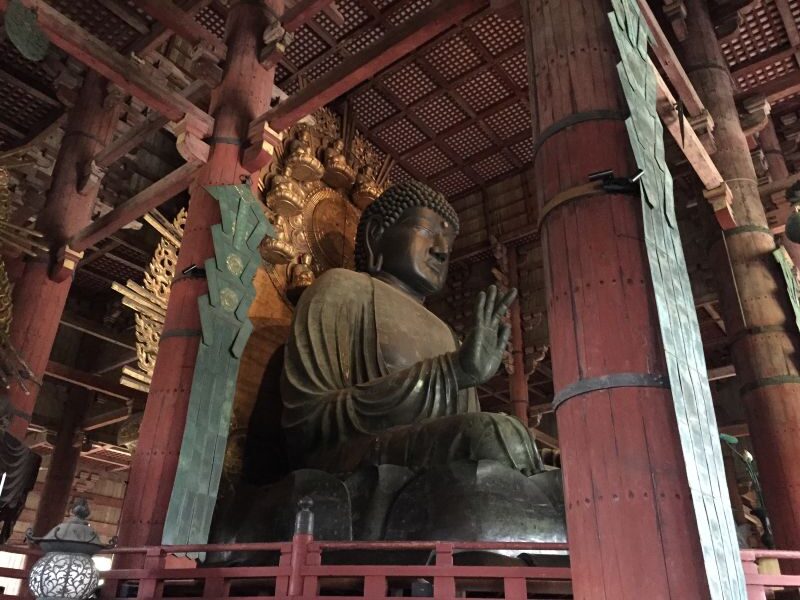
Inside the hall sits the famous Big Buddha (Daibutsu) – a bronze statue 15 meters high. Its creation in the 8th century required 437 tons of bronze and 130 kilograms of gold. Interesting detail: the statue’s ear shell alone can fit an adult!
Today the territory of Todai-Ji is a whole complex of Zen monasteries in Japan and shrines surrounded by a park where deer – sacred messengers of the gods according to Shinto beliefs – roam freely. These amazingly friendly creatures have become an integral part of the atmosphere of the monastery, creating a special feeling of harmony between nature and the creation of human hands.
Every morning at the Zen monastery in Japan, the day begins with the opening of massive gates and the ringing of bells, just as it has for many centuries. On certain days of the year, ancient Buddhist ceremonies take place here, many of which have remained unchanged since the founding of the temple.
Manpuku-Ji: where China meets Japan
In the foothills of Kyoto lies the unique Manpuku-Ji (萬福寺) Monastery, founded in 1661 by the Chinese monk Yingen Ryuki. It is not just a monastery – it is a living testament to the cultural exchange between China and Japan, embodied in stone and wood.
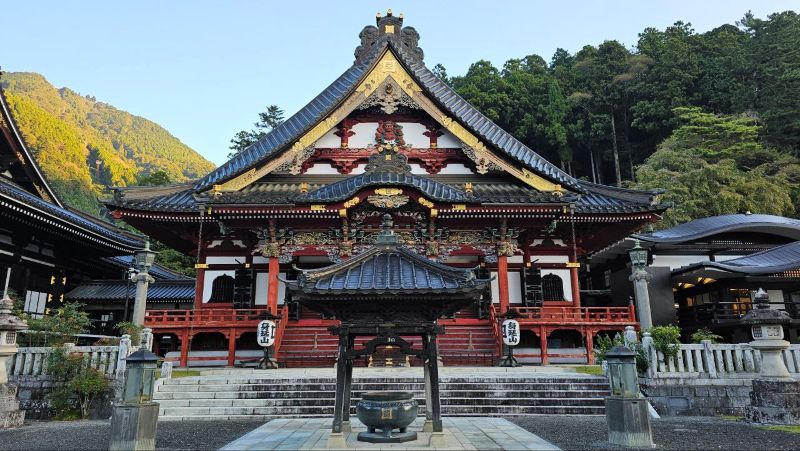
Unlike other Zen monasteries in Japan, the architecture of Manpuku-Ji strictly follows the canons of the Ming Dynasty. Red columns, curved roofs with raised corners, majestic gates – everything here recalls the Chinese roots of Zen Buddhism. Even today, when you walk through the main gate of the monastery, you feel as if you are crossing the border between two great cultures.
The peculiarity of this place is the preserved Chinese traditions. The monks still recite sutras in Chinese, wear Chinese-style robes, and follow a unique daily routine established by the founder. Even the kitchen of these Zen monasteries in Japan retains Chinese elements – special vegetarian dishes are prepared here according to recipes brought by Yinggen.
The Zen monastery houses a unique collection of works of art, including works by Ingen Ryuki himself, known not only as a spiritual mentor, but also as a talented calligrapher. His calligraphy and painting scrolls are considered national treasures of Japan.
Interesting that Manpuku-Ji became the center of a separate school of Zen, Obaku, which introduced elements of Pure Land practice into Japanese Buddhism, combining the rigor of Zen with forms of Buddhism that were more accessible to ordinary people.
Kennin-ji: the firstborn of Zen in the ancient capital of Japan
In a quiet corner of the Gion district, among the winding streets of old Kyoto, stands Kennin-ji (建仁寺), the oldest Zen monastery Japanese capital, founded in 1202 by the legendary monk Eisai. This is the place where the Rinzai school of Zen was first practiced in Japan.
Interesting fact: It was Eisai who brought to Japan not only the teachings of Zen, but also the seeds of the tea plant. In the Kennin-ji gardens, he planted the first tea bushes and wrote the first treatise on the benefits of tea. Therefore, we can say that the entire tea culture of Japan originates here.
The main treasure of this Japanese Zen monastery – the ceiling painting “Dragons” in the main hall, created by contemporary artist Koizumi Junsaku in 2002 for the 800th anniversary of the temple. Two mighty dragons, made in traditional techniques, seem to soar above the heads of visitors, reminding them of the power and wisdom of the teaching.
The monastery’s Zen gardens create a special atmosphere. The main rock garden of Dayo-en is a superb example of the concept of “borrowed landscape”: the surrounding mountains become a natural extension of the garden composition. In the Teontay Garden, you can see a rare example of a composition in the shape of the Chinese character for “heart”.
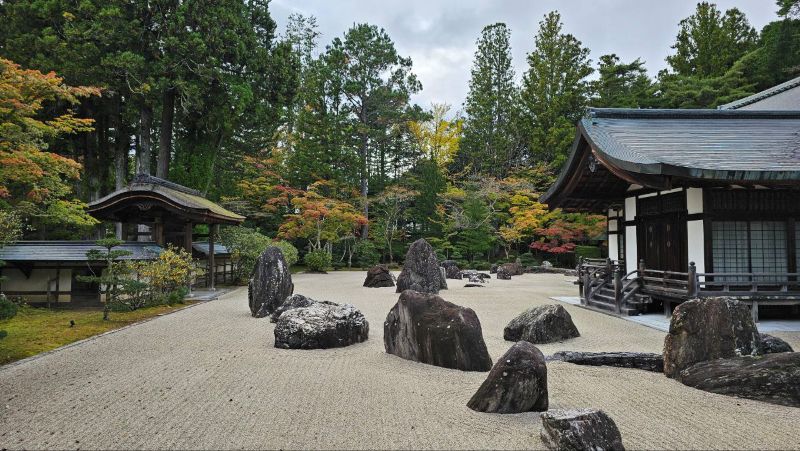
It is noteworthy that Kennin-ji remains an active Zen monastery in Japan. Every morning here, you can hear the sounds of meditation and see monks practicing zazen (sitting meditation). On certain days, the monastery opens its doors to everyone who wants to join the morning practice.
Dragons in the clouds: a masterpiece under the ceiling of Kennin-ji in Japan
In 2002, modern master Koizumi Junsaku created a stunning mural on the ceiling of Hatto’s main hall. Two mighty dragons, made in the classical technique of ink on paper, circle in a whirlwind of clouds over an area of 108 square meters.
Interesting fact: the artist worked on the painting while lying on his back for two years. He used traditional materials – natural sumi ink and washi paper – but created the composition in a modern, dynamic manner.
Dragons symbolize the duality of Zen Buddhism in Japan:
- One dragon is black, the other is white.
- One personifies a thunderstorm, the other a clear sky.
- One represents action, the other contemplation.
The composition is created in such a way that from any point in the hall, the dragons seem to be watching the visitor in this Zen monastery in Japan, and their gazes meet exactly in the center of the ceiling. Moreover, the scale of the work is so impressive that many visitors simply sit on the tatami and spend a long time looking at the details of the painting.
Interesting detail: the ink for painting was made according to an ancient recipe using soot from burnt pine branches, and the artist made the brushes himself from specially selected horsehair. This allowed us to achieve amazing depth and vividness in the image.
Today, this painting is considered one of the most impressive examples of modern Japanese temple art, seamlessly combining ancient traditions with a new artistic vision.
Shokoku-Ji: Temple of the Heavenly Dragon in Japan
In the heart of Kyoto stands Shokoku-Ji (相国寺), also known as the Temple of the Heavenly Dragon. Founded in 1382 by Shogun Ashikaga Yoshimitsu, this monastery became one of the five great Zen temples of Kyoto, “Gozan”.
What makes this place special? It is home to the famous Lake Dragon Garden (Ryugin-tei), one of the oldest surviving Zen gardens in Japan. It was created by the legendary master Soami in the 15th century and is considered one of the perfect examples of Zen philosophy in landscape art. White gravel, artfully placed rocks, and moss create a scene that changes with every hour of the day and season.
In Zen monastery in Japan houses a unique collection of paintings from the Muromachi period, including works by the famous artist Kano Tanshu. Particularly impressive are the sliding doors (fusuma) with images of dragons – hence the second name of the temple.
Interesting detail: Japan’s oldest art school, Kano, founded in the 15th century, still operates at the Zen monastery. Here they continue to teach traditional painting according to the same principles as centuries ago.
Unlike many other temples, Shokoku-ji retained its role as a center of learning. The monastery houses Hanazono University, where they study not only Zen Buddhism, but also the traditional arts of Japan. Every morning, students can be seen practicing calligraphy and meditation alongside the monks.
Bridges of time in Japan: when the past meets eternity
Five Ancient Zen monasteries in Japan – five windows into a world where time flows differently. In an age when we measure life by likes and views, these places remind us of something deeper and more important. About what existed long before us and will remain after us.
Here, among the centuries-old cryptomeria and ancient stones, you understand especially clearly: our life is just a moment in the flow of eternity. But it is precisely this moment that we can fill with meaning. The monks who created these Zen monasteries in Japan knew the secret: true wisdom is not in the pursuit of something new, but in the ability to see the eternal in every moment.
Perhaps that is why today, when the whole world is caught up in the endless race for progress, we increasingly turn our eyes to ancient shrines. We are not just looking there for beautiful views or historical facts – we are looking for answers to eternal questions: Who are we? Where are we going? What is the meaning of our journey?
If you also feel the call of ancient temples and are ready to travel not only around Japan, but also deeper into yourself, we will be happy to share this path with you. Find out more about our Ancient Tour of Zen monasteries in Japan, which can be found here. Let this be your important step towards meeting eternity…