
Morning yoga energizes the body, gives us extra strength for the day, and strengthens our mind and body.
With the modern lifestyle, when the evening city beckons with its lights, it is almost impossible to go to bed on time (before 22.00). As a result, getting out of bed early in the morning (before 6 am) is not easy. You may ask, “Why get up so early”?
Traditional yogic texts state that the early morning hours before sunrise are most beneficial for meditation and morning yoga practice because the mind is in its most peaceful state. The rest of the world has not yet woken up, and there is a special feeling of silence in the air.
“The sunrise of supreme bliss flickers in every particle of the Universe, so why not drink a cup of fresh joy every day and be inspired by new perceptions?”
Swami Chidvilasananda
Yoga in the morning – 5 reasons to practice
1. Morning yoga tones your body and relieves tension accumulated overnight
At night, our muscles rest, and while they do not move, layers of connective tissue and bodily fluid accumulate between them. When you wake up in the morning and stretch, you tear these newly formed layers of connective tissue. Every cat in the world does a good stretch when it stands up—we should do the same. Such layers of connective tissue are fragile, they easily dissolve when moving. However, if left unmoved, these layers accumulate and thicken, causing stiffness and chronic “tightness” in the muscles, which develops into constant pain. Therefore, to ensure that the body is optimally healthy and we feel physically good, it is important to stretch the body in the morning. Morning yoga helps especially well with this. In this case, even 15 minutes of morning yoga will be enough.
Additionally, if you spend most of your day sitting and hunched over your desk, in your car, or front of your computer, yoga in the morning is the right remedy for your body to regain its mobility and flexibility. The most effective way to compensate for slouching is to use poses with backbends. These poses help open the muscles of the thoracic region, develop shoulder joints, and also strengthen the hips – these are the parts of the body that are subject to constant tension due to long hours of sitting.
Back exercises:
“Cobra” / Bhujangasana

Bhujangansana is a must-have exercise for any morning yoga routine!
Execution technique
Take a lying position on your stomach. Place your palms 10-20 cm forward in front of your chest, fingers spread wide. Press your elbows to your body, legs hip-width apart, heels pointing up. Squeeze your buttocks slightly and, while inhaling, push your palms off the mat and slowly lift your body. Open your chest, stretch the top of your head up, and slightly move your shoulders back. Avoid lower back pain! The more effort you put into opening your chest, the less stress will be placed on your lower back. Stay in this position for 1-3 minutes.
An easier option
The palms can be placed a little further forward from the body. Leave your elbows half-bent.
“Dancing Dog” / Kamatkarasana

Yoga in the morning with this exercise will charge you with positivity and energy for the whole day!
Execution technique
Get into a head-down dog position (adho mukha savasana), lift your left leg, bend it at the knee and, as you exhale, bring it behind your back on the right side. The left leg is bent at the knee, the right leg is straight. Raise your left hand and place it behind your head. Push your chest forward. The supporting arm can be bent at the elbow. Aim to push your chest forward and reach your left arm back and up away from you. Perform this asana for 1 to 3 minutes.
An easier option
Bend your right leg at the knee and rest on the knee of your right leg and the foot of your left leg.
“Camel” / Ustrasana

Ushtrasana is a universal back exercise that can be performed during morning yoga and at any other time in your practice. This exercise opens the chest and gives confidence in the future.
Execution technique
Get on your knees with your toes on the mat. Squeeze your buttocks and, as you exhale, reach your heels evenly with both hands. Then push your chest forward, aiming to squeeze your shoulder blades together. Keep your head straight, do not bend your neck back – look forward in front of you. Perform for 1-3 minutes, but leave the position as soon as you feel severe discomfort.
An easier option
Place your hands on the props/bricks – adjust the height according to your current capabilities. Do not perform the asana through force and pain – this can cause a lot of harm to your health.
By doing morning yoga, you develop a healthy habit of maintaining good posture throughout the day! By exercising regularly, you will gradually stop slouching and will also definitely get rid of back pain.
2. Yoga in the morning – a stress-free day
When we wake up, our levels of cortisol (the stress hormone) are already quite high. This is necessary for the morning awakening impulse. If we wake up in the morning without leaving ourselves enough time for all the morning procedures, if we do everything in a hurry and quickly so as not to be late for work, then this creates additional stress. Accordingly, cortisol levels quickly rise, and we  (subconsciously) prepare for an equally stressful day.
If you give yourself an extra hour or a half hour in the morning to wake up peacefully and do at least 15 minutes of morning yoga, your nervous system will be able to start the day in a much more relaxed state. Making morning yoga a regular practice allows the body to develop the habit of turning off the sympathetic fight-or-flight response to stress, and instead can finally reap the healing benefits of the parasympathetic nervous system—calming the mind and relaxing the body. Thus, by doing yoga in the morning, you will improve your immune system and resistance to stress.
Morning yoga is a fantastic way to achieve two things we need in the morning: on the one hand, it is calming and relaxing, on the other hand, it is invigorating and refreshing. So, even if you feel tired when your alarm goes off, a well-thought-out morning yoga routine will wake you up and leave you feeling energized throughout the day.
3. Increase your inner strength with yoga in the morning
Gentle movements help warm the body, stimulate blood circulation, and awaken the body’s systems. Additionally, the white blood cells in your body—your disease-fighting army—can work at peak efficiency if your circulatory and lymphatic systems are working at their best. So be sure to incorporate a morning yoga practice into your daily routine to boost your immune system, especially during the cold winter months.
In addition, your overall health is determined by the health of your digestive system. You can eat as much healthy food as you want, but if your body can’t properly absorb, digest, and use the nutrients in your diet, it’s almost as if you’re throwing food straight into the trash.
Because many yoga poses gently massage your internal organs, your digestive system can eliminate toxins and absorb nutrients more effectively. Doing yoga in the morning can improve the body’s metabolism and strengthen the digestive system.
The most effective poses for massaging internal organs and stimulating the digestive system:
Matsyendrasana/Lord of the Pisces Pose
Execution technique
Sit on your buttocks and bend your left knee, pressing your left foot towards your right thigh/buttock. Bend your right leg at the knee and place your right foot behind your left thigh. As you inhale, extend your left arm up, and as you exhale, turn your body to the right and rest your left elbow on the outside of your right knee. Place your right hand behind your back and lean slightly on the mat behind your back. Don’t lean too much on your hand behind your back! Keep your spine straight, and maintain the position using your back muscles. Breathe into your stomach and, if possible, look behind your right shoulder. Maintain the position for 1-3 minutes. Then repeat on the other side, switching legs.
An easier option
Grab your right knee with your left hand and, as you exhale, push with that hand to go into a deeper twist. Perform all movements slowly and smoothly, without excessive effort.
Jathara parivartanasana
Execution technique
Lie on your back and place your arms at your sides, perpendicular to your body. Raise your straight legs perpendicular to your body up and, as you exhale, begin to lower them to the right side. Pay attention to your left shoulder blade – try to keep it pressed to the mat. As you lower your feet to the floor on the right side of your body, reach your legs toward your right palm, keeping your arms perpendicular to your body. After this, if possible, turn your head in the direction opposite to your feet. Stay in this position for 1-3 minutes, breathe deeply into your stomach. With each exhalation, relax your body more and more and watch how your body gradually goes into an ever greater twist. Then repeat on the other side.
An easier option
Follow the execution instructions described above, but bend your knees. The more your legs are bent, the easier it will be to perform this exercise.
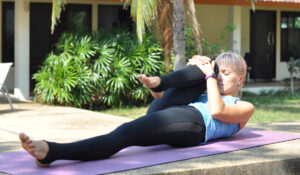
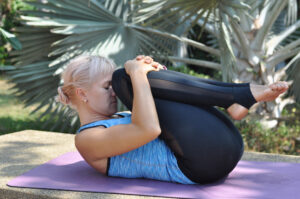
Pavanmuktasana
 | Execution technique Lie on your back and, while inhaling, stretch your legs and arms down and up, respectively, while trying to remove the lumbar arch as much as possible and press your lower back to the mat. As you exhale, bend your right leg at the knee, lift your upper body, and pull the knee of your right leg away from your forehead, helping yourself with your hands. Hold your breath in this position for 5-8 seconds. As you exhale, straighten your legs, lower your body to the mat, and stretch your arms up and your legs down. With the next exhalation, bring your left knee to your forehead and also hold your breath for 5-8 seconds. As you inhale, straighten up again and stretch your arms and legs up and down, respectively. With another exhalation, bend both legs and bring your knees to your forehead, helping yourself with your hands. Hold your breath in this position for 5-8 seconds. Inhale and once again stretch your body along the mat. Perform 2-3 sets of this practice. |
| |
|
Yoga in the morning can also be beneficial for focus and concentration. You may not be used to focusing early in the morning, but it can be very helpful in increasing your productivity and awareness throughout the rest of the day. This way, morning yoga will wake up your mind and allow you to realize your full potential throughout the day.
4. Make yourself happy with yoga in the morning

Several studies prove that regular yoga practice in the morning can reduce the symptoms of depression by influencing the production of stress hormones in the body. This makes morning yoga a great habit to not only improve your circulation and immune system but also provide a quick mood boost.
Yoga practitioners note that after a morning yoga session, the world around them miraculously changes – people on the street seem more friendly, it is easier to find a common language with others, and it is easier to choose between healthy eating rather than quick snacks. However, after practicing morning yoga, it is not the world around you that changes, but your perception of the world, which is completely created by your mind. It turns out that if you start your day by creating a positive atmosphere within yourself, the outside world will also become much friendlier.
Plus, taking the extra time to practice morning yoga is a great way to enjoy some quality time for yourself. Throughout the day, you may be constantly faced with the need to meet the needs of others, so it can seem difficult to find time to meet yourself and your own needs. This is why for many people, taking time to care for themselves feels like a luxury, and they may even feel uncomfortable taking time for themselves or feel like they’re not worth it. However, to be a source of strength and energy for others, the most important condition is to have enough energy within yourself first.
Spend some time doing yoga in the morning! Even 10 or 15 minutes of morning yoga is an ideal way to give yourself the time you need.
5. Set your rhythm for the day with yoga in the morning.

Morning yoga is a great way to tune in and explore the impact of your activities in the previous days on your physical, mental, and emotional well-being. For example, if your body feels tired and sore, it means you may have pushed yourself too hard in the previous days. So it might be worth taking some time to recover now. Or, if you notice your mind wandering around one specific thought during your morning yoga practice, this is a sign that you should take the time to listen and take action.
Plus, making yoga the first thing on your daily to-do list in the morning will help you avoid feeling guilty about not practicing that day. Instead, you do it first, and feeling like you’ve already accomplished something on your must-do list will give you self-confidence and a sense of self-care.
Before you do anything else, first of all, tune in to yourself and observe your physical and mental well-being. Scan your body for pain or tension. Ask yourself if you feel any special emotions, if you feel rested or tired. Let this observation of your inner state and well-being lay the foundation for your actions throughout the rest of the day.
If you slept well, feel rested, and have an hour or an hour and a half to practice morning yoga, then choose a full yoga class either online in a group or recorded.
At our club, we regularly conduct morning yoga classes and you can easily join any of our groups. All details on schedules, classes, and prices are here.
We also have various video courses that you can study on your own according to a schedule that suits you. Find out more about our video courses here.
For situations where there is not much time, we have prepared for you a 10-minute morning yoga practice for beginners, which is enough to fill your body with strength and set yourself up for a fruitful day.
Morning yoga – asanas
| Name of Asana in Sanskrit | The name of the asana “popularly” |
| Balasana | child’s pose |
| Marjariasana | cat pose |
| Adho Mukha Svanasana | head down dog pose |
| Uttanasana | stretching pose |
| Hasta Uttanasana | stretch pose with arms up |
| Kumbhakasana | top bar |
| Urdhva Mukha Shvanasana | head up dog pose |
| – | pose of joining the elbows in a half-sitting position |
| variation of Jathara Parivartanasana | semi-sitting twist pose |
| Sahaja Purvottanasana | upside-down table pose |
| Ananda Balasana | happy child pose |
| Shavasana | beyond the corpse |
1. Balasana / child’s pose
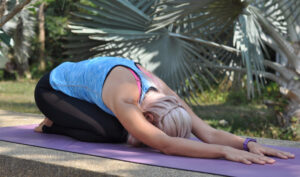 Execution technique
Sit with your buttocks on your heels, place your stomach and chest on your thighs, and extend your arms forward with your palms facing down or up. Completely relax your arms and spine. Stretch forward with your hands, pulling the mat towards you with your fingers. At the same time, observe a slight and gentle stretch of the spine.
2. Marjariasana / cat pose
Execution technique
Get into a position on your knees and hands, resting your toes on the mat. Place your palms under your shoulders, fingers spread wide. The neck is an extension of the spine. Knees hip-width apart, hips perpendicular to the mat. As you exhale, push your palms off the mat, widen your back, tuck your tailbone under you, round your spine, and look at your navel. As you inhale, relax your back, point your chest forward, and look ahead of you, arching your back under your weight (without additional effort or tension). Repeat this exercise 3-4 times, synchronizing the movements with your breathing.
3. Adho Mukha Svanasana / Downward Dog Pose
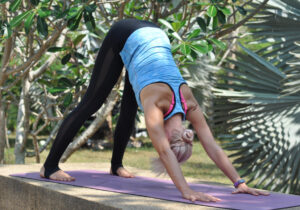 Execution technique
Stand straight, feet hip-width apart. Bend towards your feet and step your feet back at a distance of 1-1.2 meters from your hands. The fingers are spread wide apart, the palms are pressed tightly to the mat, and the feet are slightly turned with the heels outward. Bend your knees and, pushing off the mat with your hands, press your stomach to the front of your legs. Build an even position for your spine and back, pointing your tailbone up. Constantly push yourself off the mat with your hands, pushing your chest toward your hips and expanding your back. Maintaining the adjusted body position, gradually lower your heels closer to the mat and align your legs at the knees, without lifting your stomach from your hips. Stay in this position for 1-3 minutes.
4. Uttanasana / stretching pose
Execution technique
Place your feet hip-width apart, feet parallel to each other. Stretch your arms up and bend down smoothly. Bend your knees and press your stomach toward your thighs. Relax your neck (head hangs down) and grab your hands in an elbow lock. Without lifting your stomach from your hips, begin to align your legs at the knees. Reach a state of slight discomfort and stay in this position. Observe how, under the weight of your arms, with each exhalation, you go into a deeper bend. Stay in this pose for 1-3 minutes and very slowly and carefully return to the starting position, raising your body with a rounded back. The head rises last.
5. Hasta Uttanasana / stretching pose with arms up
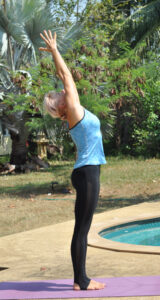 Execution technique
Place your feet hip-width apart or together – the main thing is that your feet are parallel to each other. It is easier to maintain balance when your feet are hip-width apart. As you inhale along the outer trajectory, raise your arms and bring your palms together. Squeeze your glutes, tuck your tailbone under you, and reach with your palms up, reaching behind your arms. If possible, keep your gaze (drishti) on your thumbs, stretching the back of your neck without twisting it. Hold this position for 1-3 minutes, without relaxing your buttocks and tucking your tailbone, removing the lumbar arch.
6. Kumbhakasana / upper bar
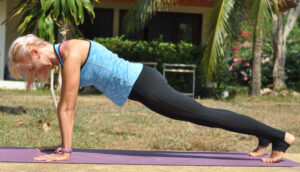 Execution technique
Stand in cat pose (marjariasana), place your hands slightly forward from the body, and rest your palms on the mat, spreading your fingers wide – your thumbs should be directed towards each other. Lift your legs off the mat and straighten them. Place some weight on your heels and rest your toes on the mat. Squeeze your glutes and tighten your abdominal muscles. Fix your gaze on a point on the mat in front of you, your neck is an extension of your spine. Imagine yourself as a straight staff. Try not to lift your pelvis up or down. Distribute your weight evenly between your arms and legs and hold the plank for 1-3 minutes.
7. Urdhva Mukha Svanasana / Upward Dog Pose
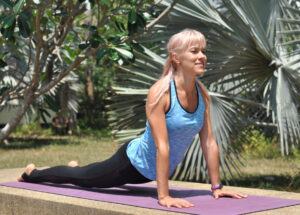 Execution technique
Lie on your stomach, straighten your legs – feet hip-width apart, point your heels up. Place your palms at chest level, spread your fingers wide, and elbows along your body. Inhale, pushing with your hands, lifting your body, directing your chest forward and opening your shoulders. Lift your knees off the mat and squeeze your glutes. Stretch the crown of your head upward. The main effort should be aimed at opening the thoracic region. There should be no pain in the lower back! Regulate the sensations in the lower back by opening the thoracic region and squeezing the buttocks. In the full version of this asana, raising the body, you need to fully straighten your arms at the elbows. However, if at the same time, you feel severe discomfort in the lower back, regulate your performance of the asana through incomplete straightening of the elbows – leave them bent and, with internal efforts, continue to direct the chest forward and move the shoulders back, thus opening the chest. Hold this pose for 1-3 minutes. Exit the asana very smoothly, and avoid sudden movements.
8. Pose of connecting elbows in a half-sitting position
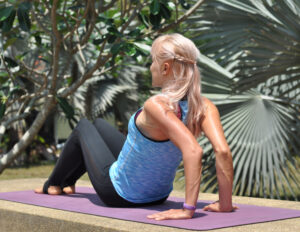 Execution technique
Sit on the mat – legs bent at the knees, feet together and pressed to the mat. Place your hands behind your back and place your palms on the mat. Turn your fingers towards the body and slightly move the body back onto your hands. Bend your elbows and try to point them toward each other, pushing your chest forward and opening your shoulders. Hold this position for 1-3 minutes.
9. Jathara Parivartanasana / half-seated twisting pose
Execution technique
Sit on the mat, bend your knees, bring your feet together and place them on the mat. Place your hands behind your back and rest your hands on the mat, pointing your fingers away from you to the sides. Straighten your back and, leaning on your hands, exhale and lower both knees to the right. As you inhale, return to the starting position and on the next exhalation, lower your knees to the left. During the exercise, keep your body still and breathe into your stomach. Perform 10-20 twists on each side.
10. Sahaja Purvottanasana / inverted table pose
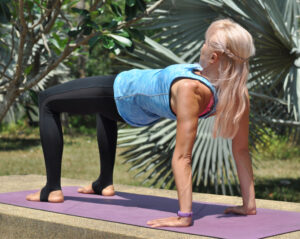 Execution technique
Take a position on the mat as before performing the previous asana (variation of Jathara Parivartanasana). The fingers can be directed either towards the body or away from you. With an inhalation, lift your pelvis up, resting on your palms and feet. Focus your gaze on a point in front of you, stretch the back of your neck, do not bend it back. Keep the distance between your knees hip-width apart and, squeezing your buttocks, continue to push your pelvis higher. Hold this asana for 1-3 minutes.
11. Ananda Balasana / Happy Child Pose
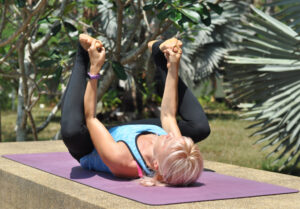 Execution technique
Lie on your back and grab your big toes with your middle and index fingers. Using the weight and strength of your arms, pull your feet toward your chest, directing your knees along your body to the sides. Make sure to direct your hips and knees along the body, do not point them too far to the sides. Hold this asana for 1-3 minutes.
12. Shavasana / corpse pose
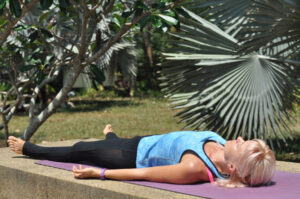 Execution technique
If your room is cool, be sure to insulate your feet and cover yourself with a blanket – during shavasana the body will quickly cool down. Lie on your back on the mat. Place your feet hip-width apart and your arms 30 degrees from your body, palms up. Close your eyes and completely relax your body. Observe your breathing and relax completely. Stay in shavasana for 3-5 minutes.
Morning yoga 10 minutes, video:
We have developed a 10-day morning yoga program with 15-minute sessions:
Join our classes. Exercise and be healthy!