Contents:
- Introduction
- History of the Practice
- Scientific Rationale
- Choosing Equipment
- Beginner Technique
- Advanced Practices
- Safety and Contraindications
- Conclusion
Introduction
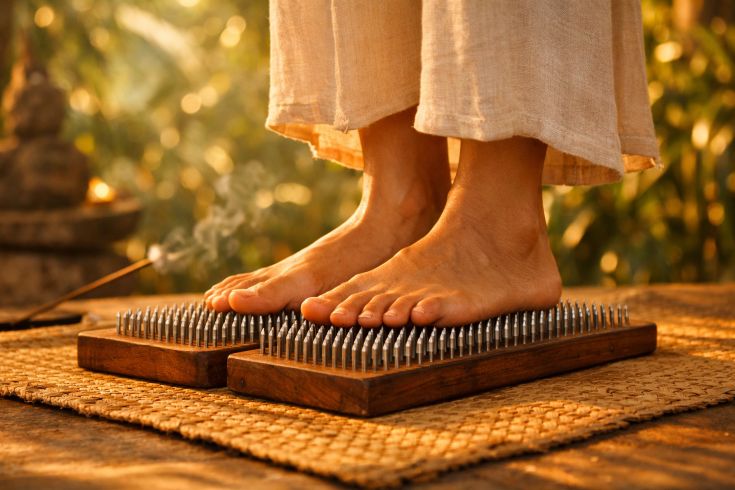
Imagine: you are standing barefoot on hundreds of sharp metal nails. The first thought is pain, fear, impossibility. Yet thousands of people around the world do this every day. And not because they are masochists or thrill-seekers. They have found what modern civilization has almost taken away from us — direct contact with ourselves.
We live in an age of endless informational noise. Notifications, deadlines, alarming news — the brain is overloaded, the body is tense, and the inner voice has long been drowned out. We look for a way out through meditation, yoga, retreats — and often don’t find it. Because the mind keeps running even when the body becomes still.
Nail standing works differently.
When the soles touch sharp spikes, the mind falls silent instantly. There is no room for thoughts about work, fears, resentment — there is only this moment, this breath, this body. A practice more than three thousand years old returns us to what yogis called awakening — a state of full presence.
But nail standing is not only about spirituality. Modern research confirms that stimulating reflex points on the feet triggers powerful physiological processes — the release of endorphins, improved circulation, and reduced cortisol levels. What the ancients knew intuitively is explained by science today.
This article is our complete guide for you. From the history of the practice and its scientific rationale to choosing your first board and learning safe entry technique. Whether you are looking for a tool to work with stress, a way to deepen meditation, or simply a new challenge — here you will find everything you need to start mindfully and safely.
Ready to step onto the nails? Then let’s go дальше.
History of the practice: from Indian ascetics to modern studios
Origins: three thousand years ago
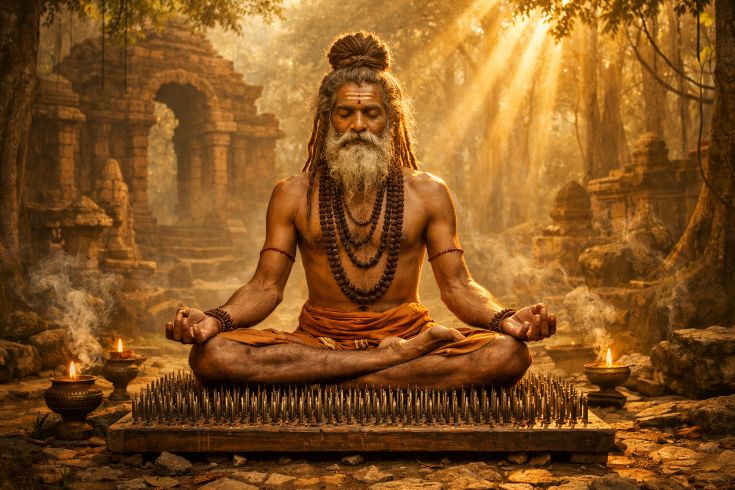
Nail standing was born in India — the cradle of yoga, meditation, and profound spiritual traditions. The earliest mentions go back more than 3,000 years, when wandering ascetics — sadhus — used it as a tool for spiritual transformation.
The word “sadhu” means “one who goes toward truth.” These people renounced worldly benefits and dedicated their lives to the search for enlightenment. Standing on nails was one of the tapas — ascetic practices through which sadhus hardened the spirit, overcame attachment to the body, and reached altered states of consciousness.
For them it was not a test of endurance. It was a bridge between the physical and the spiritual — a way to go beyond the mind through an intense bodily experience.
The legend of Bhishma
One of the most famous stories connected with the practice comes from the ancient Indian epic “Mahabharata.” The great warrior Bhishma — the grandfather of the Pandavas and Kauravas — was struck in battle and fell onto a bed of arrows piercing his body. But he did not die.
Bhishma had the gift of choosing the moment of his death. He lay on that “bed of arrows” for 58 days, waiting for an auspicious time to depart. Throughout, he remained fully conscious, gave teachings, and kept absolute calm of spirit.
This legend became a symbol of the idea that pain is not a verdict, but a choice of perception. The body may experience intense sensations, yet consciousness can remain free. This principle lies at the heart of nail standing.
From secret knowledge to open practice
For centuries, nail standing remained the domain of the chosen — monks, yogins, spiritual seekers. Boards with nails (sadhu boards) were passed from teacher to student as a sacred tool.
Everything changed in the 20th century, when Eastern practices began to spread in the West. Yoga, meditation, Ayurveda — ancient knowledge became accessible to everyday people. Nail standing followed, a bit later.
The true boom began in the 2010s. The first manufacturers of high-quality sadhu boards appeared, studios opened, and the practice became part of the wellness industry. From an ascetic ritual it turned into an instrument for working with stress, the body, and emotions — accessible to anyone.
Nail standing today
Today the practice is experiencing a renaissance. It is used by:
- Yoga studios — as an addition to asanas and meditation.
- Psychologists and coaches — to work with anxiety and emotional blocks.
- Athletes — to build mental resilience.
- Businesspeople and entrepreneurs — as a way to reset and make decisions.
- Everyday people — to reduce stress and regain contact with the body.
The practice has traveled from secret knowledge of Indian ascetics to a modern tool for self-development. But its essence remains unchanged: through the body — to awareness; through intensity — to mental silence.
Scientific rationale: what happens to the body on nails
The foot is a map of the whole organism
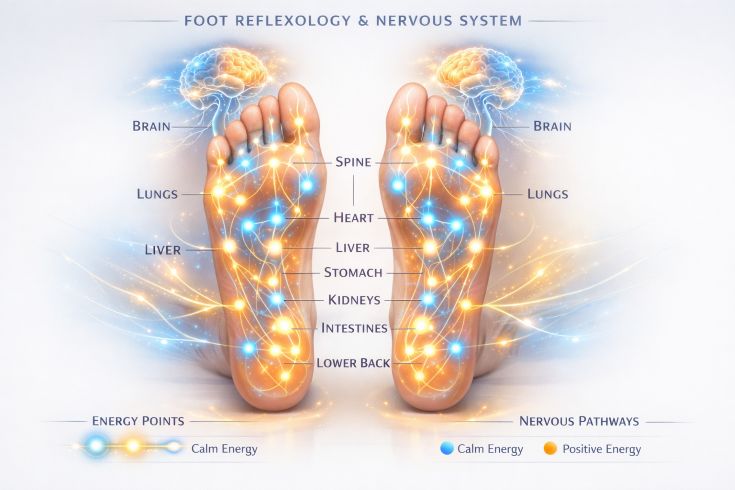
To understand how nail standing works, let’s start with anatomy. The human foot is not just a support for the body. On an area of roughly 150 square centimeters there are more than 70,000 nerve endings — one of the most sensitive zones of the body.
According to reflexology principles, the foot represents a projection of the entire body. Each area is linked with a particular organ or system: toes — head and neck; arch — spine and internal organs; heel — pelvic area. When nails act on these points, they trigger a cascade of physiological reactions throughout the body.
This is not esotericism — it is neurophysiology. Stimulating nerve endings in the feet activates afferent pathways that carry signals to the spinal cord and brain, influencing the autonomic nervous system.
Hormonal response: endorphins and cortisol
When you step onto nails, the body perceives it as an intense stressor. But that’s where it gets interesting.
In the first seconds, the sympathetic nervous system activates — the “fight or flight” response. Heart rate rises, breathing becomes shallow, muscles tense. The organism prepares for danger.
But if you stay on the board and begin to breathe consciously, a switch occurs. The body realizes there is no real threat. The parasympathetic response — the “rest and restore” system — is engaged, along with a strong release of endorphins.
Endorphins are natural painkillers, said here to be 18–30 times stronger than morphine. They don’t just reduce discomfort — they can create a state of euphoria, deep calm, and well-being. That’s why people describe the after-effects as “inner light,” “warmth throughout the body,” “bliss.”
At the same time, cortisol — the hormone of chronic stress — decreases. The text notes that regular practice can help normalize cortisol patterns, which directly affects sleep quality, immunity, and emotional stability.
Circulation and microcirculation
Nails create point pressure on the foot, producing an effect similar to a deep micromassage. This stimulates circulation not only in the legs, but throughout the body.
The mechanism is simple: while standing on nails, blood initially “moves away” from pressure points; after stepping off, a sharp influx occurs. This contrast boosts microcirculation, improves tissue nutrition, and speeds up the removal of toxins.
Practitioners often note that after regular sessions:
- feet feel less cold;
- the feeling of heaviness in the legs decreases;
- the skin condition of the feet improves;
- overall tone increases.
Neuroplasticity: training the brain
There is another aspect discussed less often — the effect on the brain.
When we consciously stay in discomfort and don’t run from it, we literally rewire neural connections. The brain learns a new pattern: intense sensation ≠ danger. This is what neuroscientists call “expanding the window of tolerance.”
In practice, this means a person who regularly stands on nails becomes more resilient to stress in everyday life. Deadlines, conflict, uncertainty — situations that used to knock you off balance start to feel calmer, because the body already knows: you can be in intensity and remain resourced.
What studies say
Scientific research on nail standing is relatively young, but some data already exists, as the article states.
- Hallman et al. (2011), “Relaxing on a Bed of Nails” (Journal of Alternative and Complementary Medicine) studied physiological responses while lying on a spiked mat. Results showed slower heart rate and increased heart-rate variability (HRV), a marker of parasympathetic activation related to relaxation.
- Kisker et al. (2024), “Regular use of acupressure mats reduces perceived stress”, reported that regular use of acupressure mats significantly reduces perceived stress in healthy young adults.
- Meta-analysis Song et al. (2020) (Evidence-Based Complementary and Alternative Medicine) summarized data on foot reflexology: point stimulation reliably improves sleep quality and reduces anxiety and depressive symptoms in adults.
- Frizziero et al. (2021) reported effectiveness of acupressure mats in reducing pain sensations and improving quality of life in chronic pain.
It’s important to understand: nail standing is not a medical procedure and does not replace treatment. But as an additional tool for working with the body and psyche, the article says its effectiveness is supported by both experience and scientific data.
Choosing equipment: your first sadhu board
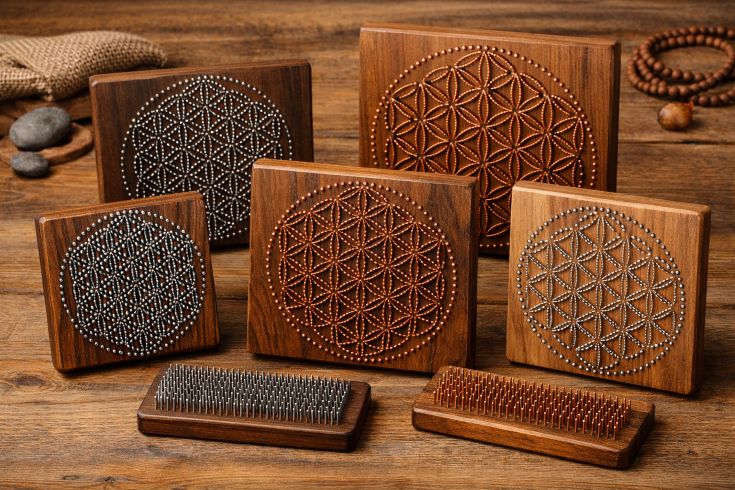
Board anatomy: what it consists of
A sadhu board is a simple construction, but every detail matters. Key elements:
Base — a wooden platform that holds the nails, typically made from birch, oak, beech, or other hard woods. The wood should be properly dried and finished for durability and safety.
Nails — the main working element. The number ranges from a few hundred to a few thousand depending on board size and spacing.
Fastening — the method of fixing nails into the base. Quality boards use reliable fastening to prevent wobbling or nails falling out.
Nail material: steel, copper, or silver
Material choice is presented as not only about durability but also about the “energy” of practice. Each metal has its properties.
Stainless steel — the most common and practical option. It doesn’t rust, doesn’t oxidize, and lasts for years. Sensations are neutral and “clean.” Ideal for beginners and regular practice; best price-to-quality ratio.
Copper — considered special; in Ayurvedic tradition copper is viewed as a “living” metal with antibacterial and balancing qualities. Practitioners note “softer,” “warmer” sensations on copper nails. Downside: copper oxidizes over time and needs care.
Zinc — used more rarely, often combined with other metals; relatively corrosion-resistant.
Silver — a premium option for those who treat the practice as a sacred ritual; associated with cleansing and lunar energy. Price is accordingly higher; few practical advantages over steel.
Starter recommendation: stainless steel. Reliable, hygienic, accessible.
Nail spacing: from gentle to extreme
This is the key parameter that determines intensity. Spacing is the distance between nails. The smaller the spacing, the more nails per area, and the softer the sensation (because body weight is distributed across more points).
- 15–12 mm — gentle level
- 10–8 mm — medium level
- 7–6 mm — intense level
- 5 mm and less — extreme level
Starter recommendation: 12–10 mm. Intense enough to “work,” gentle enough not to scare you off on day one.
Board size: tailored to your feet
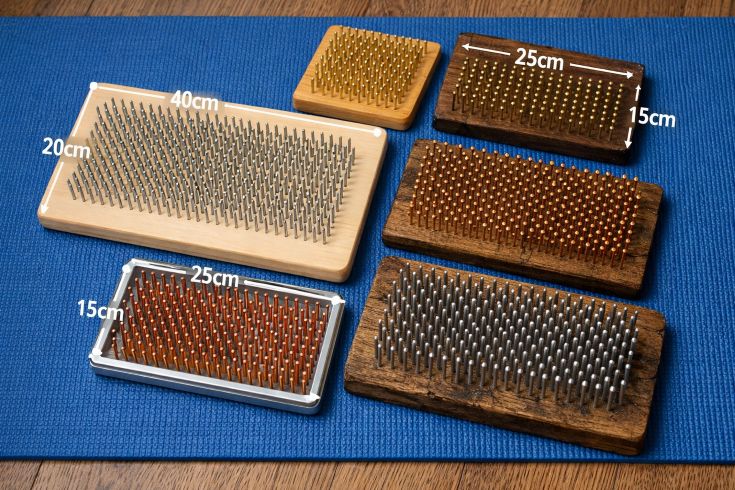
Boards come in different sizes:
- Compact (for one foot) — convenient for travel and storage. You can practice standing on one foot alternately, or use two boards.
- Standard (for both feet) — the best option for home practice. The size is usually around 40×20 cm (or close). It lets you stand on both feet, which is important for balance and full practice.
- Large (with extra space) — gives you more freedom in foot placement and allows you to change position during the practice.
Recommendation: choose a standard board for both feet. Make sure your feet fit fully on the working surface with a small margin.
Nail layout geometry: “Flower of Life” and more
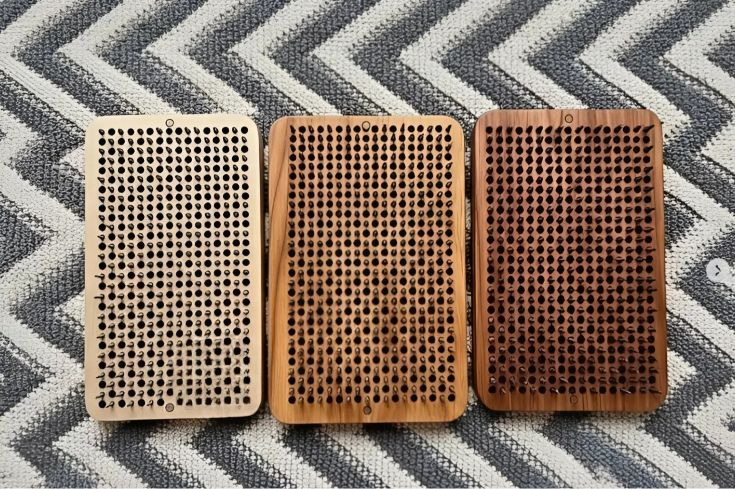
On quality boards, nails aren’t placed randomly—they follow a specific pattern. This affects both the evenness of pressure and the “energetics” of the practice.
- Flower of Life — the most popular form of sacred geometry. This ancient symbol is made of intersecting circles and can be found in temples and sanctuaries around the world. It’s believed to harmonize the energy field and enhance the meditative effect.
- Hexagonal grid — nails are placed at the vertices of regular hexagons. This ensures an even distribution of pressure.
- Square grid — a simpler option, common in budget models.
Choosing a pattern is a matter of personal preference. If the symbolic aspect matters to you, choose the Flower of Life. If you only care about functionality, any evenly spaced layout will work.
Quality board checklist
Before buying, check that:
- The nails are securely fixed — they don’t wobble or fall out.
- All nail tips are the same height — move your hand over the surface; there shouldn’t be any “sticking-out” nails.
- The wood is properly finished — smooth, with no splinters or cracks.
- There’s no rust or defects — especially important for steel nails.
- The manufacturer lists materials and specifications — transparent information usually indicates a serious approach.
Beginner technique: your first time on nails
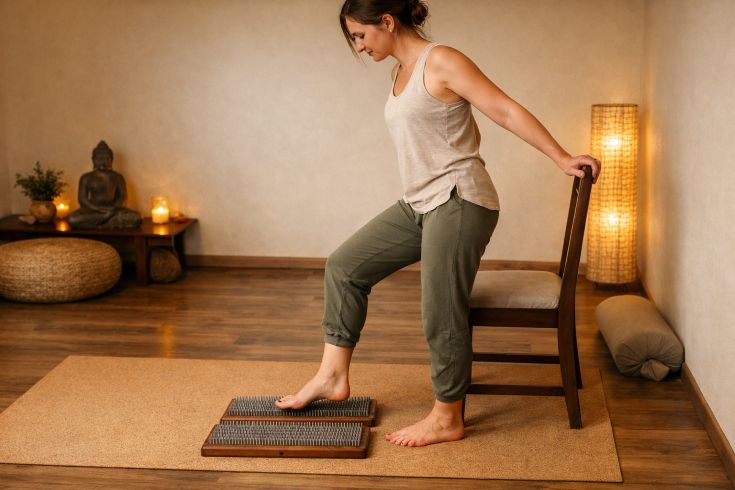
Breathing: your main tool
Deep inhale through the nose (4 counts). Breathe with the belly, not the chest. Imagine the air filling the whole body all the way to the feet.
Hold after inhale (2 counts). A soft pause, not a tense one.
Slow exhale through the mouth (6 counts). The exhale is longer than the inhale — this activates the parasympathetic system. On the exhale, imagine tension leaving the body.
Pause after the exhale (2 counts). A moment of silence before the next cycle.
This 4-2-6-2 pattern is basic. Over time, you will find your own rhythm. The main principle: the exhale is longer than the inhale, breathing is continuous, attention is on the breath—not on sensations in the feet.
What you will feel: a map of sensations
Your first experience may vary. Here’s what most beginners feel:
- First seconds (0–10). Intense pressure; possibly a sharp body reaction. You want to step off immediately. This is the peak—and it passes.
- Adaptation (10–30 seconds). The body starts getting used to it. The sharpness decreases. You notice you can breathe, you can think. The first barrier is crossed.
- Stabilization (30–60 seconds). If you breathe correctly, a strange calm appears. Sensations haven’t disappeared, but they no longer control you. This is the first glimpse of the state it was all for.
- After stepping off. Your feet burn, throb, tingle. That’s normal—blood rushes back to the pressure points. Within 5–10 minutes it fades, leaving pleasant warmth and a sense you did something important.
Progression: how to develop
Don’t rush. Nail standing is a marathon, not a sprint. A rough plan:
- Weeks 1–2. Practice every other day for 30–60 seconds. Goal: get used to sensations, learn safe entry/exit, establish breathing. Hold onto support as long as needed.
- Weeks 3–4. Increase time to 2–3 minutes. Try without support. Start noticing how sensations change from the beginning to the end.
- Months 2–3. Reach 5–10 minutes. Experiment with closed eyes. Add intention—formulate a question or theme before practice.
- Month 4+. 15–20 minutes becomes comfortable. You may be ready for a more intense board (smaller nail spacing) or advanced techniques.
This is a guideline, not a rigid rule. Listen to your body. Faster or slower progress is both normal.
Common beginner mistakes
- Starting too hard. Using an extreme board or standing 10 minutes on day one leads to disappointment. Start gently. If pain feels unbearable, see the step-by-step adaptation method below.
- Fighting sensations. Clenched teeth, tense shoulders, held breath—these amplify discomfort. Relaxation and breathing are your allies.
- Comparing yourself to others. “He stands 20 minutes and I can’t do one.” This isn’t a competition.
- Irregularity. Once a month won’t work. Without adaptation, every time feels like the first. Minimum: 2–3 times per week.
- Forcing it when you feel unwell. Sick, sleep-deprived, emotionally exhausted—postpone. This practice requires resources.
How to start if it hurts unbearably
If first contact is too painful, don’t force yourself. A gentle adaptation path:
- Start with a Kuznetsov applicator (plastic spikes are less intense). Stand or lie on it 5–10 minutes daily for 2–3 weeks.
- Transition with a “buffer.” Place a sheet of thick paper or thin cloth over the nails. It softens sensations while keeping point pressure.
- Gradually remove the layer. After a few sessions, remove the paper and step onto the nails directly.
This approach helps the nervous system adapt without stress or rejection.
After practice: integration
After stepping off, don’t rush back to tasks. Give yourself 5–10 minutes:
- sit or lie down;
- keep breathing deeply;
- observe bodily sensations;
- note your emotional state.
Many people keep a practice journal: date, time on the board, sensations, insights.
Advanced practices: beyond physical sensations
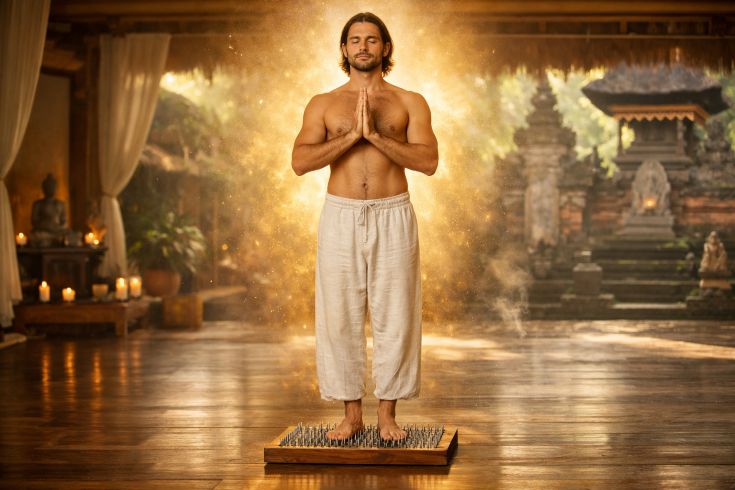
When the basic level is no longer enough
You stand 10–15 minutes without support. Breathing is steady, the body is relaxed, discomfort no longer scares you. The practice has become familiar.
But many stop here, turning it into a routine like brushing teeth. This is where depth begins: the physical level is just the doorway—beyond it is work with consciousness, emotions, and life intentions.
Time to go further.
Sankalpa: the power of conscious intention
Sankalpa is a Sanskrit word meaning “an intention born from the depth of the heart.” It’s not merely a goal or wish; it’s a resolve aligned with deep understanding of who you are and where you’re going.
In yoga nidra, sankalpa is a short affirmation “planted” in consciousness during deep relaxation. Nail standing can create a similar state when mental noise quiets and deeper layers of psyche become accessible.
How to work with sankalpa on the nails:
- Formulate it in advance. Short, positive, present tense. Not “I want to stop being afraid,” but “I am calm and confident.” Avoid “not.”
- Repeat it before stepping on. Close your eyes, take three deep breaths, repeat it three times (silently or aloud). Feel it as a state.
- Return to it at the peak. When you’re stable—breathing smooth, body adapted—repeat it again.
- Close with it. Before stepping off, repeat it once more.
Examples:
- confidence: “I trust myself and my decisions”;
- calm: “I find peace in any circumstances”;
- health: “My body restores and fills with strength”;
- relationships: “I am open to love and I receive it”;
- realization: “I act and create my reality”.
One sankalpa is for a longer period. Don’t change it every session—give it time (at least 40 days).
Long sessions: 30 minutes and more
When 15–20 minutes feels comfortable, should you increase time?
Yes—if you understand why.
What can happen:
- 20–30 minutes. Several adaptation waves: discomfort → comfort → a new wave → easing again. You observe impermanence.
- 30–45 minutes. A meditative state: thoughts slow, time feels different. Insights/images/memories may arise.
- 45–60 minutes. Deep inner work; emotional releases (tears, laughter, relief) may happen.
- 60+ minutes. For experienced practitioners; requires strong preparation, correct equipment, and ideally supervision or someone nearby.
Rules:
- increase gradually (5 minutes at a time);
- long sessions no more than 1–2 times per week;
- leave time for integration afterward;
- keep water nearby;
- avoid planning intense activity immediately after.
Working with emotions: nails as therapy
One of the strongest uses is emotional work. The body stores trauma, fears, suppressed feelings. Intense physical experience can unlock these storages.
Why it works: when strong emotions can’t be expressed, the body “freezes” them. Muscle clamps, chronic tension, psychosomatic symptoms are traces of unprocessed feelings. Nail standing creates controlled stress that can “thaw” these blocks.
Emotional release technique:
- choose an emotion/situation;
- step on with that intention in the background;
- observe what arises;
- allow it—don’t analyze or suppress; breathe, cry/laugh/sound if needed;
- close with gratitude.
Important warning: with serious trauma (violence, loss, deep depression), do this with a therapist/psychologist. The practice may bring up more than you can process alone.
Practice with closed eyes
A simple change that deepens the experience: with eyes closed, attention turns inward.
How:
- start with your usual duration;
- hold support at first (balance is harder);
- gradually let go.
What it adds:
- sharper bodily perception;
- inner imagery/“inner sight”;
- deeper relaxation;
- stronger sense of immersion.
Advanced breathing techniques
The 4-2-6-2 breath is the base. To deepen:
- Kapalabhati before practice. 30–50 sharp exhales through the nose with passive inhales.
- Exhale holds (Bahya Kumbhaka). Hold after exhale for a comfortable time.
- Nadi Shodhana on the board. Alternate-nostril breathing (hard but powerful).
- Spontaneous breathing. In long sessions, release control and let the body breathe naturally.
Dynamic practices
You don’t have to stand still:
- slow weight shifts (left/right; heel/toe);
- micro-movements (subtle sways, circles, spinal waves);
- toe rises (advanced);
- Tree pose (Vrksasana) on the board.
Keeping a practice journal
Write down:
- date/time;
- duration;
- sankalpa (if used);
- physical sensations;
- emotional state before/after;
- insights/observations;
- sleep quality the next night.
Safety and contraindications: practice without harm
Main principle: awareness, not heroism
This is a mindfulness practice, not a toughness test. “Pushing through” and ignoring body signals leads to injuries and disappointment.
Absolute contraindications
Do not practice if you have:
- pregnancy (any stage);
- epilepsy;
- acute inflammatory illnesses (fever/infection, active inflammation);
- cancer (without oncologist approval);
- thrombosis or thrombophlebitis;
- acute-phase psychiatric disorders (psychosis, severe depression with suicidal thoughts, manic episodes).
Relative contraindications
Possible with caution/limits:
- cardiovascular conditions (hypertension, ischemic heart disease, arrhythmias) — cardiologist consult recommended;
- varicose veins (depends on severity);
- diabetes, especially with neuropathy;
- skin conditions of the feet (fungus, eczema, psoriasis on feet, cracks, damaged calluses);
- recent injuries/surgeries;
- menstruation (many report higher sensitivity);
- recent severe emotional shock.
When to postpone even if you’re generally healthy
Skip a session if:
- 5 hours sleep;
- alcohol within the last 12 hours;
- taking painkillers;
- fever;
- severe headache;
- extreme fatigue/exhaustion;
- flare of chronic illness.
Foot check: before and after
Before:
- no cuts/wounds/blisters;
- no inflammation/redness/pustules;
- no cracks (between toes/heels);
- skin clean and dry.
After:
- pinpoint redness is normal (15–30 min);
- bleeding punctures should not happen with correct technique;
- unusual pain spots—monitor.
Equipment hygiene
Basic rules:
- clean, dry feet only;
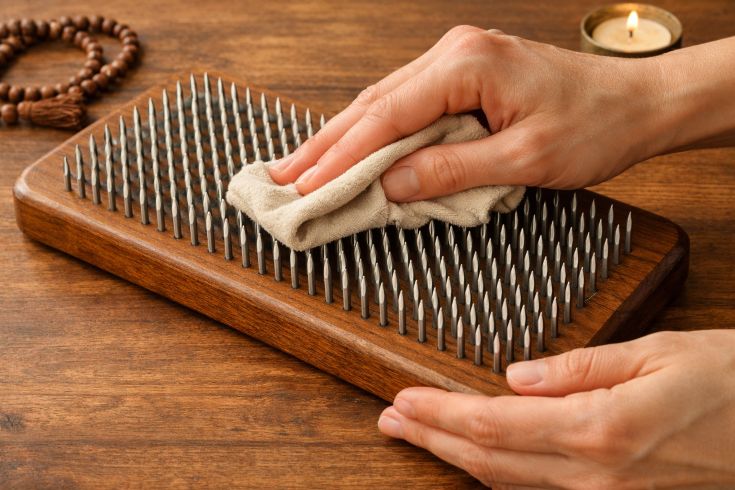
- wipe nails with antiseptic after each session;
- store dry and dust-protected;
- don’t share (or disinfect thoroughly);
- check nails for rust/bent tips.
In a studio:
- confirm disinfection between clients;
- thin socks can be used initially (less effect);
- if hygiene is doubtful, refuse or bring your own board.
Red flags: stop immediately
Step off right away if:
- dizziness / near-fainting;
- sharp “different” pain;
- numbness of part/all of the foot;
- strong nausea;
- very strong heartbeat or chest pain/pressure;
- panic attack;
- blood on the feet.
Typical injuries and prevention
- skin micro-punctures → prevent with slow entry/exit, support, gradual adaptation;
- bruises/deep marks → avoid long sessions too early, avoid overly aggressive boards;
- worsening vein issues → add dynamic shifts, limit time;
- emotional overload → go gradually, have support, know when to stop.
Special cases: children and older adults
- children under 14: not recommended;
- teens 14–18: only with parental consent, softest boards, adult supervision;
- older adults: age isn’t a contraindication by itself, but start very gently, with support, short sessions; consult a doctor if chronic conditions exist.
When you need a doctor
See a doctor if:
- marks/redness last more than a day;
- signs of inflammation appear (swelling, heat, pus);
- pain or numbness persists;
- unusual symptoms occur;
- skin was injured.
Legal aspect: practice at your own responsibility
At home—responsibility is yours. In a studio, ask about instructor training, health screening, hygiene, and emergency actions. Serious studios may request informed consent.
Conclusion: the first step on the path
Thousands of years—and one moment
You’ve gone a long way through this article: from ancient ascetics to modern research, from choosing a first board to advanced techniques, from safety rules to deeper mechanisms.
But this is only a map—and a map is not the territory.
Nail standing can’t be understood with the mind; it must be lived.
What you may gain
With regular mindful practice:
- body: better circulation, reduced muscle clamps, stronger grounding;
- emotions: more stress resilience, ability to feel without suppression, inner calm;
- mind: clearer thinking, better focus, quieter inner critic, more space between stimulus and response;
- life: a different relationship to challenges—less fear, more growth.
What not to expect
Not a magic pill. It won’t replace therapy for deep trauma, won’t cure conditions requiring medical treatment, and won’t solve real-world problems without action. But it offers an инструмент—a way to return to yourself.
A closing message
Thousands found this path before you. Now it’s your turn.
The nails are waiting.
We invite you to Bali

If this article resonated with you, come join us for the “Kundalini Power” retreat. We’ll be practicing nail standing alongside yoga, pranayama, meditation, and sound therapy—in powerful locations where every practice is felt more deeply.
Bali is the perfect space not just to try it, but to truly live this experience. We’d be happy to walk this path with you.
May 1, 2026 · 13 days
Roman Teos and Olya Amitara