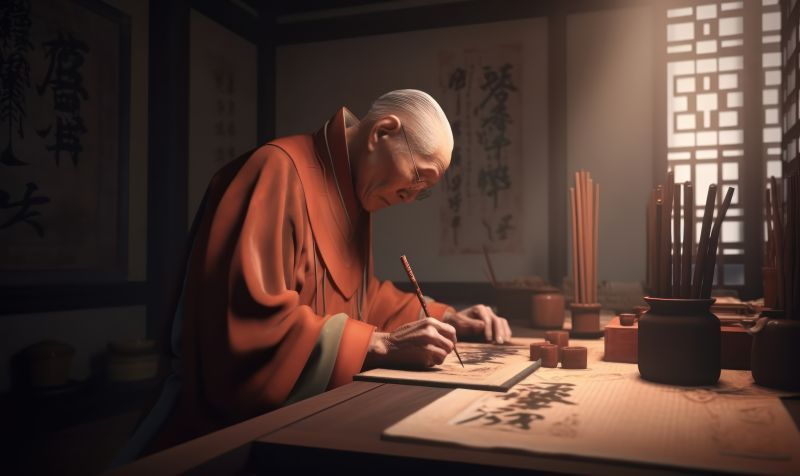
Imagine a quiet room in an ancient temple. A monk is bent over a sheet of rice paper, his brush frozen in the air just before touching the surface. This moment of full concentration and simultaneous emptiness of the mind is the essence of Japanese calligraphy (書道 – Shodō). Here, every stroke is not just a line but an expression of the soul, and every character is not just a symbol but an imprint of a moment of truth.
A special place in this art is held by the practice of copying Buddhist sutras (写経 – Shakyō). This is not mechanical copying of texts but a profound spiritual experience where the act of writing becomes a form of meditation, and every reproduced character an act of devotion and self-discovery.
To understand how this ancient art achieved such depth and significance in Japanese culture, let us look back at its origins and evolution through the centuries.
The History of Sacred Art
Calligraphy came to Japan alongside Buddhist sutras in the 6th century. Monks traveling from China through Korea brought with them not only sacred texts but also a special reverence for the process of writing itself. In ancient monasteries, copying sutras became the first form of Japanese calligraphy, transforming from mere transcription into a profound spiritual practice.
By the 8th century, Japan had developed its own schools of calligraphy, where the art of writing evolved in two directions. At the imperial court, it became a refined art form, symbolizing education and sophistication. In monasteries, however, calligraphy remained primarily a spiritual practice, a path toward enlightenment through every movement of the brush.
Over time, Japanese masters created unique styles distinct from their Chinese origins. New forms emerged, such as waka (和歌) — the calligraphic writing of Japanese poetry, and kana (仮名) — a particular style for recording Japanese syllables, reflecting the softness and fluidity of the Japanese language.
Each historical period contributed its own nuances to the art of calligraphy, but one element remained unchanged: the profound veneration of the act of writing as a path to spiritual perfection.
Philosophy and Spirituality
In Japanese calligraphy, each brushstroke is more than just the writing of a character. It is a moment of absolute presence, where breath, movement, and consciousness merge into one. Masters often say, “When you write — only write,” emphasizing the importance of complete immersion in the process.
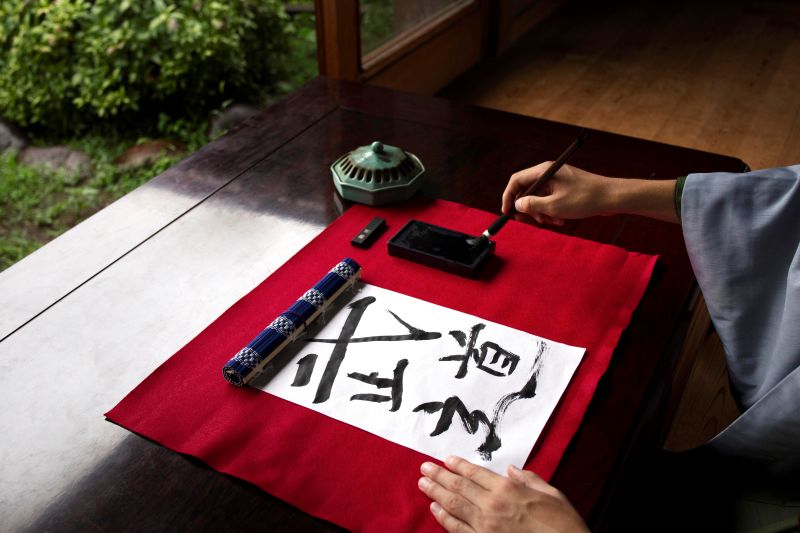
A key concept in the practice of calligraphy is the state of *mushin* (無心), the “empty mind.” This is not the absence of thoughts, but a special state of freedom from judgment and expectation. In this state, each stroke is born naturally, like a breath, without interference from rational thinking.
Zen Buddhism introduced into calligraphy the principle of *ichi-go ichi-e* (一期一会) — “one moment, one encounter.” Each written character is unique and unrepeatable, just like the moment of its creation. This reflects deep wisdom: the acceptance of imperfection and the beauty of the present moment.
The practice of calligraphy becomes a form of moving meditation, where through the simple act of writing, one discovers profound truths about the nature of the mind and reality.
The Practice of Copying Sutras
In the tradition of Shakyō (写経) — the copying of Buddhist sutras — every detail holds deep meaning. The preparation for practice begins long before the brush touches the paper. Masters say, “First, clear the space around you, then clear your mind.”
Special materials are used for this practice: delicate rice paper called *washi* (和紙), *sumi* ink (墨) made from natural components, and specific brushes known as *fude* (筆), each designed for a particular style of writing. Even the posture of the writer — *seiza* (正座) — is part of the practice, helping to maintain the proper state of mind.
The process itself begins with a cleansing ritual and a brief meditation. Each character is written with full awareness as if it were the only one and the last. Mistakes are not corrected — they become part of the journey, serving as reminders of the imperfection of human nature.
Immersing themselves in this practice day after day, month after month, calligraphers notice remarkable changes not only in their penmanship but also in their state of mind. Modern science is increasingly intrigued by this phenomenon, studying how the regular practice of calligraphy affects brain function, emotional well-being, and even physical health. Let us explore these fascinating transformations in more detail.
Impact on the Mind
In the modern world, where human attention is constantly scattered across countless tasks, calligraphy offers a unique opportunity for deep concentration. What happens to our brain during this incredible practice?
Researchers from Tohoku University discovered something remarkable: just 20 minutes of calligraphy can reduce levels of the stress hormone cortisol by a third. Imagine that the simple act of writing characters works on the body like profound relaxation or meditation. This explains why people feel such tranquility and lightness after a session.
Even more fascinating results came from a long-term study conducted at Kyoto University. Individuals who regularly practiced calligraphy experienced significant improvements in memory and learning ability. Why? Because calligraphy simultaneously engages numerous areas of the brain: visual memory, motor skills, and attention focus. It’s like a comprehensive workout for the mind, but instead of heavy exercises, it involves the gentle movement of a brush across paper.
In the digital age, calligraphy takes on new meaning as a way to restore a connection with the present moment. More and more people are discovering this practice not only as an art form but as a path to inner balance and mental clarity.
It’s no surprise that in modern Japan, the art of calligraphy is undergoing a true revival, finding new applications in various areas of life.
Modern Significance
While most people type messages on their smartphones, in Japan, the art of calligraphy is not only being preserved but is also finding new life. In modern offices of major companies, special rooms are being created for calligraphy sessions, offering employees a moment of peace amidst a hectic workday.
The younger generation is discovering calligraphy through unconventional formats: performances where masters create massive characters set to contemporary music, and short videos of the calligraphy process are gaining popularity on social media. Traditional art is adapting to the pace of modern life while retaining its profound essence.
It is particularly fascinating to see how calligraphy integrates into various creative fields, from logo design to creating prints for clothing. Modern artists use calligraphic elements in their work, crafting a unique synthesis of ancient art and contemporary trends.
Still, the core value of calligraphy remains the same — it offers a chance to find a moment of stillness and harmony in an ever-accelerating world. Perhaps that’s why more and more people around the globe are turning to this practice, seeing in it not only aesthetic pleasure but also a path to inner balance.
Conclusion
Japanese calligraphy is much more than the art of beautiful writing. It is a living tradition that has carried through the centuries the wisdom of finding harmony in the simple stroke of a brush. From ancient monasteries to modern offices, from sacred sutras to artistic performances, it continues to teach us the importance of being present in the moment.
We invite you to immerse yourself in this incredible art through our special Zen tour of Japan. You will visit the ancient temples of Kyoto, where monks have practiced the art of calligraphy for centuries, participate in a traditional masterclass led by a true Shodō master, and experience the atmosphere of age-old traditions that remain alive to this day. The program also includes visits to secluded monasteries and sacred sites, each stone resonating with the timeless wisdom of Zen Buddhism.
It is never too late to begin practicing calligraphy. As Japanese masters say: “What matters is not the final result, but the journey your brush and spirit take.”