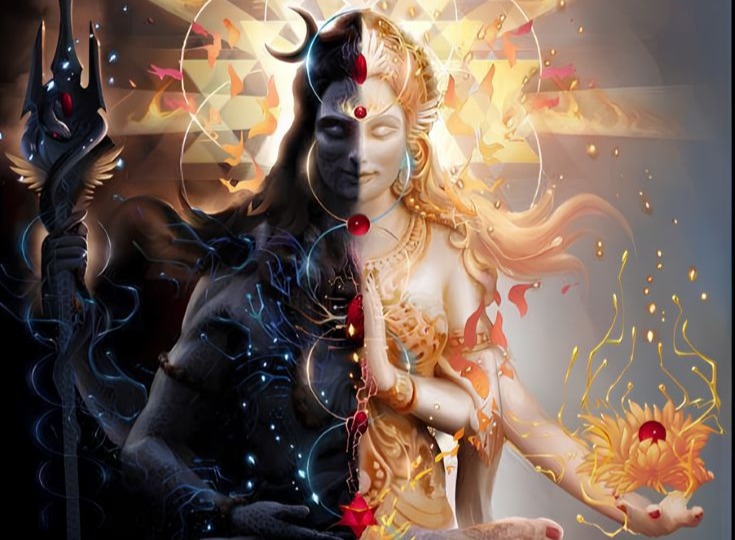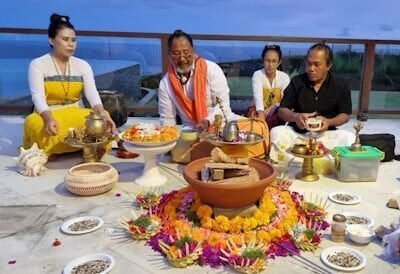
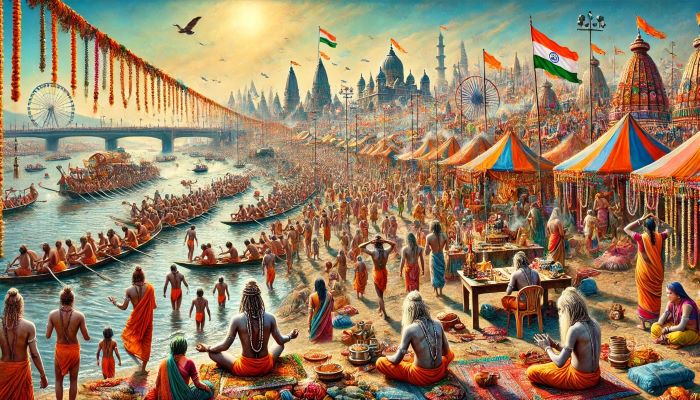
Maha Kumbh Mela is the greatest spiritual festival in the world, the name of which has a deep sacred meaning. In Sanskrit, each word has a special meaning: “kumbh” is a sacred jar, “mela” is a festival or gathering, and “maha” emphasizes the greatness and grandeur of the event.
The year 2025 will be truly unique in the history of this ancient celebration. During this period, the Maha Kumbh Mela will take place – the rarest and most significant event, occurring only once every 144 years. Numerologically, this event has a special meaning: the number of the full cycle (144) and the year of the event (2025) add up to the number 9, considered the most favorable sign in the Vedic tradition.
The upcoming Maha Kumbh Mela will last 44 days – from January 13 to February 26, 2025. During this sacred period, millions of believers worldwide will gather to participate in ritual ablutions. Participants strive not only for physical cleansing, but also for deep spiritual transformation, the discovery of their true selves, and the comprehension of eternal wisdom, symbolically contained in the sacred jar.
History of Maha Kumbh Mela
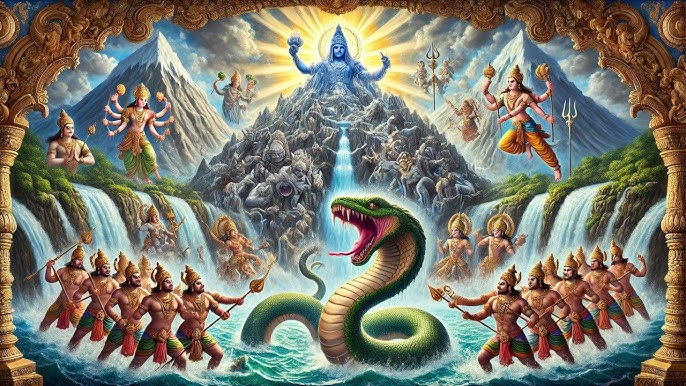
The history of the Maha Kumbh Mela has its roots in the ancient Vedic scriptures. According to the Vedas, at the dawn of the creation of our world, a significant event took place – the churning of the Ocean of Milk (Kshirasagara) by demigods and demons to obtain the nectar of immortality – “Amrita”.
When the divine physician Dhanvantari emerged from the ocean with a jar of precious nectar, a struggle began between the demigods and demons for its possession. The son of the god Indra, Jayanta, seeing amrita, snatched the jug from the hands of Dhanvantari. Noticing this, Shukracharya (Guru of the demons) immediately sent the demons in pursuit.
According to divine reckoning, one day of the gods is equal to one year of mortal beings. Jayanta ran for 12 divine days (equal to 12 earthly years) to protect the Amrit Kalasha from the demons. During this time, he stayed in four places that are now considered sacred:
- Haridwar (where the Ganga River emerges from the Himalayas);
- Prayag (modern Allahabad);
- Nashik-Trimbakeshwar (on the banks of the Godavari River);
- Ujjain (on the banks of the Kshipra River).
Four great celestial beings participated in saving the sacred nectar:
- God Brihaspati (Jupiter) is the keeper of divine wisdom.
- Surya (Sun) is the source of life force.
- Lord Shani (Saturn) is the son of the Sun, personifying discipline and karma.
- Chandra (Moon) is the ruler of the mind and emotions.
As mentioned in the Skanda Purana, the Maha Kumbha Mela is celebrated not only at the places where the Amrita Kumbha was omitted but also at the places where drops of sacred nectar were shed. These four cities in modern India still host millions of pilgrims, maintaining an unbroken spiritual tradition.
Astrological Significance of Maha Kumbh Mela
The basis for determining the timing of the Maha Kumbh Mela is the complex astrological system of Jyotish. The ancient sages established a clear connection between the position of celestial bodies and favorable periods for sacred ablutions. There are four main celebration cycles:
- Kumbh Mela (every 3 years).
- Ardha Kumbh Mela (every 6 years).
- Purna Kumbh Mela (every 12 years).
- Maha Kumbh Mela (every 144 years).
Each holy city has its special astrological conditions, recorded in ancient Sanskrit texts:
For Haridwar:
पद्मिनी नायके मेषे कुम्भ राशि गते गुरोः ।
गंगा द्वारे भवेद योगः कुम्भ नामा तथोत्तमाः।।
“When Jupiter enters Aquarius (Kumbh) and the Sun and Moon are in Aries and Sagittarius respectively, the Kumbh is held at Haridwar.”
For Prayag:
मकरे च दिवा नाथे ह्मजगें च बृहस्पतौ कुम्भ योगोभवेत्तत्र प्रयागे ह्यति दूलर्भ:
“When Jupiter is in Taurus (Vrishabha) and the Sun and Moon are in Capricorn (Makara), the Kumbh is held in Prayag.”
For Nashik:
सिंह राशि गते सूर्ये सिंह राशौ बृहस्पतौ ।
गोदावर्या भवेत कुम्भों जायते खलु मुक्तिदः ।।
“When Jupiter enters Leo (Simha) and the Sun and Moon enter Cancer, the Kumbh is held at Nashik and Trimbakeshwar.”
For Ujjain:
मेष राशि गते सूर्ये सिंह राशौ बृहस्पतौ ।
उज्जियन्यां भवेत कुम्भः सदामुक्ति प्रदायकः ।।
“When Jupiter is in Leo and the Sun and Moon are in Aries, the Kumbh is held in Ujjain.”
When Jupiter is in the zodiac Simha (Leo), the celebrations in Trimbakeshwar, Nashik and Ujjain are known as Simhastha Kumbh.
Spiritual practice of Maha Kumbh Mela
Mach Kumbh Mela is not just a mass gathering of people, but a powerful spiritual event, where every element is filled with deep sacred meaning. The central activity of the festival is a sacred bath at the confluence of three sacred rivers: the Ganga, representing purity and divine grace, the Yamuna, symbolizing vitality and devotion, and the Saraswati, a mystical underground transcendental river representing the highest knowledge.
The special spiritual power of the holiday is manifested through the purification of karma. It is believed that bathing in sacred waters during the Kumbh Mela can weaken the influence of negative karma, promote rapid spiritual growth, cleanse all seven human bodies and even free one from the cycle of rebirth.
The festival brings together various categories of spiritual practitioners:
- sanyasis (renouncers of the world);
- vairagis (ascetics);
- udasins (hermits);
- sadhus (saints);
- Mahamandeleshwars (spiritual leaders).
Each group brings its unique wisdom and practices, creating a unified field of the highest vibrations. Their presence and blessing is considered especially valuable during the holiday.
Water, as the primary element of life, plays a key role in the holiday. It not only physically cleanses the body, but also energetically renews prana, spiritually transforms consciousness and karmically frees the soul. This complex effect makes bathing during the Maha Kumbh Mela especially significant.
Kumbh makes us realize the importance of harmony with nature, respect for water resources and the unity of all living beings. This holiday awakens cosmic consciousness and reminds us of the deep connection between man and the universe. Just as the sacred jug (kumbha) never runs dry, so the spiritual energy of the holiday is constantly renewed, giving strength and inspiration to all participants in this great event.
Practical aspects of the Maha Kumbh Mela
The upcoming Maha Kumbh Mela 2025 will be a spiritual event of unprecedented scale. From January 13 to February 26, the holy city of Prayagraj (formerly Allahabad) will turn into a major pilgrimage center. During these 44 days, approximately 400 million visitors are expected, making this event the largest gathering of people in human history.
The venue was not chosen by chance – it is here that the sangam takes place, the sacred confluence of three rivers, where, according to ancient texts, divine energy is most powerfully manifested. The Indian government and the Uttar Pradesh administration are preparing unprecedented infrastructure to accommodate pilgrims.
The festival area will be divided into special sectors, each of which is intended for different groups of participants. For the convenience of pilgrims, temporary tent cities are being created, equipped with everything necessary – from basic amenities to medical facilities. Particular attention is paid to safety: the territory will be under constant surveillance, and special services will monitor compliance with sanitary standards.
During the holiday, there are especially favorable days for sacred ablutions, which are determined by the position of the stars and planets. These days are considered the most effective for spiritual cleansing and receiving blessings. The exact schedule of these dates will be announced closer to the start of the event.
For those planning to attend the Maha Kumbh Mela, it is important to remember that this is not a tourist event, but a deeply spiritual event. An appropriate attitude and respect for local traditions are required. It is recommended to familiarize yourself with the rules of conduct in advance and prepare for possible difficulties associated with the mass nature of the event.
Participation in the great ablution of the Maha Kumbh Mela 2025 is a unique opportunity that comes once in a lifetime, because the next such event will occur only in 144 years.
Conclusion
Spiritual practice and purification do not require physical presence at the sacred holiday. The purification principles behind the Maha Kumbh Mela can be applied in everyday life through conscious practices and correct lifestyle. It is worth noting that bathing in these 44 days in an open body of water where you live will also have a favorable effect.
The Maha Kumbh Mela 2025 will begin on January 13 and conclude on February 26 attracting millions of pilgrims. Important dates for bathing include Paush Purnima (January 13), Makar Sankranti (January 14), Mauni Amavasya (January 29), Basant Panchami (February 3) and Maha Shivratri (February 26).
If you are unable to travel to India for the Maha Kumbh Mela, but want to start a cleansing practice now, we invite you to join our Easy Detox program. Just as sacred waters purify the soul during the Kumbh Mela, the right diet can purify your body naturally.